Question
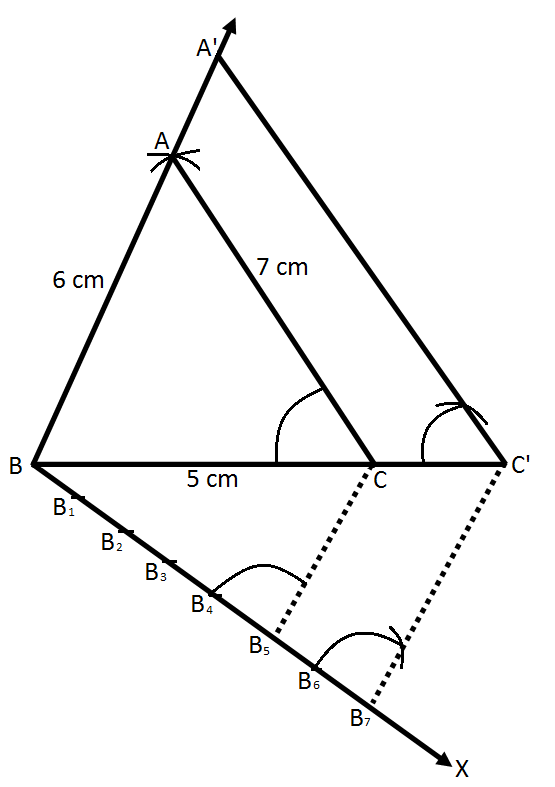
Construct a triangle with sides $5cm, 6cm$ and $7cm$ and then another triangle whose sides are $\frac{7}{5}$ of the corresponding sides of the first triangle.
Answer

Steps of construction:
  1. Draw a line segment $BC = 5cm.$
  2. With centre B and radius 6cm and with centre C and radius 7cm, draw arcs intersecting each other at A.
  3. Join AB and AC. Then ABC is the triangle.
  4. Draw a ray BX making an acute angle with BC and cut off 7 equal parts making $BB_1 = B_1B_2 = B_2B_3 = B_3B_4 = B_4B_5 = B_5B_6 = B_6B_7.$
  5. Join B_5 and C.
  6. From $B_7,$ draw $B_7C’$ parallel to $B_5C$ and $C’A’$ parallel $CA$. Then $\triangle\text{A}’\text{BC}'$ is the required triangle.

Need a full question paper?

Generate a complete, print-ready paper with questions like this in minutes — across 16+ boards, with answer keys.
Start Generating Free

Similar questions

The radius of a circle with centre O is 5cm (see figure). Two radii OA and OB are drawn at right angles to each other. Find the areas of the segments made by the chord AB $(\text{Take }\pi=3.14).$
Present age of mother of Manish is 1 year more than 5 times the present age of Manish. Four years before If the product of their ages was 22 then find the present age of Manish and his mother
Find the next 4 terms of the sequence $\frac{1}{6}, \frac{1}{4}, \frac{1}{3}$ also find $S _n$.
To find the width of the river, a man observes the top of a tower on the opposite bank making an angle of elevation of $61^{\circ}$. When he moves $50 \mathrm{~m}$ backword from bank and observes the same top of the tower, his line of vision makes an angle of elevation of $35^{\circ}$. Find the height of the tower and width of the river. $\left(\tan 61^{\circ}=1.8, \tan 35^{\circ}=0.7\right)$
A hemisphere of lead of radius 9cm is cast into a right circular cone of height 72cm. Find the radius of the base of the cone.
In a $\triangle\text{ABC},\angle\text{C}=90^\circ,\angle\text{ABC}=\theta^\circ,\text{BC}=21\text{units}$ and AB = 29units.
Show that $\big(\cos^2\theta-\sin^2\theta\big)=\frac{41}{841}.$
ABCD is a rectangle. Points M and N are on BD such that $\text{AM}\perp\text{BD}$ and $\text{CN}\perp\text{BD}.$ Prove that $BM^2 + BN^2= DM^2+ DN^2$​​​​​​​.
Find the value of $p$ for which quadratic equation $(p+1) x^2-6(p+1) x+3(p+9)=0, p \neq-1$ has equal roots. Hence, find the roots of the equation.
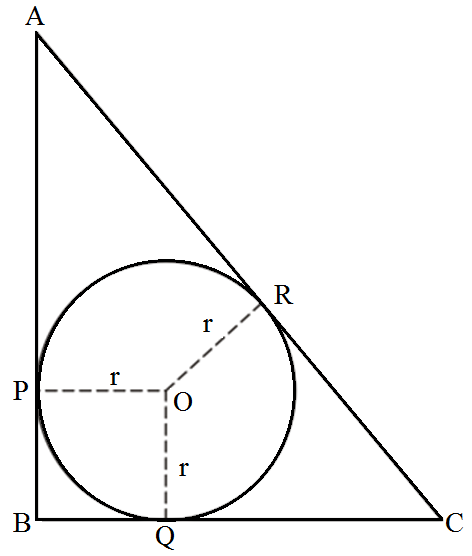
In the given figure, $ABC$ is a right triangle right-angled at $B$ such that $BC = 6cm$ and $AB = 8cm$. Find the radius of its in circle.
Solve the following quadratic equation.
(2x + 3)2 = 25