Question 14 Marks
Draw a right triangle ABC in which AB = 6cm, BC = 8cm and $\angle\text{B}=90^\circ.$ Draw BD perpendicular from B on AC and draw a circle passing through the points B, C and D. Construct tangents from A to this circle.
AnswerSteps of Construction: Draw a line segment BC = 8cm. From B draw an angle of 90°. Draw an arc BA = 6cm cutting the angle at A. Join AC.$\triangle\text{ABC}$ is the required A.
Draw $\bot$ bisector of BC cutting BC at M. Take M as centre and BM as radius, draw a circle. Take A as centre and AB as radius draw an arc cutting the circle at E. Join AE. AB and AE are the required tangents. Justification:$\angle\text{ABC}=90^\circ$ (Given)
Since, OB is a radius of the circle.$\therefore$ AB is a tangent to the circle.
Also AE is a tangent to the circle.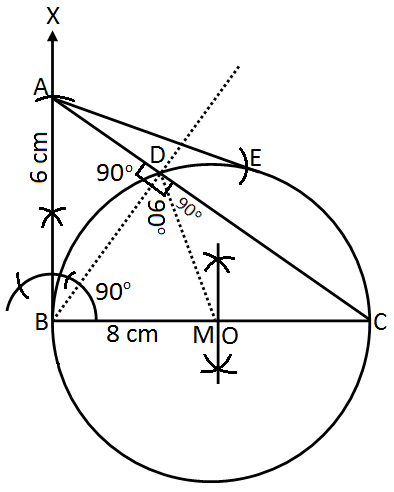
View full question & answer→Question 24 Marks
Construct an isosceles triangle whose base is 8cm and altitude 4cm and then another triangle whose sides are $\frac{3}{2}$ times the corresponding sides of the isosceles triangle.
AnswerGiven that Construct an isosceles triangle ABC in which AB = BC = 6cm and altitude = 4cm then another triangle similar to it whose sides are $\frac{3}{2}$ of the corresponding sides of $\triangle\text{ABC}.$ We follow the following steps to construct the given
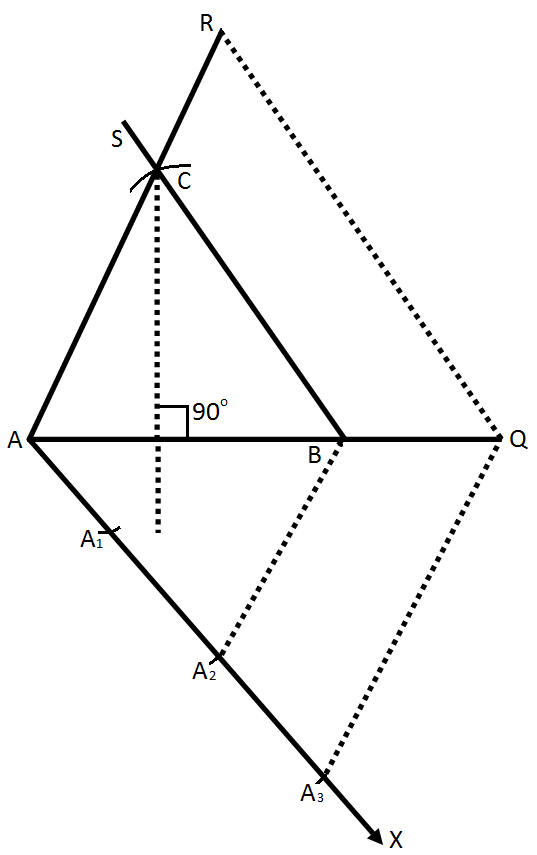
Step of construction:
Step I: First of all we draw a line segment $A B=6 cm$.
Step II: With $B$ as centre and radius $=B C=6 cm$, draw an arc.
Step III: From point $A$ and $B$ construct altitutde $C D=4 cm$, which cut the line $B S$ at point $C$.
Step IV: Join $A C$ to obtain $\triangle A B C$.
Step V: Below $A B$, makes an acute angle $\angle B A X=60^{\circ}$.
Step VI: Along $A X$, mark off five points $A_1, A_2$ and $A_3$ such that $A A_1=A_1 A_2=A_2 A_3$.
Step VII: Join $A _2 B$.
Step VIII: Since we have to construct a triangle $\triangle AQR$ each of whose sides is $\left(1.5\right.$ times $\left.=\frac{3}{2}\right)$ of the corresponding sides of $\triangle A B C$. So, we draw a line $A_3 Q$ on $A X$ from point $A_3$ which is $A_3 Q \| A_2 B$, and meeting $A B$ at Q.
Step IX: From $Q$ point draw $Q R \| B C$, and meeting $A C$ at $R$. Thus, $\triangle A Q R$ is the required triangle, each of whose sides is $\left(\frac{3}{2}\right)$ of the corresponding sides of $\triangle ABC$. View full question & answer→Question 34 Marks
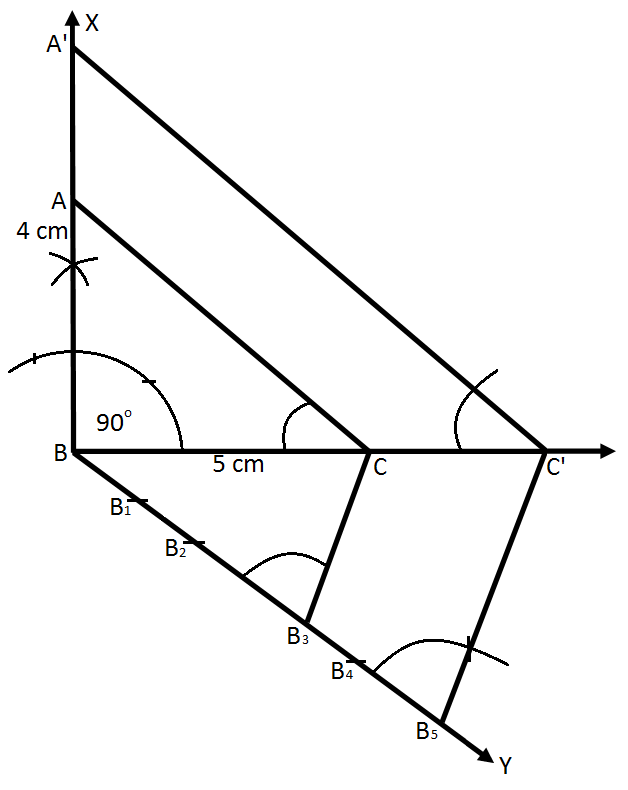
Draw a right triangle in which the sides (other than hypotenuse) are of lengths 5cm and 4cm. Then construct another triangle whose sides are $\frac{5}{3}$ times the corresponding sides of the given triangle.
AnswerSteps of construction:
- Draw a line segment $BC = 5cm.$
- At $B,$ draw perpendicular BX and cut off $BA = 4cm.$
- join Ac , then $ABC$ is the triangle.
- Draw a ray BY making an acute angle with BC, and cut off 5 equal parts making $BB_1 = B_1B_2 = B_2B_3 = B_3B_4 = B_4B_5.$
- Join $B_3$ and C.
- From $B_5,$ draw $B_5C’$ parallel to $B_3C$ and $C’A’$ parallel to $CA.$
Then $\triangle\text{A}'\text{BC}'$ is the required triangle.
View full question & answer→Question 44 Marks
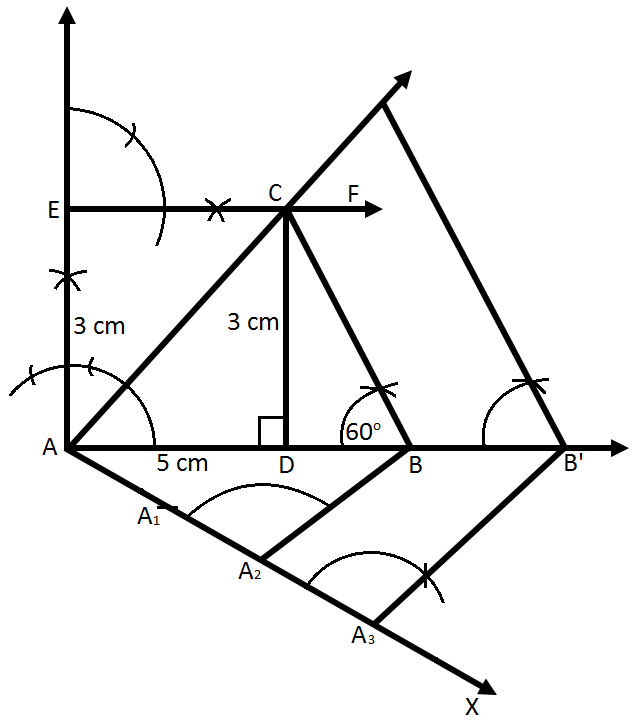
Construct a $\triangle\text{ABC}$ in which AB = 5cm, $\angle\text{B} = 60^\circ,$ altitude $CD = 3cm.$ Construct a $\triangle\text{AQR}$ similar to $\triangle\text{ABC}$ such that side of $\triangle\text{AQR}$ is 1.5 times that of the corresponding sides of $\triangle\text{ABC}.$
AnswerSteps of construction:
- Draw a line segment $AB = 5cm.$
- At A, draw a perpendicular and cut off $AE = 3cm.$
- From E, draw $EF || AB.$
- From B, draw a ray making an angle of 60 meeting $EF$ at $C.$
- Join $CA$. Then ABC is the triangle.
- From A, draw a ray AX making an acute angle with AB and cut off 3 equal parts making $AA_1 = A_1A_2 = A_2A_3.$
- Join $A_2$ and $B.$
- From $A,$ draw $A'B’$ parallel to $A_2B$ and $B’C’$ parallel to $BC.$
Then $\triangle\text{C}'\text{AB}'$ is the required triangle.
View full question & answer→Question 54 Marks
Draw a circle of radius 6cm. From a point 10cm away from its centre, construct the pair of tangents to the circle and measure their lengths.
AnswerGiven that Construct a circle of radius 6cm, and let point P = 10cm form its centre, construct the pair of tangents to the circle. Find the length of tangents. We follow the following steps to construct the given
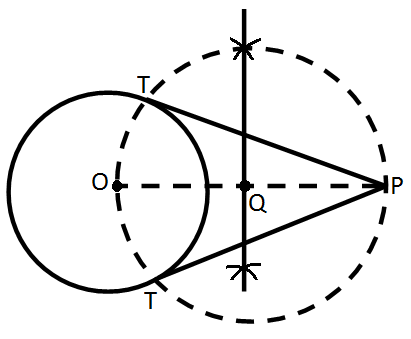
Step of construction:
Step I: First of all we draw a circle of radius AB = 6cm.
Step II: Make a point P at a distance of OP = 10cm, and join OP.
Step III: Draw a right bisector of OP, intersecting OP at Q.
Step IV: Taking Q as centre and radius OQ = PQ, draw a circle to intersect the given circle at T and T’.
Step V: Joins PT and PT’ to obtain the require tangents. Thus, PT and P'T' are the required tangents. Find the length of tangents.
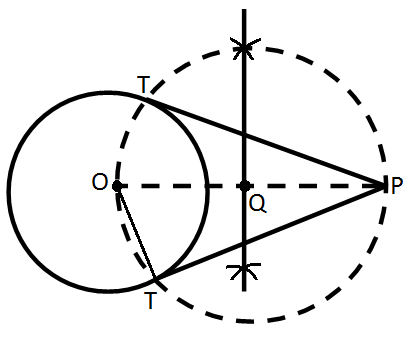
As we know that $\text{OT}\bot\text{PT}$ and $\triangle\text{OPT}$ is right triangle.
Therefore, $OT = 6cm $and PO = 10cm In
$\triangle\text{OPT}$ $PT^2 = OP^2 - OT^2 = 10^2 - 6^2 = 100 - 36 = 64$$\text{PT}=\sqrt{64}$
= 8 Thus, the length of tangents = 8cm View full question & answer→Question 64 Marks
Draw two concentric circles of radii $3\ cm$ and $5\ cm$. Construct a tangent to smaller circle from a point on the larger circle. Also measure its length.
AnswerFollowing are the steps to draw tangents on the given circle:
Step I: Draw a circle of $3\ cm$ radius with centre O on the given plane.
Step II: Draw a circle of $5\ cm$ radius, taking O as its centre. Locate a point P on this circle and join OP.
Step III: Bisect OP. Let M be the midpoint of PO.
Step IV: Taking M as its centre and MO as its radius, draw a circle. Let it intersect the given circle at points Q and R.
Step V: Join PQ and PR. PQ and PR are the required tangents.
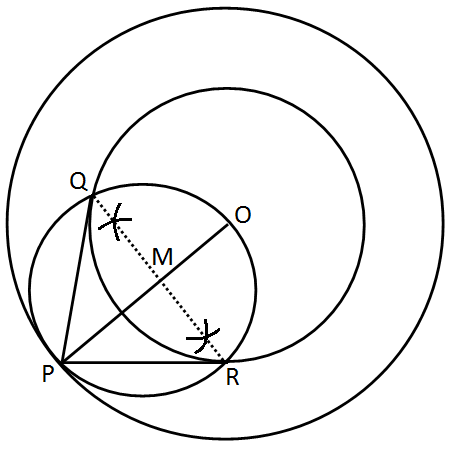
In can be observed that PQ and PR are of length $4\ cm$ each.
In $\triangle\text{PQO},$ Since PQ is a tangent,
$\angle\text{PQO}=90^\circ$
$PO = 5\ cm QO = 3\ cm$ Applying Pythagoras theorem in $\triangle\text{PQO},$
we obtain $(PQ)^2 + (OQ)^2 $
$= (PO)^2 PQ^2 + (3)^2 $
$= (5)^2 PQ^2 + 9 $
$= 25 PQ^2 $
$= 25 - 9 PQ^2 $
$= 16 PQ = 4\ cm$ Hence justified. View full question & answer→Question 74 Marks
Draw a right triangle ABC in which AC = AB = 4.5cm and $\angle\text{A} = 90^\circ.$ Draw a triangle similar to $\triangle\text{ABC}$ with its sides equal to $\Big(\frac{5}{4}\Big)^\text{th}$ of the corresponding sides of $\triangle\text{ABC}.$
AnswerGiven that Construct a right triangle of sides AB = AC = 4.5cm, and $\angle\text{A}=90^\circ$ and then a triangle similar to it whose sides are $\Big(\frac{5}{4}\Big)^\text{th}$ of the corresponding sides of $\triangle\text{ABC}.$ We follow the following steps to construct the given
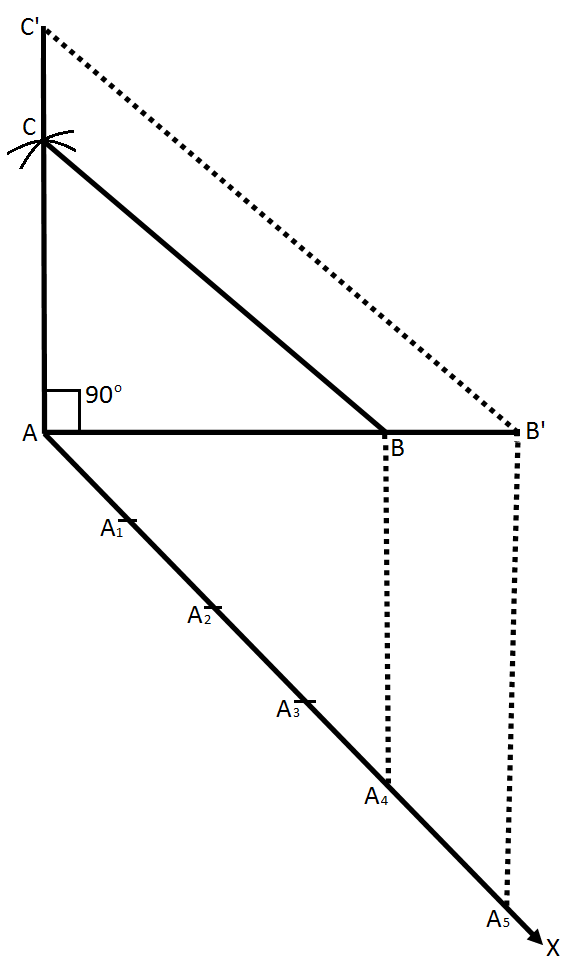
Step of construction:
Step I: First of all we draw a line segment $A B=4.5 cm$.
Step II: With $A$ as centre and draw an angle $\angle A=90^{\circ}$.
Step III: With A as centre and radius $AC =4.5 cm$.
Step IV: Join $B C$ to obtain $\triangle ABC$.
Step V: Below $A B$, makes an acute angle $\angle B A X=60^{\circ}$.
Step VI: Along $A X$, mark off five points $A_1, A_2, A_3, A_4$ and $A_5$ such that $A_1=A_1 A_2=A_2 A_3=A_3 A_4=A_4 A_5$.
Step VII: Join $A_4 B$.
Step VIII: Since we have to construct a triangle each of whose sides is $\left(\frac{5}{4}\right)^{\text {th }}$ of the corresponding sides of $\triangle ABC$.
So, we draw a line $A_5 B^{\prime}$ on $A X$ from point $A_5$ which is $A_5 B^{\prime} \| A_4 B$, and meeting $A B$ at $B^{\prime}$.
Step IX: From $B^{\prime}$ point draw $B^{\prime} C^{\prime} \| B C$, and meeting $A C$ at $C^{\prime}$. Thus, $\triangle AB ^{\prime} C ^{\prime}$ is the required triangle, each of whose sides is $\left(\frac{5}{4}\right)^{\text {th }}$ of the corresponding sides of $\triangle ABC$. View full question & answer→Question 84 Marks
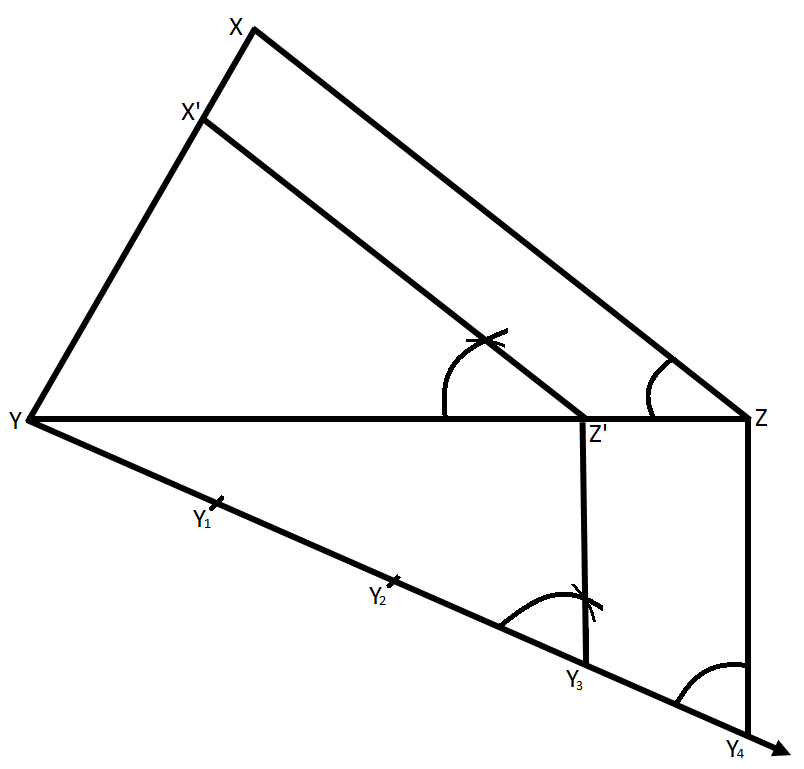
Construct a triangle similar to a given $\triangle\text{XYZ}$ with its sides equal to $\Big(\frac{3}{4}\Big)^\text{th}$ of the corresponding sides of $\triangle\text{XYZ}$ Write the steps of construction.
AnswerSteps of construction:
- Draw a triangle $XYZ$ with some suitable data.
- Draw a ray $YL$ making an acute angle with $XZ$ and cut off $5$ equal parts making $YY_1 = Y_1Y_2 = Y_2Y_3 = Y_3Y_4.$
- Join $Y_4$ and $Z.$
- From$ Y_3,$ draw $Y_3Z’$ parallel to $Y_4Z $ and $Z’X’$ parallel to $ZX.$
Then $\triangle\text{X}'\text{YZ}'$ is the required triangle.
View full question & answer→Question 94 Marks
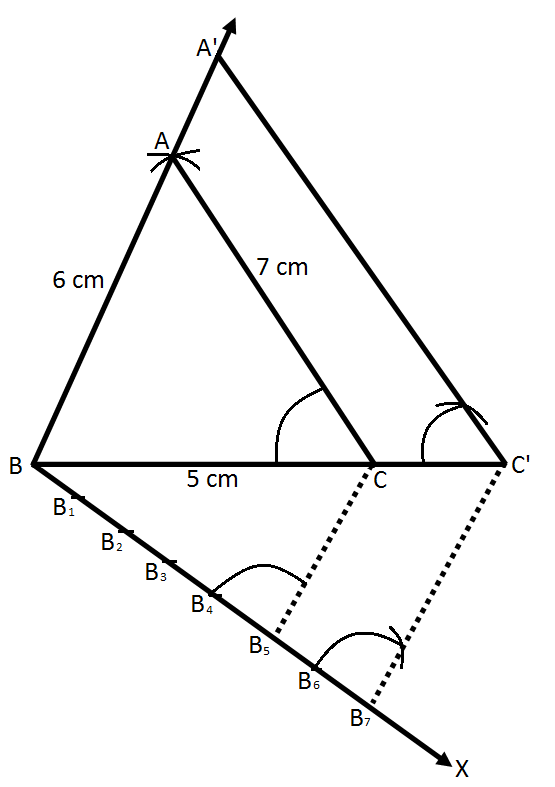
Construct a triangle with sides $5cm, 6cm$ and $7cm$ and then another triangle whose sides are $\frac{7}{5}$ of the corresponding sides of the first triangle.
AnswerSteps of construction:
- Draw a line segment $BC = 5cm.$
- With centre B and radius 6cm and with centre C and radius 7cm, draw arcs intersecting each other at A.
- Join AB and AC. Then ABC is the triangle.
- Draw a ray BX making an acute angle with BC and cut off 7 equal parts making $BB_1 = B_1B_2 = B_2B_3 = B_3B_4 = B_4B_5 = B_5B_6 = B_6B_7.$
- Join B_5 and C.
- From $B_7,$ draw $B_7C’$ parallel to $B_5C$ and $C’A’$ parallel $CA$. Then $\triangle\text{A}’\text{BC}'$ is the required triangle.
View full question & answer→Question 104 Marks
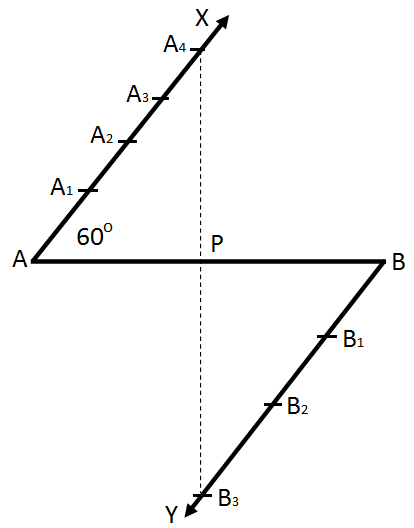
Divide a line segment of length 9cm internally in the ratio $4 : 3$. Also, give justification of the construction.
AnswerGiven that Determine a point which divides a line segment of length 9cm internally in the ratio of 4 : 3. We follow the following steps to construct the given
Step of construction:
Step I: First of all we draw a line segment AB = 9cm.
Step II: We draw a ray AX making an acute angle $\angle\text{BAX}=60^\circ$ with AB.
Step III: Draw a ray BY parallel to AX by making an acute angle $\angle\text{ABY}=\angle\text{BAX}.$
Step IV: Mark of two points $A_1, A_2, A_3, A_4 $on AX and three points $B_1, B_2, B_3$ on BY in such a way that $AA_1 = A_1A_2 = A_2A_3 = A_3A_4 = BB_1 = B_1B_2 = B_2B_1.$
Step V: Joins $A_4B_3$ and this line intersects AB at a point P. Thus, P is the point dividing AB internally in the ratio of 4 : 3 Justification: In $\triangle\text{AA}_4\text{P}$ and $\triangle\text{BB}_3\text{P},$
we have$\angle\text{A}_4\text{AP}=\angle\text{PBB}_3\ [\angle\text{ABY}=\angle\text{BAX}]$
And $\angle\text{APA}_4=\angle\text{BPB}_3$ [Vertically opposite angle]
So, AA similarity criterion,
we have$\triangle\text{AA}_4\text{P}\approx\triangle\text{BB}_3\text{P},$
$\frac{\text{AA}_4}{\text{BB}_3}=\frac{\text{AP}}{\text{BP}}$
$\frac{\text{AP}}{\text{BP}}=\frac{4}{3}$ View full question & answer→Question 114 Marks
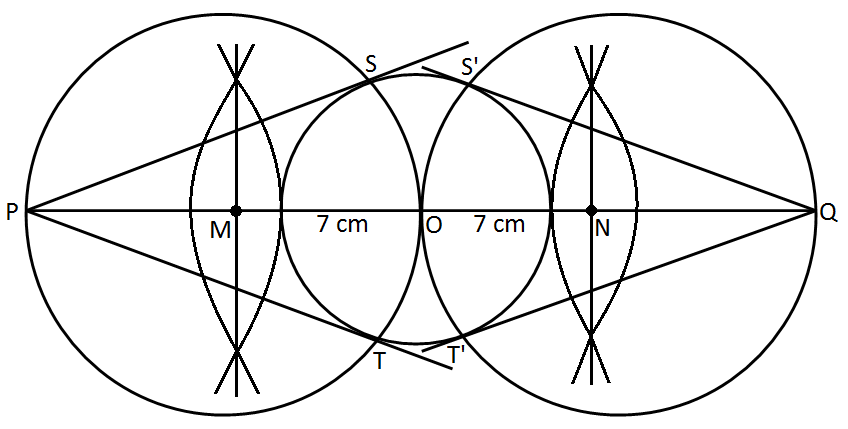
Draw a circle of radius 3cm. Take two points P and Q on one of its extended diameter each at a distance of 7cm from its centre. Draw tangents to the circle from these two points P and Q.
AnswerSteps of construction:
- Draw a circle with centre O and radius 3cm.
- Draw a diameter and produce it to both sides.
- Take two points P and Q on this diameter with a distance of 7cm each from the centre O.
- Bisect PO at M and QO at N.
- With centres M and N, draw circle on PO and QO as diameter which intersect the given circle at S, T and S’, T’ respectively.
- Join PS, PT, QS’ and QT’.
Then PS, PT, QS’ and QT’ are the required tangents to the given circle.
View full question & answer→Question 124 Marks
Draw a right triangle in which the sides (other than the hypotenuse) arc of lengths 4cm and 3cm. Now, construct another triangle whose sides are $\frac{5}{3}$ times the corresponding sides of the given triangle.
AnswerSteps of construction:
- Draw a right triangle $ABC$ in which the sides (other than hypotenuse) are of lengths 4cm and 3cm $\angle\text{B}=90^\circ.$
- Draw a line BX, which makes an acute angle $\angle\text{CBX}$ below the line BC.
- Locate 5 points $B_1, B_2, B_3, B_4$ and $B_5$ on BX such that $BB_1 = B_1B_2 = B_2B_3 = B_3B_4 = B_4B_5.$
- Join $B_3$ to $C$ and draw a line through $B_5$ parallel to $B_3C,$ intersecting the extended line segment $BC$ at $C’.$
- Draw a line through $C’$ parallel to $CA$ intersecting the extended line segment $BA$ at $A’.$
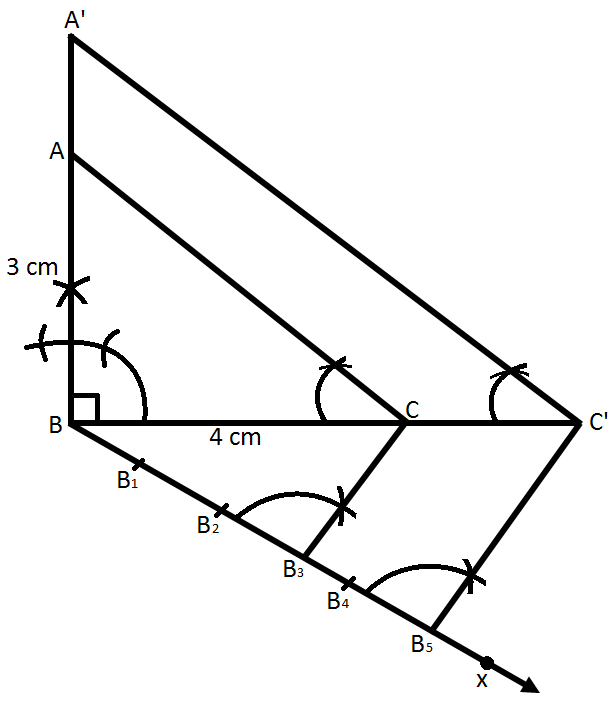
Justification of the construction:$\because\text{CA }||\text{ C}'\text{A}'$ [By construction]
$\therefore\ \triangle\text{A}'\text{BC}'\sim\triangle\text{ABC}$ [AA similarity crierion]
$\Rightarrow\ \frac{\text{A}'\text{B}}{\text{AB}}=\frac{\text{A}'\text{C}''}{\text{AC}}=\frac{\text{BC}'}{\text{BC}}$
$\big[\because$ Corresponding sides of two similar triangles are proportional$\big]$
$\text{B}_5\text{C}'\ ||\text{ B}_3\text{C}$ [By construction]
$\triangle\text{BB}_5\text{C}'\sim\triangle\text{BB}_3\text{C}$ [AA similarity crierion]
$\frac{\text{BC}'}{\text{BC}}=\frac{\text{BB}_5}{\text{BB}_3}$ [By the Basic Proportionality Theorem]
$\frac{\text{BB}_5}{\text{BB}_3}=\frac{5}{3}$ [By construction]
$\therefore\ \frac{\text{BC}'}{\text{BC}}=\frac{5}{3}$
$\therefore\ \frac{\text{A}'\text{B}}{\text{AB}}=\frac{\text{A}'\text{C}'}{\text{AC}}=\frac{\text{BC}'}{\text{BC}}=\frac{5}{3}$
$\Rightarrow\ \text{A}'\text{C}'=\frac{5}{3}\text{AC}$ View full question & answer→Question 134 Marks
Divide a line segment of length 14cm internally in the ratio 2 : 5. Also justify your construction.
AnswerSteps of construction:
- Draw a line segment AB = 14cm.
- Draw a ray AX making an acute angle with AB.
- From B, draw another ray BY parallel to AX.
- From AX, cut off 2 equal parts and from B, cut off 5 equal parts.
- Join 2 and 5 which intersects AB at P.
P is the required point which divides AB in the ratio of 2 : 5 internally.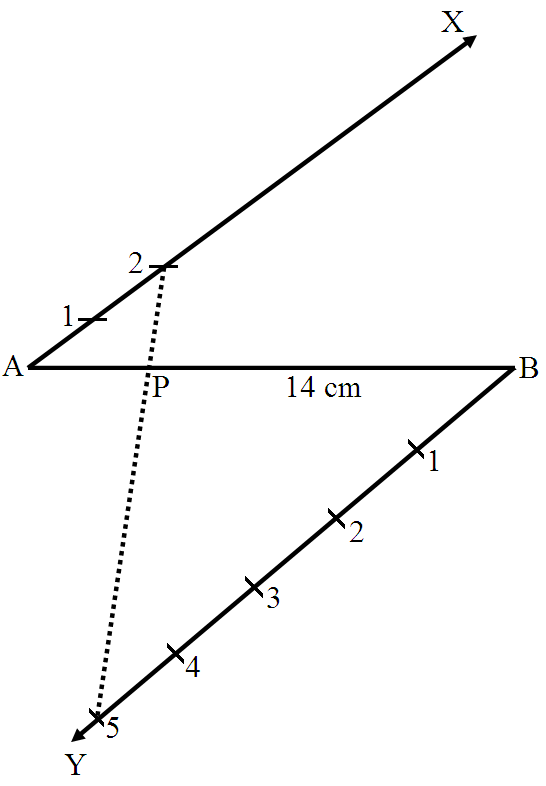
Justification: in $\triangle\text{A}_2\text{AP}$ and $\triangle\text{B}_5\text{BP}$$\angle\text{AA}_2\text{P}=\angle\text{BB}_5\text{P}$ (Alternate angle)
$\angle\text{APA}_2=\angle\text{BPB}_5$ [V. O. A.]
$\therefore\triangle\text{A}_2\text{AP}\cong\triangle\text{B}_5\text{BP}$
$\frac{\text{AP}}{\text{BP}}=\frac{\text{AA}_2}{\text{BB}_2}$
$\frac{\text{AP}}{\text{BP}}=\frac{2}{5}$ (By C.P.C.T.) View full question & answer→Question 144 Marks
Construct a triangle similar to a given $\triangle\text{ABC}$ such that each of its sides is $\Big(\frac{5}{7}\Big)^{\text{th}}$ of the corresponding sides of $\triangle\text{ABC}.$ It is given that AB - 5cm, BC = 7cm and $\angle\text{ABC} = 50^\circ.$
AnswerGiven that AB = 5cm, BC = 7cm and $\angle\text{ABC}=50^\circ$ Construct a triangle similar to a triangle ABC such that each of sides is $\Big(\frac{5}{7}\Big)^{\text{th}}$ of the corresponding sides of triangle ABC. We follow the following steps to construct the given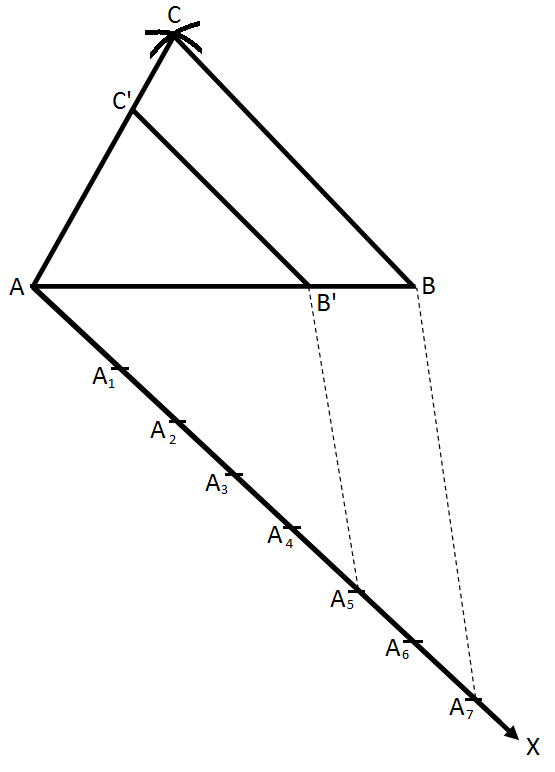
Step of construction:
Step I: First of all we draw a line segment.
Step II: With B as centre and draw an angle $\angle ABY =50^{\circ}$.
Step III: With B as centre and radius $=B C=7 cm$, draw an arc, cut the line BY drawn in step II at $C$.
Step IV: Joins $A C$ to obtain $\triangle A B C$.
Step V: Below $A B$, makes an acute angle $\angle B A X=60^{\circ}$.
Step VI: Along $A X$, mark off seven points $A_1, A_2, A_3, A_4, A_5, A_6$ and $A_7$ such that $A A_1=A_1 A_2=A_2 A_3=A_3 A_4=A_4 A_5=$ $A _5 A_6= A _6 A_7$.
Step VII: Join $A_7 B$.
Step VIII: Since we have to construct a triangle each of whose sides is $\left(\frac{5}{7}\right)^{\text {th }}$ of the corresponding sides of $\triangle ABC$.
So, we take five parts out of seven equal parts on $A X$ from point $A_5$ draw $A_5 B^{\prime} \| A_7 B$, and meeting $A B$ at $B^{\prime}$.
Step IX: From $B^{\prime}$ draw $B^{\prime} C \| B C$, and meeting $A C$ at $C^{\prime}$. Thus, $\triangle A B^{\prime} C^{\prime}$ is the required triangle, each of whose sides is $\left(\frac{5}{7}\right)^{\text {th }}$ of the corresponding sides of $\triangle ABC$. View full question & answer→Question 154 Marks
Draw a pair of tangents to a circle of radius 4.5cm, which are inclined to each other at an angle of 45°.
AnswerSteps of Construction: Step I: Draw a circle with centre O and radius 4.5cm. Step II: Draw any diameter AOB of the circle. Step III: Construct $\angle\text{BOC}=45^\circ$ such that radius OC cuts the circle at C. Step IV: Draw $\text{AM}\bot\text{AB}$ and $\text{CN}\bot\text{OC}.$ Suppose AM and CN intersect each other at P.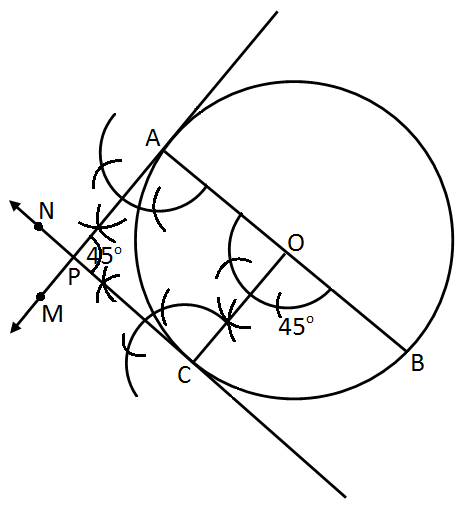
Here, AP and CP are the pair of tangents to the circle inclined to each other at an angle of 45º.
View full question & answer→Question 164 Marks
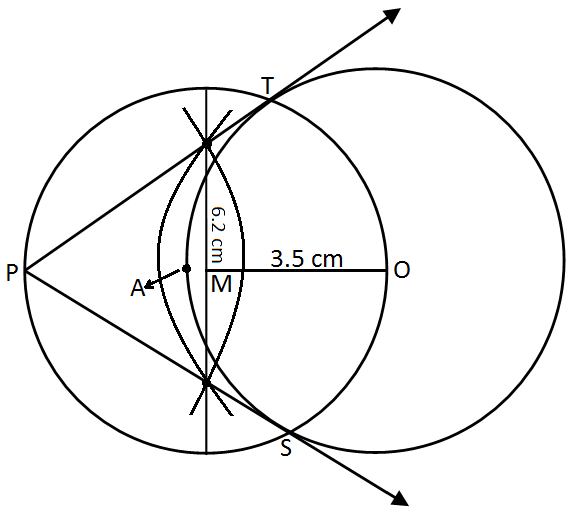
Draw two tangents to a circle of raidus 3.5cm from a point P at a distance of 6.2cm from its centre.
AnswerSteps of construction:
- Draw a circle with centre O and radius 3.5cm.
- Take a point P which is 6.2cm from O.
- Bisect PO at M and draw a circle with centre M and diameter OP which intersects the given circle at T and S respectively.
- Join PT and PS.
PT and PS are the required tangents to circle.
View full question & answer→Question 174 Marks
Determine a point which divides a line segment of length 12cm internally in the ratio 2 : 3. Also justify your construction.
AnswerSteps of construction:
- Draw a line segment AB = 12cm.
- Draw a ray AX at A making an acute angle with AB.
- From B, draw another ray BY parallel to AX.
- Cut off 2 equal parts from AX and 3 equal parts from BY.
- Join 2 and 3 which intersects AB at P.
P is the required point which divides AB in the ratio of 2 : 3 internally.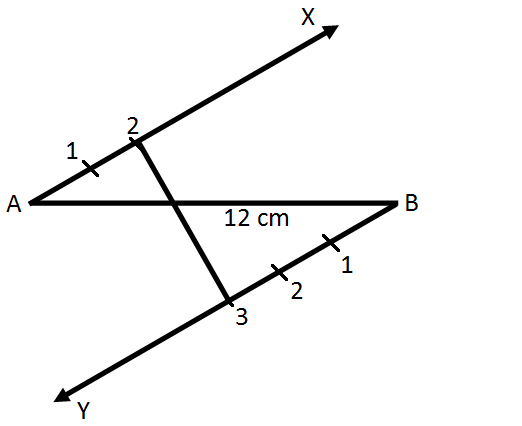
Justification: in $\triangle\text{APA}_2$ and $\text{BB}_3\text{P}$$\angle\text{APA}_2=\angle\text{BPB}_3$ (V.O.T.)
$\angle\text{AA}_2\text{P}=\angle\text{BB}_3\text{P}$ (Alternate angle)
$\therefore$ by A. A criterion
$\triangle\text{AA}_2\text{P}\cong\triangle\text{BB}_3\text{P}$
$\frac{\text{AA}_2}{\text{BB}_3}=\frac{\text{AP}}{\text{BP}}$
$\frac{2}{3}=\frac{\text{AP}}{\text{BP}}$
$\frac{\text{AP}}{\text{BP}}=\frac{2}{3}$ (C.P.C.T.) View full question & answer→Question 184 Marks
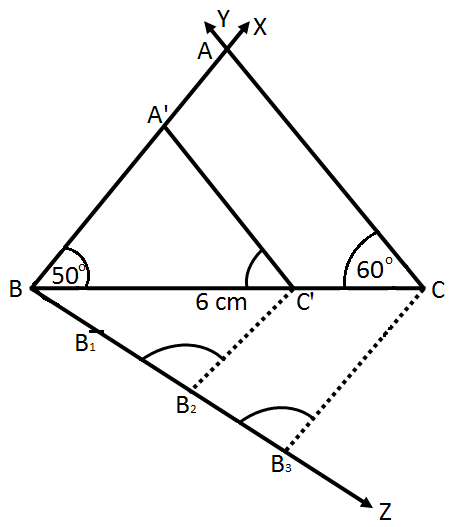
Construct a triangle similar to a given $\angle\text{ABC}$ such that each of its sides is rd of the corresponding sides of $\triangle\text{ABC}.$ It is given that BC = 6cm, $\angle\text{B} = 50^\circ$ and $\angle\text{C} = 60^\circ.$
AnswerSteps of construction:
- Draw a line segment $BC = 6cm.$
- Draw a ray $BX$ making an angle of $50^\circ$ and $CY$ making $60^\circ$ with $BC$ which intersect each other at $A.$ Then $ABC$ is the triangle.
- From B, draw another ray $BZ$ making an acute angle below $BC$ and intersect $3$ equal parts making $BB_1= B_1B_2 = B_2B_2.$
- Join $B_3C.$
- From $B_2,$ draw $B_2C’$ parallel to $B_3C$ and $C’A’$ parallel to $CA$.
Then $\Delta\text{A}’\text{BC}’$ is the required triangle.
View full question & answer→Question 194 Marks
Construct a triangle similar to $\triangle\text{ABC}$ in which AB = 4.6cm, BC = 5.1cm, $\angle\text{A}=60^\circ$ with scale factor 4 : 5.
AnswerGiven that Construct a $\triangle\text{ABC}$ of given data, AB = 4.6cm, BC = 5.1cm and $\angle\text{A}=60^\circ$ and then a triangle similar to it whose sides are $\Big(4:5=\frac{4}{5}\Big)^\text{th}$ of the corresponding sides of $\triangle\text{ABC}.$ We follow the following steps to construct the given
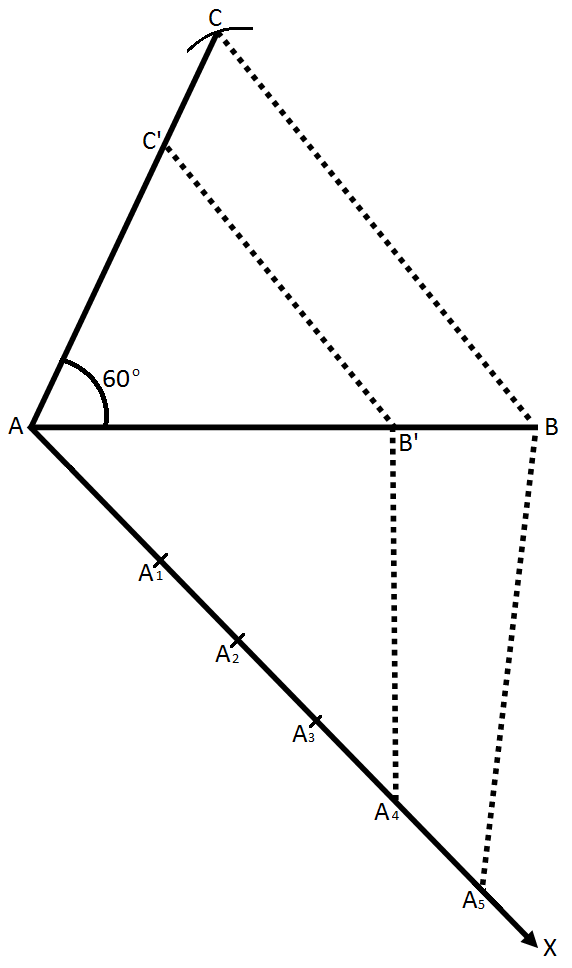
Step of construction:
Step I: First of all we draw a line segment AB = 4.6cm.
Step II: With A as centre draw an angle $\angle\text{A}=60^\circ.$
Step III: With B as centre and radius = BC = 5.1cm, draw an arc, intersecting the arc drawn in step II at C.
Step IV: Joins BC to obtain $\triangle\text{ABC}.$
Step V: Below AB, makes an acute angle $\angle\text{BAX}=60^\circ.$
Step VI: Along AX, mark off five points $A_1, A_2, A_3, A_4$ and $A_5$ such that $AA_1 = A_1A_2 = A_2A_3 = A_3A_4 = A_4A_5.$
Step VII: Join $A_5B.$
Step VIII: Since we have to construct a triangle each of whose sides is $\Big(\frac{4}{5}\Big)^\text{th}$ of the corresponding sides of $\triangle\text{ABC}.$ So, we take four parts out of five equal parts on AX from point $A_4$ draw $A_4B || A_5B$, and meeting AB at B’.
Step IX: From B’ draw B'C' || BC, and meeting AC at C’. Thus, $\triangle\text{AB}'\text{C}'$ is the required triangle, each of whose sides is $\Big(\frac{4}{5}\Big)^\text{th}$ of the corresponding sides of $\triangle\text{ABC}.$ View full question & answer→Question 204 Marks
Draw a $\triangle\text{ABC}$ in which base $BC = 6cm, AB = 5cm$ and $\angle\text{ABC}=60^\circ.$ Then construct another triangle whose sides are of the corresponding sides of $\triangle\text{ABC}.$
AnswerSteps of construction:
- Draw a triangle $ABC$ with side $BC = 6cm, AB = 5cm$ and $\angle\text{ABC}=60^\circ.$
- Draw a ray $BX,$ which makes an acute angle $\angle\text{CBX}$ below the line BC.
- Locate four points $B_1, B_2, B_3$ and $B_4$ on BX such that $BB_1 = B_1B_2 = B_2B_3 = B_3B_4.$
- Join $B_4C$ and draw a line through $B_3$ parallel to $B_4C$ intersecting $BC$ to $C’.$
- Draw a line through C’ parallel to the line CA to intersect BA at A’.
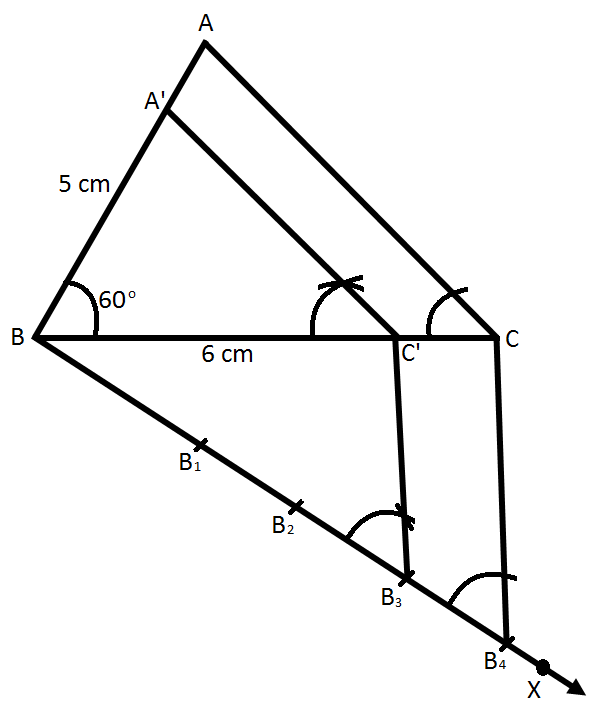
Justification of the construction:$\because\text{B}_4\text{C }||\text{ B}_3\text{C}'$ [By construction]
$\therefore\ \frac{\text{BB}_3}{\text{BB}_4}=\frac{\text{BC}'}{\text{BC}}$
[Basic Proportionality Theorem] But $\frac{\text{BB}_3}{\text{BB}_4}=\frac{3}{4}$ [By condtruction]$\therefore\ \frac{\text{BC}'}{\text{BC}}=\frac{3}{4}\ \dots(\text{i})$
$\because\text{CA }||\text{ C}'\text{A}'$ [By construction]
$\therefore\ \triangle\text{BC}'\text{A}'\sim\triangle\text{BCA}$
From equation (i),$\frac{\text{A}'\text{B}}{\text{AB}}=\frac{\text{A}'\text{C}'}{\text{AC}}=\frac{\text{BC}'}{\text{BC}}=\frac{3}{4}$
[Basic Propotionality Theorem] View full question & answer→Question 214 Marks
Draw a right triangle in which sides (other than the hypotenuse) are of lengths 8cm and 6cm. Then construct another triangle whose sides are $\frac{3}{4}$ times the corresponding sides of the first triangle.
AnswerGiven that Construct a right triangle of sides let AB = 8cm, AC 6cm, and $\angle\text{A}=90^\circ$ and then a triangle similar to it whose sides are $\Big(\frac{3}{4}\Big)^\text{th}$ of the corresponding sides of
$\triangle\text{ABC}.$
We follow the following steps to construct the given
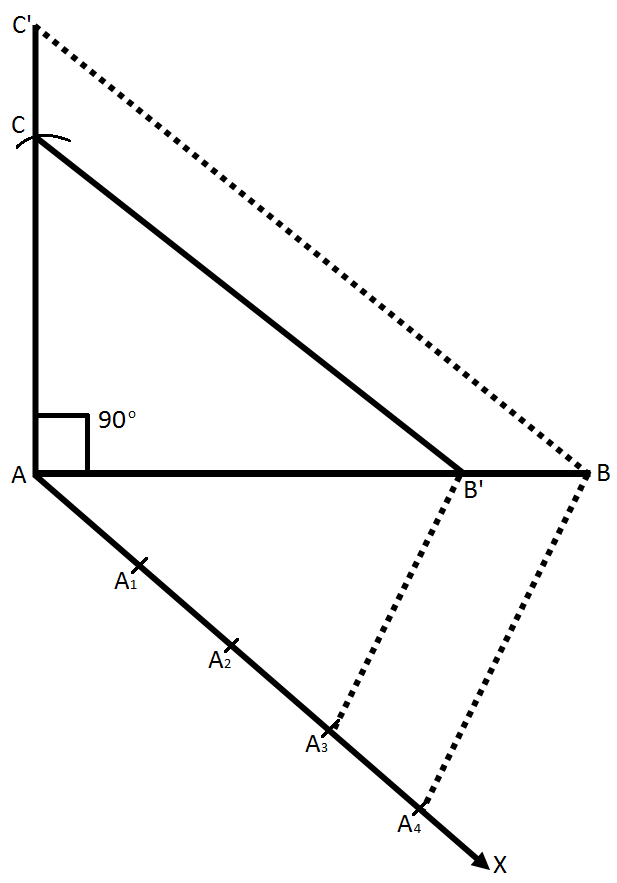
Step of construction:
Step I: First of all we draw a line segment let AB = 8cm.
Step II: With A as centre and draw an angle $\angle\text{A}=90^\circ.$
Step III: With A as centre and radius AC = 6cm.
Step IV: Join BC to obtain right $\triangle\text{ABC}.$
Step V: Below AB, makes an acute angle $\angle\text{BAX}=60^\circ.$
Step VI: Along AX, mark off five points $A_1, A_2, A_3$, and $A_4$ such that $AA_1 = A_1A_2 = A_2A_3 = A_3A_4$.
Step VII: Join $A_4B$. Step VIII: Since we have to construct a triangle each of whose sides is $\Big(\frac{3}{4}\Big)^\text{th}$ of the corresponding sides of right $\triangle\text{ABC}.$ So, we draw a line $A_3B'$ on AX from point $A_3$ which is $A_3B' || A_4B$, and meeting AB at B’. Step IX: From B’ point draw B'C' || BC, and meeting AC at C’. Thus, $\triangle\text{AB}'\text{C}'$ is the required triangle, each of whose sides is $\Big(\frac{3}{4}\Big)^\text{th}$ of the corresponding sides of $\triangle\text{ABC}.$ View full question & answer→Question 224 Marks
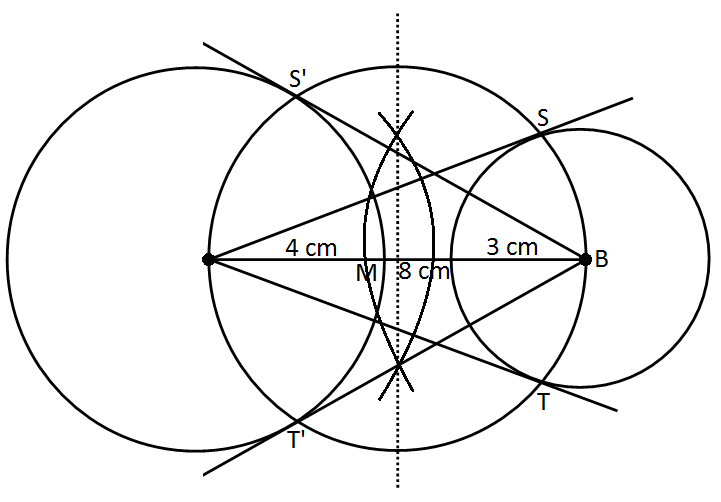
Draw a line segment AB of length 8cm. Taking A as centre, draw a circle of radius 4cm and taking B as centre, draw another circle of radius 3cm. Construct tangents to each circle from the centre of the other circle.
AnswerSteps of construction:
- Draw a line segment AB = 8cm.
- With centre A and radius 4cm and with centre B and radius 3cm, circles are drawn.
- Bisect AB at M.
- With centre M and diameter AB, draw a circle which intersects the two circles at S’, T’ and S, T respectively.
- Join AS, AT, BS’and BT’.
Then AS, AT, BS’ and BT’ are the required tangent.
View full question & answer→Question 234 Marks
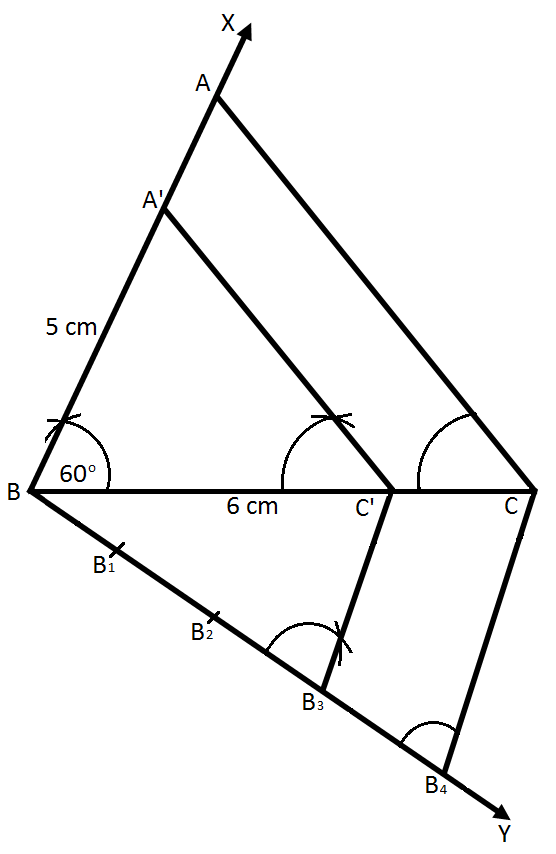
Draw a $\triangle\text{ABC}$ with side $BC = 6\ cm, AB = 5\ cm$ and $\angle\text{ABC} = 60^\circ.$ Then construct a triangle whose sides are $\Big(\frac{3}{4}\Big)^\text{th}$ of the corresponding sides of the $\triangle\text{ABC}.$
AnswerSteps of construction:
- Draw a line segment $BC = 6\ cm.$
- At $B$, draw a ray $BX$ making an angle of $60^\circ $ with $BC$ and cut off $BA = 5\ cm$.
- Join $AC$. Then $ABC$ is the triangle.
- Draw a ray BY making an acute angle with $BC$ and cut off $4$ equal parts making $BB_1 = B_1B_2B_2B_3 = B_3B_4.$
- Join $B_4$ and $C$.
- From $B_3$, draw $B_3C’$ parallel to $B_4C$ and $C’A’$ parallel to $CA$.
Then $\triangle\text{A}'\text{BC}'$ is the required triangle.
View full question & answer→Question 244 Marks
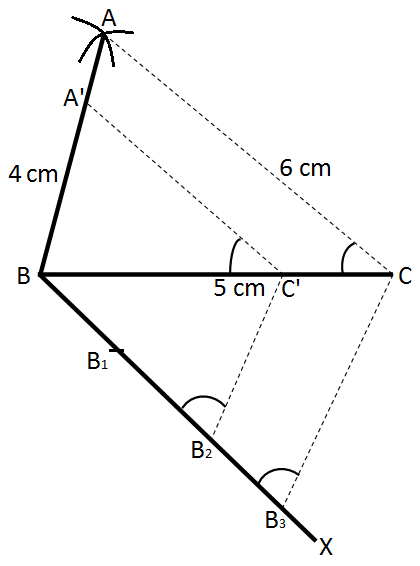
Construct a triangle of sides $4\ cm, 5\ cm$ and $6\ cm$ and then a triangle similar to it whose sides are $\Big(\frac{2}{3}\Big)$ of the corresponding sides of it.
AnswerSteps of construction:
- Draw a line segment $BC = 5\ cm.$
- With centre B and radius $4\ cm$ and with centre C and radius $6\ cm$, draw arcs intersecting each other at A.
- Join AB and AC. Then ABC is the triangle.
- Draw a ray BX making an acute angle with BC and cut off $3$ equal parts making $BB_1 = B_1B_2 = B_2B_3$.
- Join $B_3C$.
- Draw B’C’ parallel to $B_3C$ and C’A’ parallel to CA then $\triangle\text{A}'\text{BC}'$ is the required triangle.
View full question & answer→Question 254 Marks
Draw a $\triangle ABC$ in which $BC = 6\ cm, AB = 4\ cm$ and $AC = 5\ cm$.
Draw a triangle similar to $\triangle\text{ABC}.$
with its sides equal to $\Big(\frac{3}{4}\Big)^\text{th}$ of the corresponding sides of $\triangle\text{ABC}.$
AnswerGiven that Construct a triangle of sides $AB = 4\ cm, BC = 6\ cm$ and AC = 5\ cm and then a triangle similar to it whose sides are $\Big(\frac{3}{4}\Big)^\text{th}$ of the corresponding sides of $\triangle\text{ABC}.$ We follow the following steps to construct the given
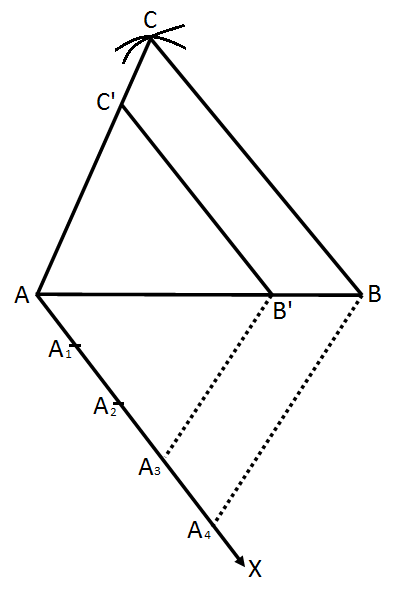
Step of construction:
Step I: First of all we draw a line segment $AB = 4\ cm.$
Step II: With A as centre and radius $= AC = 5\ cm$, draw an arc.
Step III: With B as centre and radius $= BC = 6\ cm$, draw an arc, intersecting the arc drawn in step II at C.
Step IV: Joins AC and BC to obtain $\triangle\text{ABC}.$
Step V: Below AB, makes an acute angle $\angle\text{BAX}=60^\circ.$
Step VI: Along AX, mark off four points $A_1, A_2, A_3$ and $A_4$ such that $AA_1 = A_1A_2 = A_2A_3 = A_3A_4$.
Step VII: Join A4B.
Step VIII: Since we have to construct a triangle each of whose sides is $\Big(\frac{3}{4}\Big)^\text{th}$ of the corresponding sides of $\triangle\text{ABC}.$ So, we take three parts out of four equal parts on AX from point $A_3$ draw $A_3B' || A_4B$, and meeting AB at B’.
Step IX: From B’ draw $B'C || BC$, and meeting AC at C'. Thus, $\triangle\text{AB}'\text{C}'$ is the required triangle, each of whose sides is $\Big(\frac{3}{4}\Big)^\text{th}$ of the corresponding sides of $\triangle\text{ABC}.$ View full question & answer→Question 264 Marks
Construct a triangle $PQR$ with sides $QR = 7\ cm, PQ = 6\ cm$ and $ \angle\text{PQR} = 60^\circ.$ Then construct another triangle whose sides are $\frac{3}{5}$ of the corresponiding sides of $\triangle\text{PQR}.$
AnswerSteps of Construction:
Step I: Draw a line segment $QR = 7\ cm.$
Step II: At Q, draw $\angle\text{PQR}=60^\circ.$
Step III: With Q as centre and radius $6\ cm$, draw an arc cutting the ray QX at P.
Step IV: Join PR. Thus, $\triangle\text{PQR}$ is the required triangle.
Step V: Below QR, draw an acute angle $\angle\text{YQR}.$
Step VI: Along QY, mark five points $R_1, R_2, R_3, R_4$ and $R_5$ such that $QR_1 = R_1R_2 = R_2R_3 = R_3R_4 = R_4R_5.$
Step VII: Join $RR_5$.
Step VIII: From $R_3$, draw $R_3R' || RR_5$ meeting QR at R'.
Step IX: From $R'$, draw $P'R' || PR$ meeting $PQ$ in $P'$.
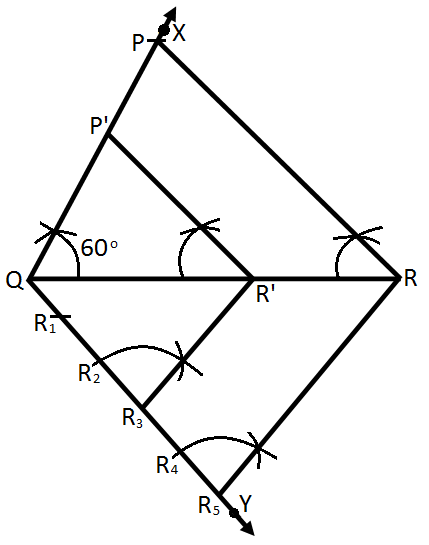
Here, $\triangle\text{P}'\text{QR}'$ is the required triangle whose sides are $\frac{3}{5}$ of the corresponding sides of $\triangle\text{PQR}.$ View full question & answer→Question 274 Marks
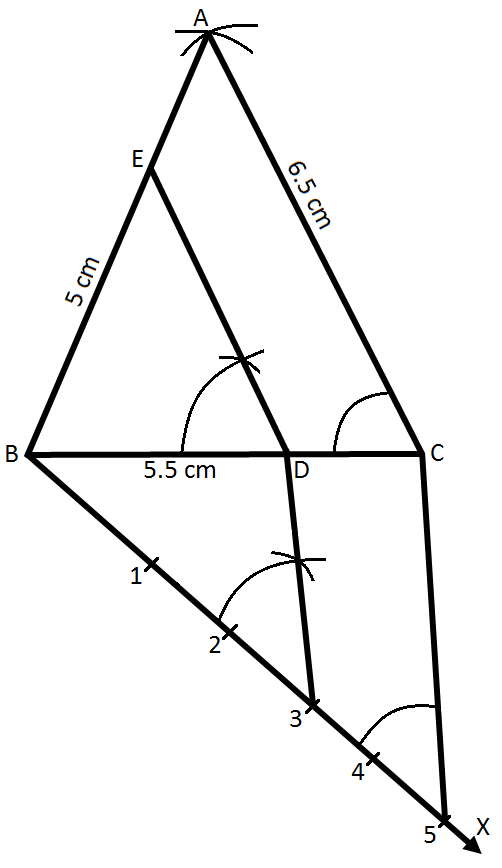
Construct a triangle with sides 5cm, 5.5cm and 6.5cm. Now construct another triangle, whose sides are $\frac{3}{5}$ times the corresponding sides of the given triangle.
AnswerSteps of construction:
- Draw line segment BC = 5.5cm.
- With centre B and radius 5cm and with centre C and radius 6.5cm, draw arcs which intersect each other at A.
- Join BA and CA. $\triangle\text{ABC}$ is the given triangle.
- At B, draw a ray BX making an acute angle and cut off 5 equal parts from BX.
- Join C5 and draw 3D || 5C which meets BC at D.
From D, draw DE || CA which meets AB at E.$\therefore\triangle\text{EBD}$ is the required triangle.
View full question & answer→Question 284 Marks
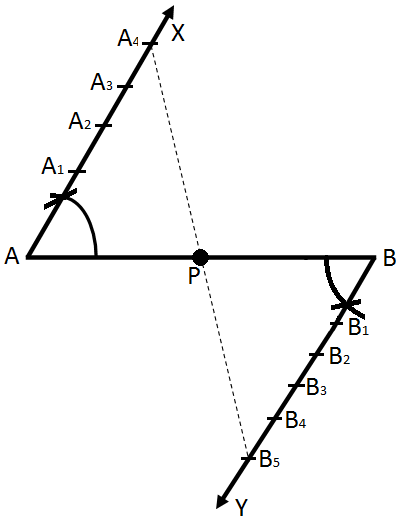
Draw a line segment of length $8\ cm$ and divide it internally in the ratio $4 : 5$.
AnswerSteps of construction:
- Draw a line segment $AB = 8\ cm$.
- Draw a ray $AX$ making an acute angle $\angle\text{BAX}=60^\circ$ with AB.
- Draw a ray $BY$ parallel to AX by making an acute angle $\angle\text{ABY}=\angle\text{BAX}.$
- Mark of four points $A_1, A_2, A_3, A_4$ on AX and five points $B_1, B_2, B_3, B_4, B_5$ on $BY$ in such a way that $AA_1 = A_1A_2 = A_2A_3 = A_3A_4.$
- Join $A_4B_5$ and this line intersects AB at a point P.
Thus, P is the point dividing AB internally in the ratio of $4 : 5.$
View full question & answer→