Question
Construct a $\triangle\text{ABC}$ in which AB = 6cm, $\angle\text{A}=30^\circ$ and $\angle\text{B}=60^\circ.$ Construct another $\triangle\text{AB}'\text{C}'$similar to $\triangle\text{ABC}$ with base AB' = 8cm.
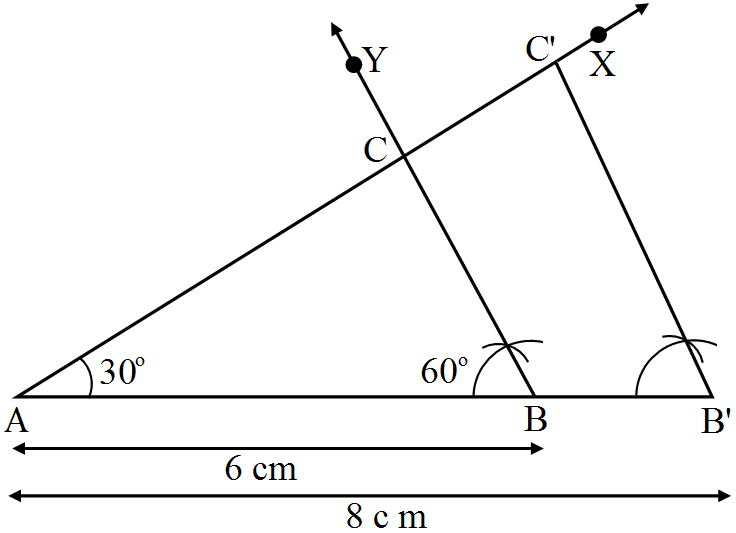
Answer


Steps of Construction:
Step 1. Draw a line segment AB = 6cm.
Step 2. At A, draw $\angle\text{XAB}=30^\circ$
Step 3. At B, draw $\angle\text{YBA}=60^\circ.$ Suppose AX and BY intersect at C.
Thus, $\triangle\text{ABC}$ is the required triangle.
Step 4. Produce AB to B' such that AB' = 8cm.
Step 5. From B', draw B'C' || BC meeting AX at C'.
Here, $\triangle\text{AB}'\text{C}'$ is the required triangle similar to $\triangle\text{ABC}.$

Need a full question paper?

Generate a complete, print-ready paper with questions like this in minutes — across 16+ boards, with answer keys.

Start Generating Free

Similar questions

Draw two concentric circles of radii 3cm and 5cm. Construct a tangent to smaller circle from a point on the larger circle. Also measure its length.
Find the area of the quadrilaterals, the coordinates of whose vertices are (-3, 2), (5, 4), (7, -6) and (-5, -4).
In an A.P., if the $5^{\text {th }}$ and $12^{\text {th }}$ terms are 30 and 65 respectively, what is the sum of first 20 terms?
Show that cube of any positive integer is of the form 4m, 4m + 1 or 4m + 3, for some integer m.
Prove the following trigonometric identities.
$\frac{\cot^2\text{A}(\sec\text{A}-1)}{1+\sin\text{A}}=\sec^2\text{A}\Big(\frac{1-\sin\text{A}}{1+\sin\text{A}}\Big)$
Find the roots the following quadratic equation (if they exist) by the method of completing the square.
$2\text{x}^2+\text{x}-4=0$
Solve the following pairs of equations:
$43x + 67y = -24$
$67x + 43y = 24$
A toy is in the form of a cone surmounted on a hemisphere. The diameter of the base and the height of the cone are 6cm and 4cm, respectively. Determine the surface area of the toy. $(\text{use}\ \pi=3.14)$
Two line segments AB and AC include an angle of 60° where AB = 5cm and AC = 7cm. Locate points P and Q on AB and AC, respectively such that
$\text{AP}=\frac{3}{4}\text{AB and AQ}=\frac{1}{4}\text{AC}.$ Join P and Q and measure the length PQ.
A train covered a certain distance at a uniform speed. If the train had been 5 kmph faster, it would have taken 3 hours less than the scheduled time. And, If the train were slower by 4 kmph, it would have taken 3 hours more than the scheduled time. Find the length of the journey.