Question
Construct a $\triangle\text{ABC}$ in which AB + AC = 5.6cm, BC = 4.5cm and$\triangle\text{ABC}$
Answer


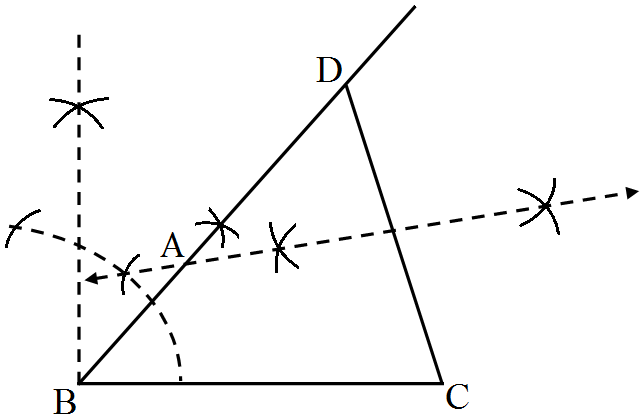
Steps of Construction:
  1. Construct a line segment BC of 4.5cm.
  2. At the point B, draw $\angle\text{XBC}=45^\circ.$
  3. Keeping B as centre and radius 5.6cm draw an arc which intersects XB at D.
  4. Join DC.
  5. Draw the perpendicular bisector of DC which intersects DB at A.
  6. Join AC.
Hence $\triangle\text{ABC}$ is the required triangle.

Need a full question paper?

Generate a complete, print-ready paper with questions like this in minutes — across 16+ boards, with answer keys.

Start Generating Free

Similar questions

In a circle with radius 13 cm , two equal chords are at a distance of 5 cm from the centre. Find the lengths of chords.
Given: In a circle with cente $O$,
OA and OC are the radii and AB and CD are its congruent chords,
$O A=O C=13 cm$
$O E=O F=5 cm$
seg $O E \perp$ chord CD, C-E-D
seg OF $\perp$ chord AB. A-F-B
To find: length of the chords
A rectangular sheet of paper $30cm \times 18cm$ can be transformed into the curved surface of a right circular cylinder in two ways i.e. either by rolling the paper along its length or by rolling it along its breadth.
Find the ratio of the volumes of the two cylinders thus formed.
Simplify:$\frac{2+\sqrt{3}}{2-\sqrt{3}}+\frac{2-\sqrt{3}}{2+\sqrt{3}}+\frac{\sqrt{3}-1}{\sqrt{3}+1}$
Find the perimeter and area of the quadrilateral ABCD in which AB = 17cm, AD = 9cm, CD = 12cm, $\angle\text{ACB}=90^\circ$ and AC = 15cm.
The opposite sides of a quadrilateral are parallel. If one angle of the quadrilateral is 60°. Find the other angles.
Factorize:
$a^2 + 2ab + b^2 - c^2$
Plot the following points on the graph paper:(-4, 0)
Using factor theorem, factorize the following polynomials:
$x^3 - 23x^2 + 142x - 120$
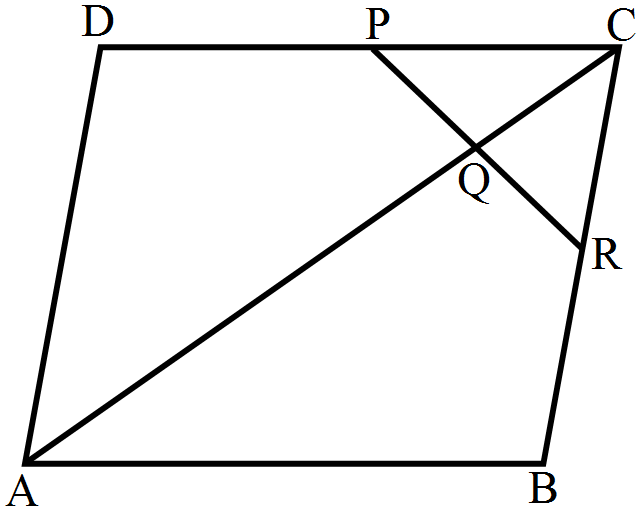
In ABCD is a parallelogram in which P is the mid-points of DC and Q is a point on AC such that $\text{CQ}=\frac{1}{4}\text{AC}.$ if PQ produced meets BC at E, prove R is a mid-points of BC.
On the plane of a graph paper draw X' OX and YOY' as coordinate axes and plot each of the following points.
  1. A(5, 3)
  2. B(6, 2)
  3. C(-5, 3)
  4. D(4, -6)
  5. E(-3, -2)
  6. F(-4, 4)
  7. G(3, -4)
  8. H(5, 4)
  9. I(0, 6)
  10. J(-3, 0)
  11. K (0, -2)
  12. O(0, 0)