Questions

4 Mark Question

Take a timed test

20 questions · self-marked practice — reveal the answer and mark yourself.

Question 14 Marks
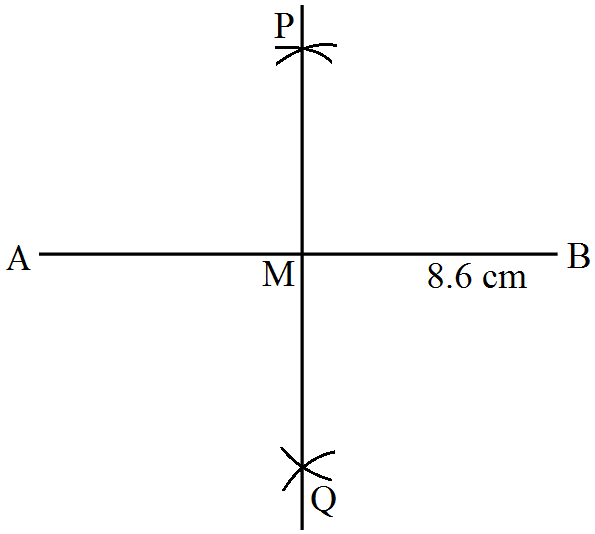
Draw a line segment of length 8.6cm. Bisect it and measure the length of each part.
Answer
Steps of construction:
  1. Draw a line segment AB of 8.6cm.
  2. Keeping A as centre and radius more than half of AB draw arcs on each side of AB.
  3. Keeping B as centre and the same radius draw arcs on each side of AB cutting the previous arcs at P and Q respectively.
  4. Join the points P and Q which intersects AB at C.
Therefore AC = BC = 4.3cm.
View full question & answer
Question 24 Marks
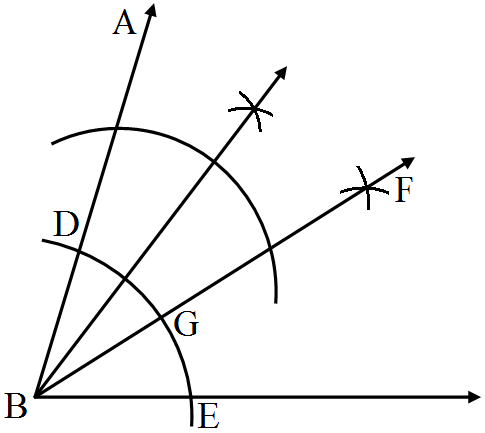
Using a protractor, draw an angle of measure 72°. With this angle as given, draw angles of measure 36° and 54°.
Answer

Steps of construction:
  1. Draw an $\angle\text{ABC}$ of 720 with the help of a protractor.
  2. Keeping B as center and any radius draw an arc which intersects AB at D and BC at E.
  3. Keeping D and E as center and radius more than half of DE draw two arcs which intersect each other at F.
  4. Join FB which intersects the arc in (2) at G.
  5. Keeping D and G as center and radius more than half of DG draw two arcs which intersect each other at H.
  6. Join HB.
Therefore $\angle\text{HBC}=54^\circ,\angle\text{FBC}=36^\circ$
View full question & answer
Question 34 Marks
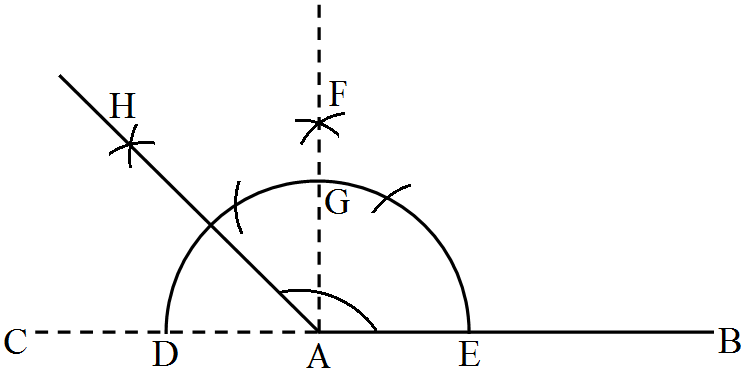
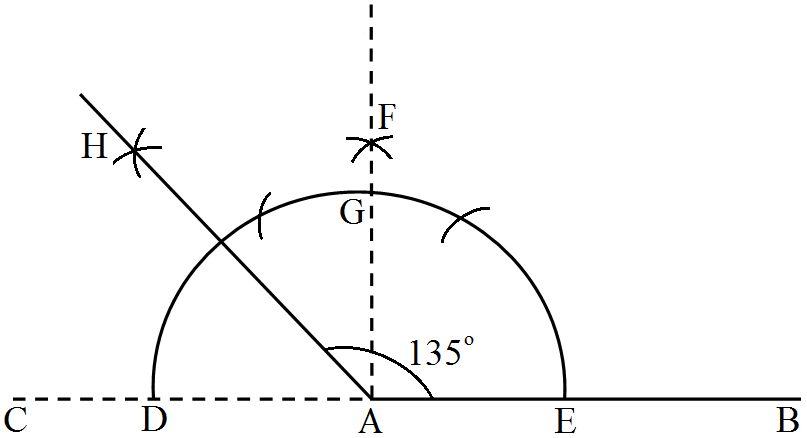
Using rulers and compasses only, draw an angle of measure 135°.
Answer

Steps of construction:
  1. Draw a line segment AB and produce BA to C.
  2. Keeping A as the center and any radius draw an arc which intersects AC at D and AB at E.
  3. Keeping D and E as center and radius more than half of DE draw arcs which intersect each other at F.
  4. Join FA which intersects the arc in (2) at G.
  5. Keeping G and D as center and radius more than half of GD draw arcs which intersect each other at H.
  6. Join HA.
Therefore $\angle\text{HAB}=135^\circ$
View full question & answer
Question 44 Marks
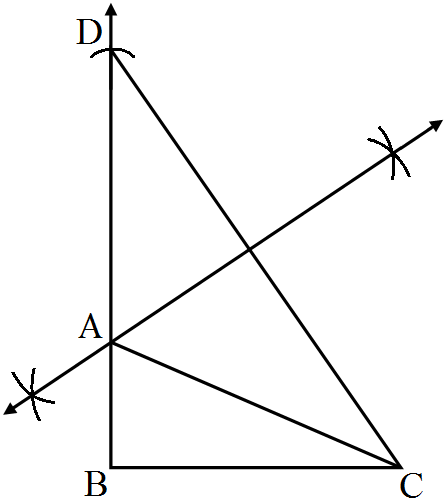
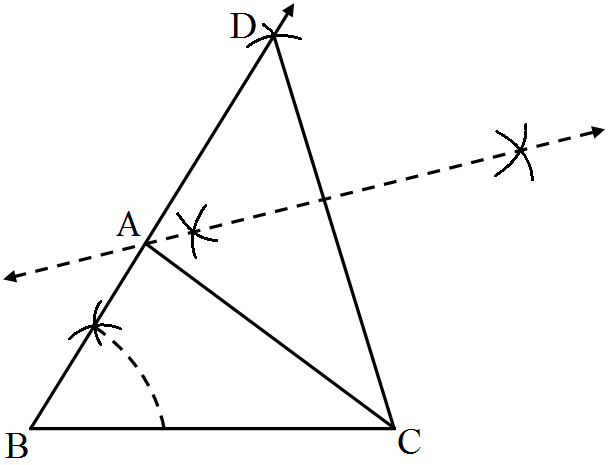
Construct a right-angled triangle ABC whose base BC is 6cm and the sum of the hypotenuse AC and other side AB is 10cm.
Answer

Steps of construction:
  1. Construct a line segment BC of 6cm.
  2. At the point B, draw $\angle\text{XBC}=90^\circ.$
  3. Keeping B as center and radius 10cm draw an arc which intersects XB at D.
  4. Join DC.
  5. Draw the perpendicular bisector of DC which intersects DB at A.
  6. Join AC.
Hence $\triangle\text{ABC}$ is the required triangle.
View full question & answer
Question 54 Marks
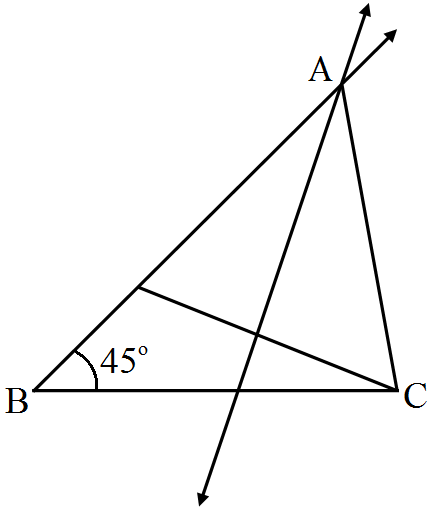
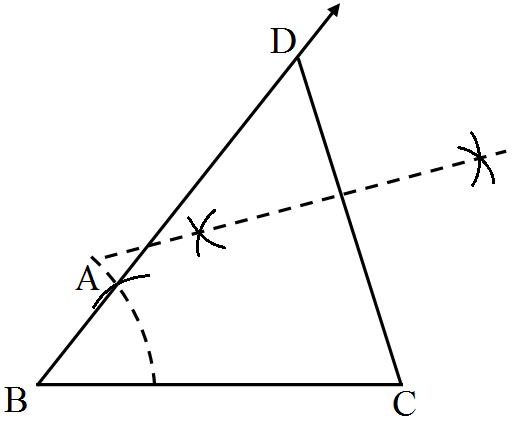
Construct a $\triangle\text{ABC}$ in which BC = 3.4cm, AB - AC = 1.5cm and $\angle\text{B}=45^\circ.$
Answer

Steps of Construction:
  1. Construct a line segment BC of 3.4cm.
  2. At the point B, draw $\angle\text{XBC}=45^\circ$
  3. Keeping B as centre and radius 1.5cm draw an arc which intersects XB at D.
  4. Join DC.
  5. Draw the perpendicular bisector of DC which intersects DB at A.
  6. Join AC.
Hence $\triangle\text{ABC}$ is the required triangle.
View full question & answer
Question 64 Marks
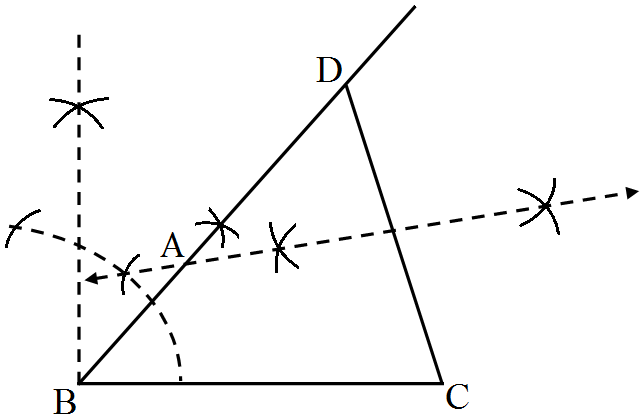
Construct a $\triangle\text{ABC}$ in which AB + AC = 5.6cm, BC = 4.5cm and$\triangle\text{ABC}$
Answer

Steps of Construction:
  1. Construct a line segment BC of 4.5cm.
  2. At the point B, draw $\angle\text{XBC}=45^\circ.$
  3. Keeping B as centre and radius 5.6cm draw an arc which intersects XB at D.
  4. Join DC.
  5. Draw the perpendicular bisector of DC which intersects DB at A.
  6. Join AC.
Hence $\triangle\text{ABC}$ is the required triangle.
View full question & answer
Question 74 Marks
Draw a line segment AB bisect it. Bisect one of the equal parts to obtain a line segment of length $\frac{1}{2}(\text{AB})$
Answer

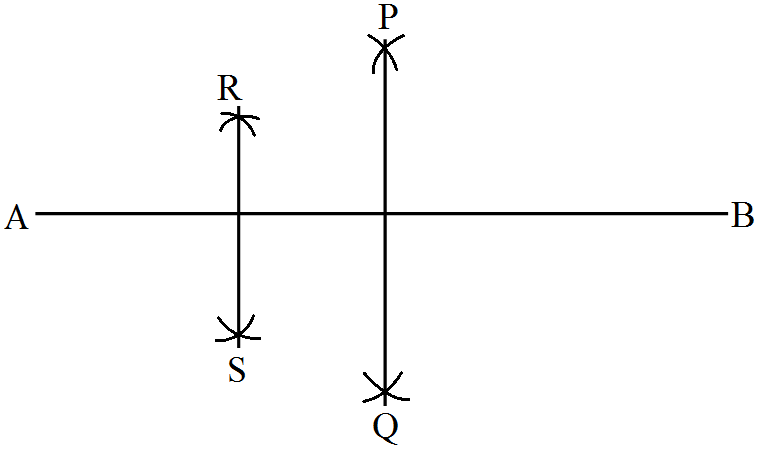
Steps of construction:
  1. Draw a line segment AB.
  2. With A as centre and radius more than half of AB draw arcs, one on each side of AB.
  3. With B as the centre and same radius draw arcs cutting the previous arcs at points P and Q respectively.
  4. Join P and Q which intersects AB at C.
  5. With A as centre and radius more than half of AC draw arcs, one on each side of AC.
  6. With C as the centre and same radius draw arcs cutting the previous arcs at R and S respectively.
  7. Join points R and S which intersects AC at D.
Therefore $\text{AD}=\big(\frac{1}{2}\big)\text{(AB)} $
View full question & answer
Question 84 Marks
Draw a line segment of length 10cm and bisect it. Further, bisect one of the equal parts and measure its length.
Answer

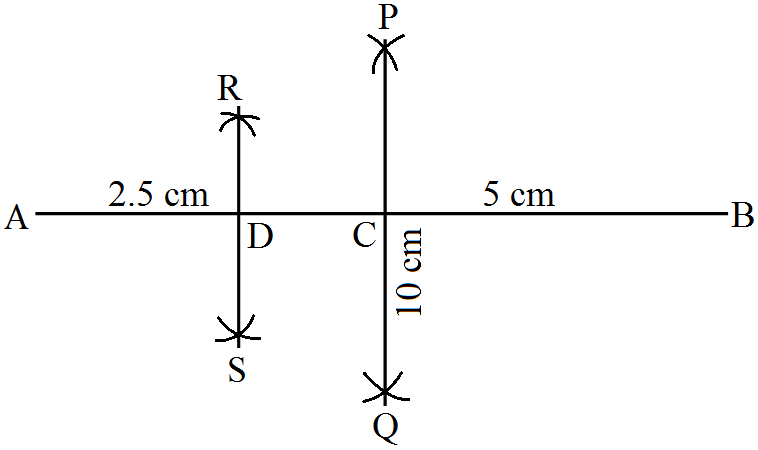
Steps of construction:
  1. Draw a line segment AB of length 10cm.
  2. Keeping A as centre and radius more than half of AB draw arcs one on each side of AB.
  3. Keeping B as centre and same radius draw arcs cutting the previous arc at point P and Q respectively.
  4. Join P and Q which intersects AB at C.
  5. Keeping A as centre and radius more than half of AC draw arcs on each side of AC.
  6. Keeping C as centre and the same radius draw arcs cutting the previous arcs at points R and S respectively.
  7. Join points R and S which intersects AC at D.
Therefore AD = 2.5cm
View full question & answer
Question 94 Marks
Draw a line segment AB and by ruler and compasses, obtain a line segment of length $\frac{3}{4}\text{(AB)}.$
Answer

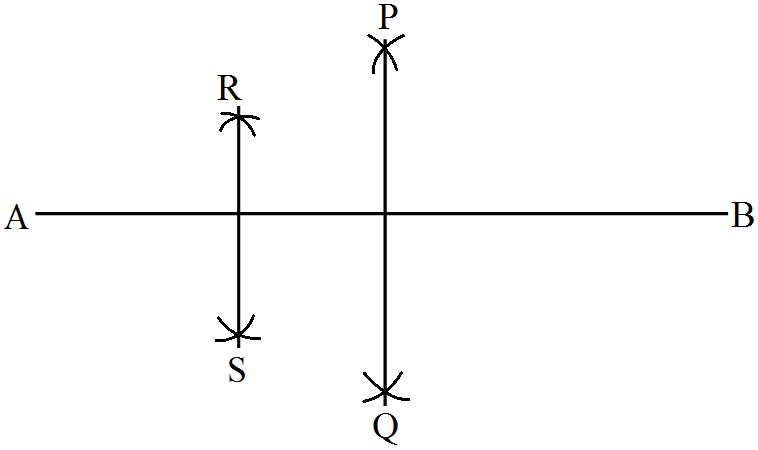
Steps of construction:
  1. Draw a line segment AB.
  2. With A as centre and radius more than half of AB draw arcs, one on each side of AB.
  3. With B as the centre and same radius draw arcs cutting the previous arcs at points P and Q respectively.
  4. Join P and Q which intersects AB at C.
  5. With A as centre and radius more than half of AC draw arcs, one on each side of AC.
  6. With C as the centre and same radius draw arcs cutting the previous arcs at R and S respectively.
  7. Join points R and S which intersects AC at D.
Therefore $\text{AD}=\frac{3}{4}\text{(AB)}$
View full question & answer
Question 104 Marks
Construct a right-angled triangle whose perimeter is equal to 10cm and one acute angle equal to 60°.
Answer

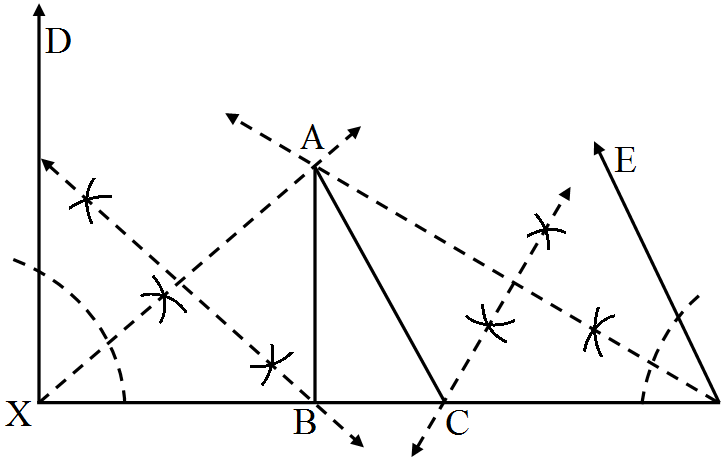
Steps of Construction:
  1. Draw a line segment XY of 10cm.
  2. Draw $\angle\text{DXY}=90^\circ$ and $\angle\text{EYX}=60^\circ.$
  3. Draw the angle bisectors of $\angle\text{DXY}$ and $\angle\text{EYX}$ which intersect each other at A.
  4. Draw the perpendicular bisector of AX and AY which intersect XY at B and C respectively.
  5. Join AB and AC.
Hence $\triangle\text{ABC}$ is the required triangle.
View full question & answer
Question 114 Marks
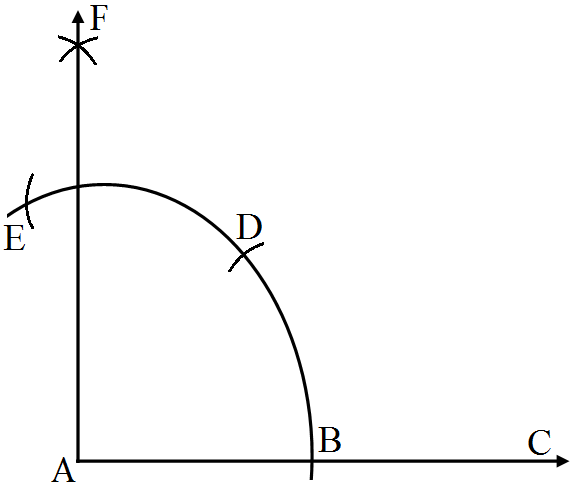
Using rulers and compasses only, draw a right angle.
Answer

Steps of construction:
  1. Draw a line segment AB.
  2. Keeping A as the center and any radius draw an arc which intersects AB at C.
  3. Keeping C as center and the same radius draw an arc which intersects the previous arc at D.
  4. Keeping D as the center and same radius draw an arc which intersects arc in (2) at E.
  5. Keeping E and D as center and radius more than half of ED draw arcs which intersect each other at F.
  6. Join FA.
Therefore $\angle\text{FAB}=90^\circ$
View full question & answer
Question 124 Marks
Using rulers and compasses only, construct a $\triangle\text{ABC},$ given base BC = 7cm, $\angle\text{ABC}=60^\circ,$ and AB + AC = 12cm.
Answer

Steps of Construction:
  1. Construct a line segment BC of 7cm.
  2. At the point B, draw $\angle\text{XBC}=60^\circ$
  3. Keeping B as centre and radius 12cm draw an arc which intersects XB at D.
  4. Join DC.
  5. Draw the perpendicular bisector of DC which intersects DB at A.
  6. Join AC.
Hence $\triangle\text{ABC}$ is the required triangle.
View full question & answer
Question 134 Marks
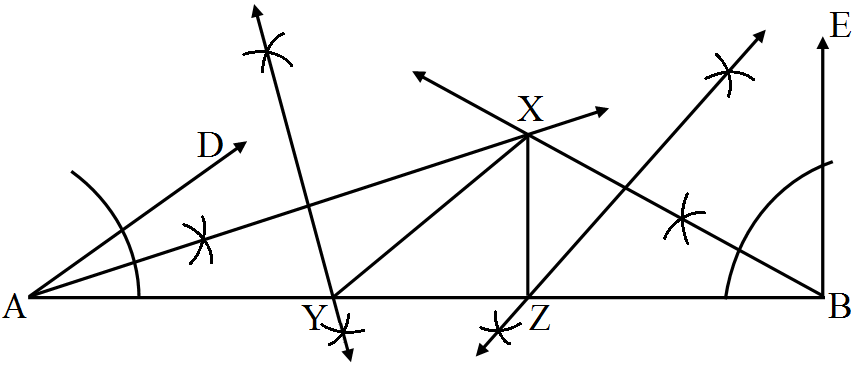
Construct a triangle XYZ in which $\angle\text{Y}=30^\circ,$ $\angle\text{Z}=90^\circ$ and XY + YZ + ZX = 11cm.
Answer

Steps of construction:
  1. Draw a line segment AB of 11cm.
  2. Draw $\angle\text{DAB}=30^\circ$ and $\angle\text{FBA}=90^\circ.$
  3. Draw the angle bisectors of $\angle\text{DAB}$ and $\angle\text{EBA}$ which intersect each other at A.
  4. Draw the perpendicular bisector of XA and XB which intersect AB at Y and Z respectively
  5. Join XY and XZ.
Hence $\triangle\text{XYZ}$ is the required triangle.
View full question & answer
Question 144 Marks
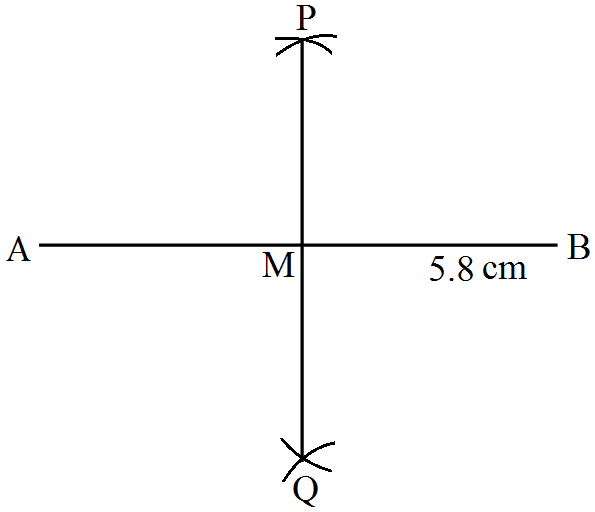
Draw a line segment AB of length 5.8cm. Draw the perpendicular bisector of this line segment.
Answer

Steps of construction:
  1. Draw a line segment AB of 5.8cm.
  2. Keeping A as centre and radius more than half of AB draw arcs on each side of AB.
  3. Keeping B as centre and the same radius draw arcs on each side of AB cutting the previous arcs at P and Q respectively.
  4. Join the points P and Q.
Hence PQ is the perpendicular bisector of AB.
View full question & answer
Question 154 Marks
Construct the angles of the following measurements:
135°
Answer

Steps of construction:
  1. Draw a line segment AB and produce BA to C.
  2. Keeping A as the centre and any radius draw an arc which intersects AC at D and AB at E.
  3. Keeping D and E as centre and radius more than half of DE draw arcs which intersect each other at F.
  4. Join FA which intersects the arc in (2) at G.
  5. Keeping G and D as centre and radius more than half of GD draw arcs which intersect each other at H
  6. Join HA.
Therefore $\angle\text{HAB}=135^\circ $
View full question & answer
Question 164 Marks
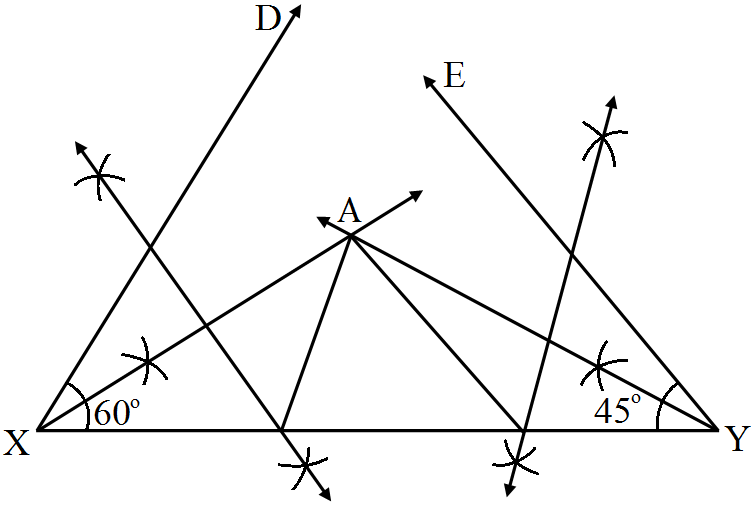
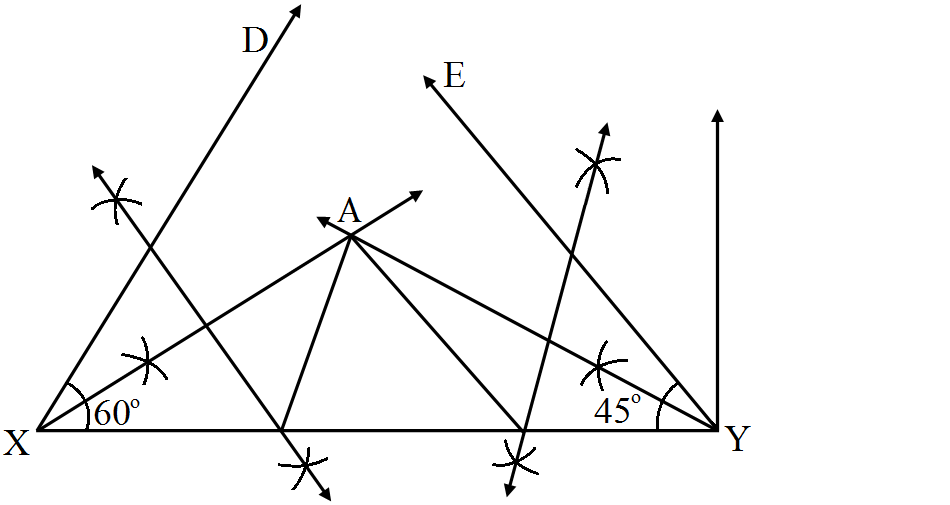
Construct a triangle whose perimeter is 6.4cm, and angles at the base are 60° & 45°.
Answer

Steps of construction:
  1. Draw a line segment XY of 6.4cm.
  2. Draw $\angle\text{DXY}=60^\circ$ and $\angle\text{EYX}=45^\circ.$
  3. Draw the angle bisectors of $\angle\text{DXY}$ and $\angle\text{EYX}$ which intersect each other at A.
  4. Draw the perpendicular bisector of AX and AY which intersect XY at B and C respectively.
  5. Join AB and AC.
Hence $\triangle\text{ABC}$ is the required triangle.
View full question & answer
Question 174 Marks
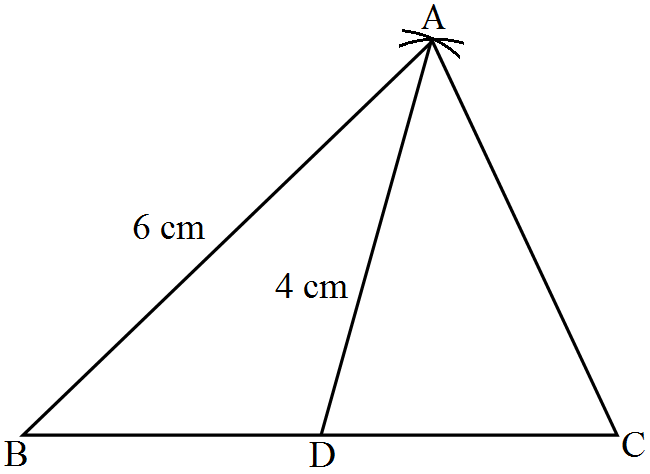
Construct a triangle ABC such that BC = 6cm, AB = 6cm and median AD = 4cm.
Answer

Steps of construction:
  1. Draw a line segment BC of 6cm.
  2. Take mid-point O of side BC.
  3. With center B and D and radii 6cm and 4cm, draw two arcs which intersect each other at A.
  4. Join AB, AD and AC.
Hence $\triangle\text{ABC}$ is the required triangle.
View full question & answer
Question 184 Marks
Construct a $\triangle\text{ABC}$ in which BC = 3.6cm, AB + AC = 4.8cm and $\angle\text{B}=60^\circ. $
Answer

Steps of Construction:
  1. Construct a line segment BC of 3.6cm.
  2. At the point B, draw $\angle\text{XBC}=60^\circ.$
  3. Keeping B as center and radius 4.8cm draw an arc which intersects XB at D.
  4. Join DC.
  5. Draw the perpendicular bisector of DC which intersects DB at A.
  6. Join AC.
Hence $\triangle\text{ABC}$ is the required triangle.
View full question & answer
Question 194 Marks
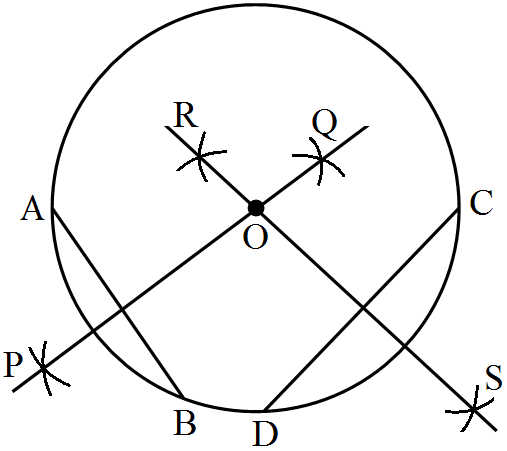
Draw a circle with centere at point O. Draw its two chords AB and CD such that AB is not parallel to CD. Draw the perpendicular bisectors of AB and CD. At what point do they intersect?
Answer

Steps of construction:
  1. Keeping O as the centre and any radius draw a circle.
  2. Draw two chords AB and CD.
  3. Keeping A as centre and radius more than half of AB draw arcs, one on each side of AB.
  4. Keeping B as centre and the same radius draw arcs cutting the previous arcs at point P and Q respectively.
  5. Join the points P and Q.
  6. Keeping D as centre and radius more than half of DC draw arcs, one on each side of DC.
  7. Keeping C as centre and the same radius draw arcs cutting the previous arcs at points R and S respectively.
  8. Join the points R and S.
Both the perpendicular bisectors PQ and RS intersect each other at the centre O of the circle.
View full question & answer
Question 204 Marks
Using rulers and compasses only, construct a $\triangle\text{ABC}$ from the following data:
AB + BC + CA = 12cm, $\angle\text{B}=45^\circ$ and $\angle\text{C}=60^\circ$
Answer

Steps of construction:
  1. Draw a line segment XY of 12cm.
  2. Draw $\angle\text{DXY}=45^\circ$ and $\angle\text{EYX}=60^\circ.$
  3. Draw the angle bisectors of $\angle\text{DXY}$ and $\angle\text{EYX}$ which intersect each other at A.
  4. Draw the perpendicular bisector of AX and AY which intersect XY at B and C respectively.
  5. Join AB and AC.
Hence $\triangle\text{ABC}$ is the required triangle.
View full question & answer