Question
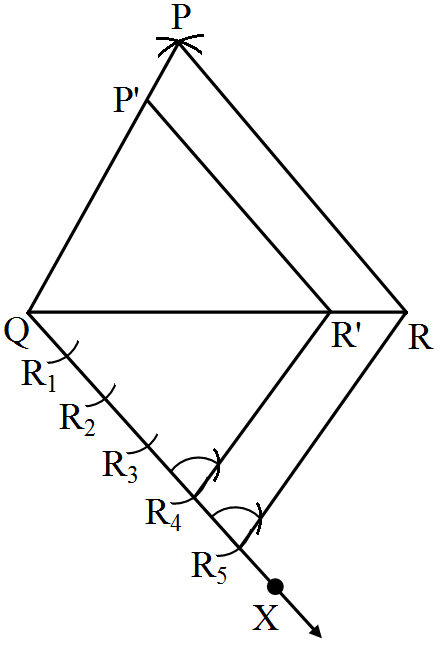
Construct a $\triangle\text{PQR},$ in which PQ = 6cm, QR = 7cm and PR = 8cm. Then, construct another triangle whose sides are $\frac{4}{5}\text{ times}$ the corresponding sides of $\triangle\text{PQR}.$
Answer


Steps of construction:
Step 1. Draw a line segment $Q R=7 cm$.
Step 2. With $Q$ as centre and radius 6 cm , draw an arc.
Step 3. With $R$ as centre and radius 8 cm , draw an arc cutting the previous arc at $P$.
Step 4. Join $P Q$ and $P R$. Thus, $\triangle P Q R$ is the required triangle.
Step 5. Below $Q R$, draw an acute angle $\angle R Q X$.
Step 6. Along $Q X$, mark five points $R_1, R_2, R_3, R_4$ and $R_5$ such that $Q R_1=R_1 R_2=R_2 R_3=R_3 R_4=R_4 R_5$.
Step 7. Join RR5.
Step 8. From $R_4$, draw $R_4 R^{\prime} \| R R_5$ meeting $Q R$ at $R^{\prime}$.
Step 9. From $R^{\prime}$, draw $P^{\prime} R^{\prime} \| P R$ meeting $P Q$ in $P^{\prime}$. Here, $\triangle P^{\prime} Q R^{\prime}$ is the required triangle, each of whose sides are $\frac{4}{5}$ times the corresponding sides of $\triangle PQR$.

Need a full question paper?

Generate a complete, print-ready paper with questions like this in minutes — across 16+ boards, with answer keys.
Start Generating Free

Similar questions

Prove the following identities:
$\frac{\text{cosec }\theta+\cot\theta}{\text{cosec }\theta-\cot\theta}=(\text{cosec }\theta+\cot\theta)^2$
$=1+2\cot^2\theta+2\text{ cosec }\theta\cot\theta$
A bucket made up of a metal sheet is in the form of a frustum of a cone of height 16cm and radii of its lower and upper ends are 8cm and 20cm, respectively. Find the cost of the bucket if the cost of metal sheet used is Rs. 15 per $100cm^2$. $\big[\text{Use }\pi=3.14\big]$
Solve for x and y:
3(2x + y) = 7xy,
3(x + 3y) = 11xy $(\text{x}\neq0\ \text{and}\ \text{y}\neq0)$
Three consecutive vertices of a parallelogram are (-2, 1), (1, 0) and (4, 3). Find the fourth vertex.
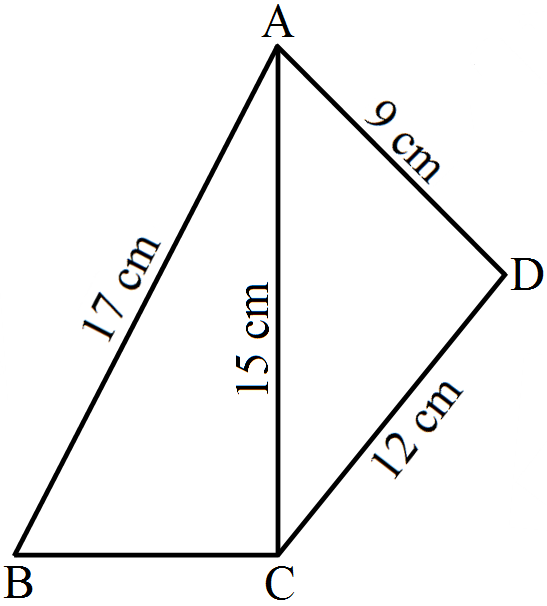
Find the perimeter and area of the quadrilateral ABCD in which AB = 17cm, AD = 9cm, CD = 12cm, $\angle\text{ACB} = 90^\circ$ and AC = 15cm.
If $\sec\theta+\tan\theta=\text{p},$ prove that:$\sec\theta=\frac12\Big(\text{p}+\frac{1}{\text{p}}\Big)$
In a hospital, the ages of diabetic patients were recorded as follows. Find the median age.
Age (in years) 0-15 15-30 30-45 45-60 60-75
Number of patients 5 20 40 50 25
Show that the sum of an AP whose first term is a, the second term b and the last term c, is equal to $\frac{\big(\text{a+c}\big)\big(\text{b + c - 2a}\big)}{2\big(\text{b - a}\big)}.$
Solve the following quadratic equation:
$3\Big(\frac{\text{3x}-1}{\text{2x}+3}\Big)-2\Big(\frac{\text{2x}+3}{\text{3x}-1}\Big)=5$ $\text{x}\neq\frac{1}{3},\ \frac{-3}{2}$
The path of a train a is given by the equation 3x + 4y - 12 = 0 and the path of another train B is given by the equation 6x + 8y - 48 = 0. Represent this situation graphically.