Question
If $\sec\theta+\tan\theta=\text{p},$ prove that:$\sec\theta=\frac12\Big(\text{p}+\frac{1}{\text{p}}\Big)$

Answer

We have,$\sec\theta+\tan\theta=\text{p}\dots(1)$
$\Rightarrow\frac{\sec\theta+\tan\theta}{1}\times\frac{\sec\theta-\tan\theta}{\sec\theta-\tan\theta}=\text{p}$
$\Rightarrow\frac{\sec^2\theta-\tan^2\theta}{\sec\theta-\tan\theta}=\text{p}$
$\Rightarrow\frac{1}{\sec\theta-\tan\theta}=\text{p}$
$\Rightarrow\sec\theta-\tan\theta=\frac{1}{\text{p}}\dots(2)$
Adding (1) and (2), we get:
$2\sec\theta=\text{p}+\frac{1}{\text{p}}$
$\Rightarrow\sec\theta=\frac12\Big(\text{p}+\frac{1}{\text{p}}\Big)$

Need a full question paper?

Generate a complete, print-ready paper with questions like this in minutes — across 16+ boards, with answer keys.
Start Generating Free

Similar questions

A solid is consisting of a right circular cone of height 120 cm and radius 60 cm standing on a hemisphere of radius 60 cm. It is placed upright in a right circular cylinder full of water such that it touches the bottom. Find the volume of water left in the cylinder, if the radius of the cylinder is 60 cm and its height is 180 cm.
Find the area of $\triangle\text{ABC}$ with vertices A(0, -1), B(2, 1) and C(0, 3). Also, find the area of the triangle formed by joining the midpoints of its sides. Show that the ratio of the areas of two triangles is 4 : 1
For the following statments state whether true (T) or false(F):
If two triangles are similar then their corresponding angles are equal and their corresponding sides are equal.
If the roots of the quadratic equation $(x-a)(x-b)+(x-b)(x-c)+(x-c)(x-a)=0$ are equal. Then show that $a=b$ $=c$
Find the ratio in which the line 2x + 3y - 5 = 0 divides the line segment joining the points (8, -9) and (2, 1). Also find the coordinates of the point of division.
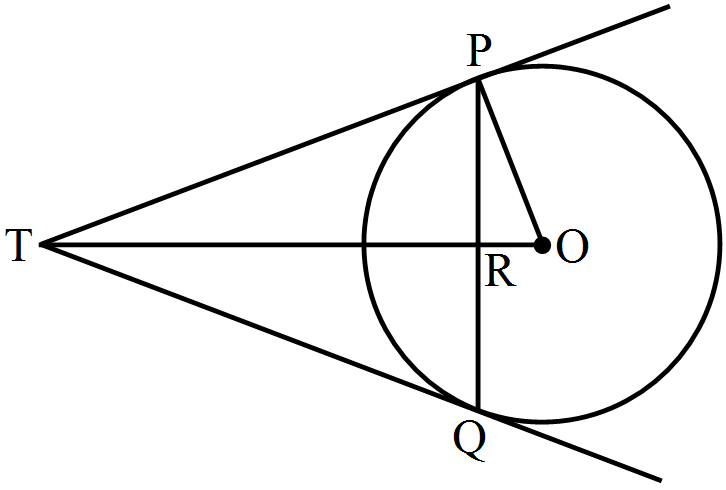
PQ is a chord of length 16cm of a circle of radius 10cm. The tangent at P and Q intersect at point T as shown in the figure.
Finf the length of TP.
Show graphically that the following system of equation is in-consistent (i.e. has no solution):
x - 2y = 6
3x - 6y = 0
Let there be an A.P. with first term ' $a$ ', common difference ' $d$ '. If $a_n$ denotes in $n ^{\text {th }}$ term and $S_n$ the sum of first $n$ terms, find. n and a , if $a _{ n }=4, d=2$ and $S _{ n }=-14$.
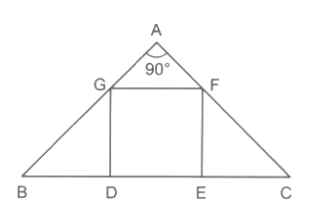
In the given figure, $\text{DEFG}$ is a square and $\angle B A C=90^{\circ}$. Prove that
$i. \triangle A G F \sim \triangle D B G$
$ii. \triangle A G F \sim \triangle E F C$
$iii. \triangle D B G \sim \triangle E F C$
$iv. D E^2=B D \times E C$
Image
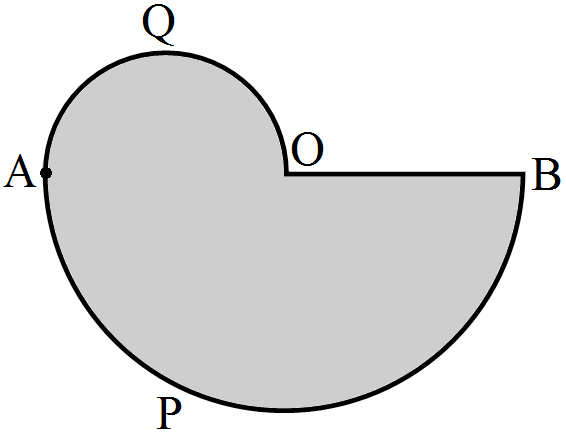
In the given figure, APB and AQO ar semicircles and AO = OB. if the perimeter of the figure is 40cm, find the area of the shaded region.