Question
Construct an angle bisector to draw an angle of 45°.

Answer

For getting measurement of 45° (for the bisected angle), one has to make an angle of 90° (i.e. 45° × 2).

Step 1:
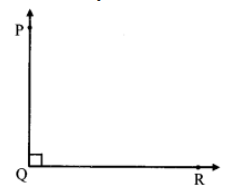
Draw ∠PQR of 90°.

Image

Step 2:
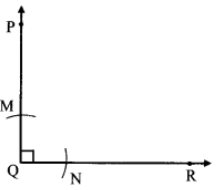
Cut arcs on the rays QP and QR.
Name these points as M and N respectively.
Image

Step 3:
Place the compass point on point M and draw an arc inside the angle.
Without changing the distance of the compass, place the compass point on point N and cut the
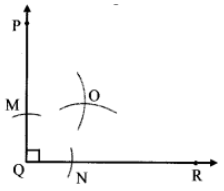
Image

Step 4:
Draw ray QO.
Ray QO is the angle bisector of ∠PQR.
i.e. m∠PQO = m∠RQO = 45°
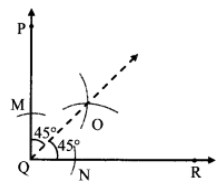
Image

Need a full question paper?

Generate a complete, print-ready paper with questions like this in minutes — across 16+ boards, with answer keys.
Start Generating Free

Similar questions

Ravish's house is $\frac{9}{10}\text{km}$ from his school. He walked some distance and then took a bus for $\frac{1}{2}\text{km}$ up to the school. How far did he walk?
Construct $\angle\text{AOB}=85^\circ$ with the help of a protractor. Draw a ray OX bisecting $\angle\text{AOB}.$
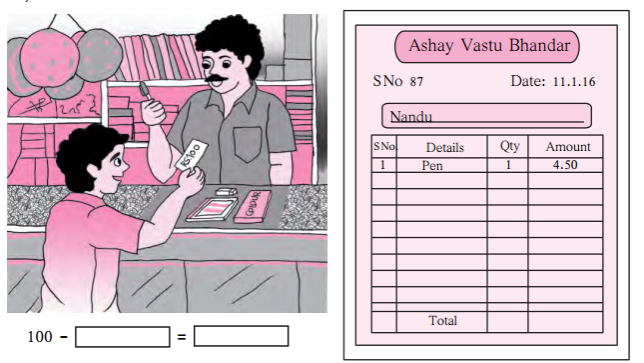
Nandu went to a shop to buy a pen, notebook, eraser and a paint box. The shopkeeper told him the prices. A pen costs four and a half rupees, an eraser one and a half, a notebook six and a half and a paintbox twenty-five rupees and fifty paise. Nandu bought one of each article. Prepare his bill.
If Nandu gave a 100 rupee note, how much money does he get back?

Image

Nandu will get __ rupees back.

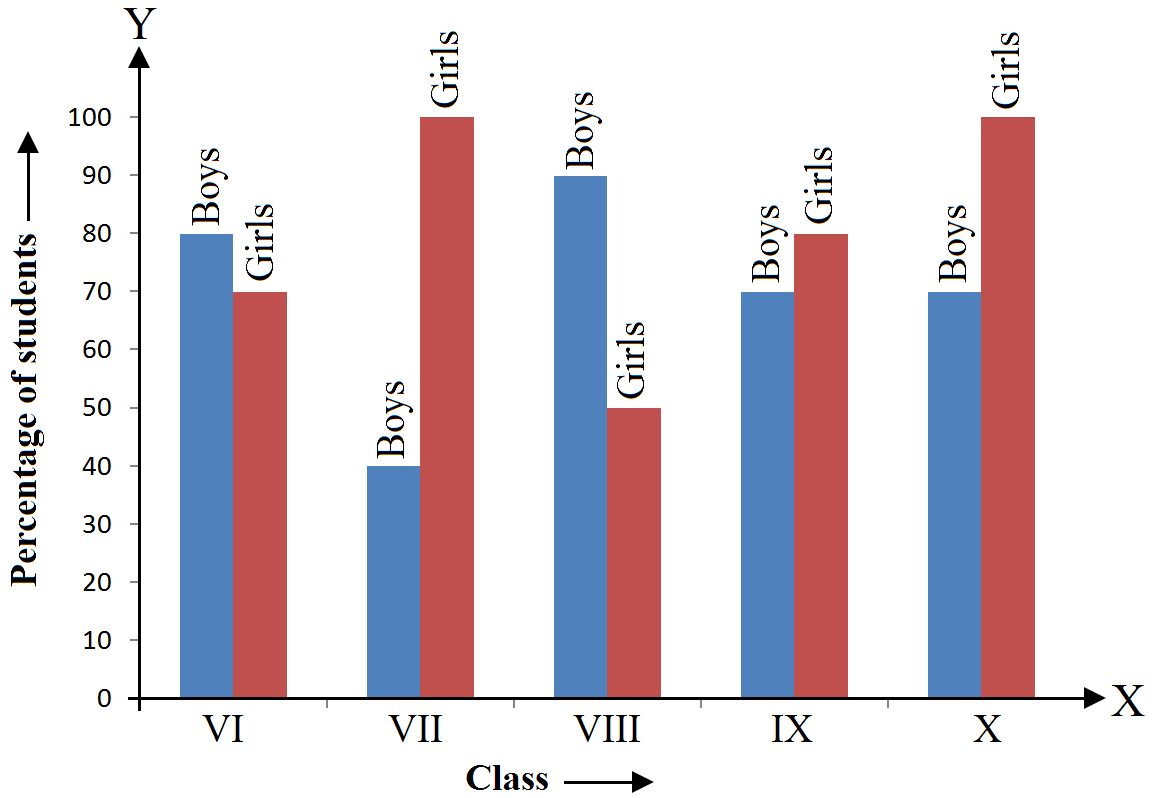
The following bar graph shows the results of an annual examination in a secondary school.
Read the bar graph and choose the correct option in each of the following.
  1. The pair of classes in which the results of boys and girls are inversely proportional are:
  1. VI, VIII
  2. VI, IX
  3. VIII, IX
  4. VIII, X
  1. The class having the lowest faliure rate of girls is:
  1. VII
  2. X
  3. IX
  4. VIII
  1. The class having the lowest pass rate of student is:
  1. VI
  2. VII
  3. VIII
  4. IX
Construct an angle of 120° and bisect it.
Using a protractor, draw an angle of measure 72°. With this angle as given, draw angles of measure 36° and 54°.
$6 \frac{1}{3}+2 \frac{1}{3}$
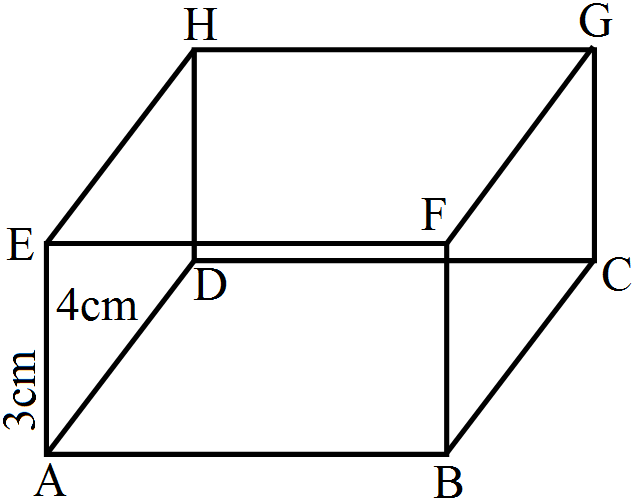
The dimensions of a cuboid with vertices A, B, C, D, E, F, G and H are as shown:


i. Which edges are of length 4 cm ? Which edges are of length 5 cm ?
ii. Which faces have area equal to $20 cm^2$ ?
iii. Which faces have the largest area? What is this largest area?
iv. Which faces have a diagonal equal to 5 cm ?
v . What is the area of the base of this cuboid?
vi. Do all the lateral faces have the same area?
Two ropes, one 8 metres long and the other 12 metres long are to be cut into pieces of the same length. What will the maximum possible length of each piece be?
Find the largest number which divides 630 and 940 leaving remainders 6 and 4 respectively.