Question
$6 \frac{1}{3}+2 \frac{1}{3}$

Answer

$\begin{aligned} & \text { i. } 6 \frac{1}{3}+2 \frac{1}{3} \\ & 6 \frac{1}{3}+2 \frac{1}{3}=\frac{6 \times 3+1}{3}+\frac{2 \times 3+1}{3} \\ & =\frac{18+1}{3}+\frac{6+1}{3} \\ & =\frac{19}{3}+\frac{7}{3} \\ & =\frac{19+7}{3} \\ & =\frac{26}{3} \\ & \therefore \quad 6 \frac{1}{3}+2 \frac{1}{3}=8 \frac{2}{3} \\ & \end{aligned}$

Need a full question paper?

Generate a complete, print-ready paper with questions like this in minutes — across 16+ boards, with answer keys.

Start Generating Free

Similar questions

$3 \frac{1}{5}+2 \frac{1}{3}$
Draw a line AB. Take a point P on it. Draw a line passing through P and perpendicular to AB.
Draw $\angle\text{ABC}$ os measure 60° such that AB = 4.5cm and BC = 5cm and BC = 5cm. Through C draw a line parallel to AB and through B draw a line parallel to AC. Intersecting each other at D. Measure BD and CD.
Complete the following table:
NumberDivide the number by 4. Is it completely divisible?The number formed by the digits in the tens and units places.Is this number divisible by 4?
99292
7314
6448
8116
7773
3024
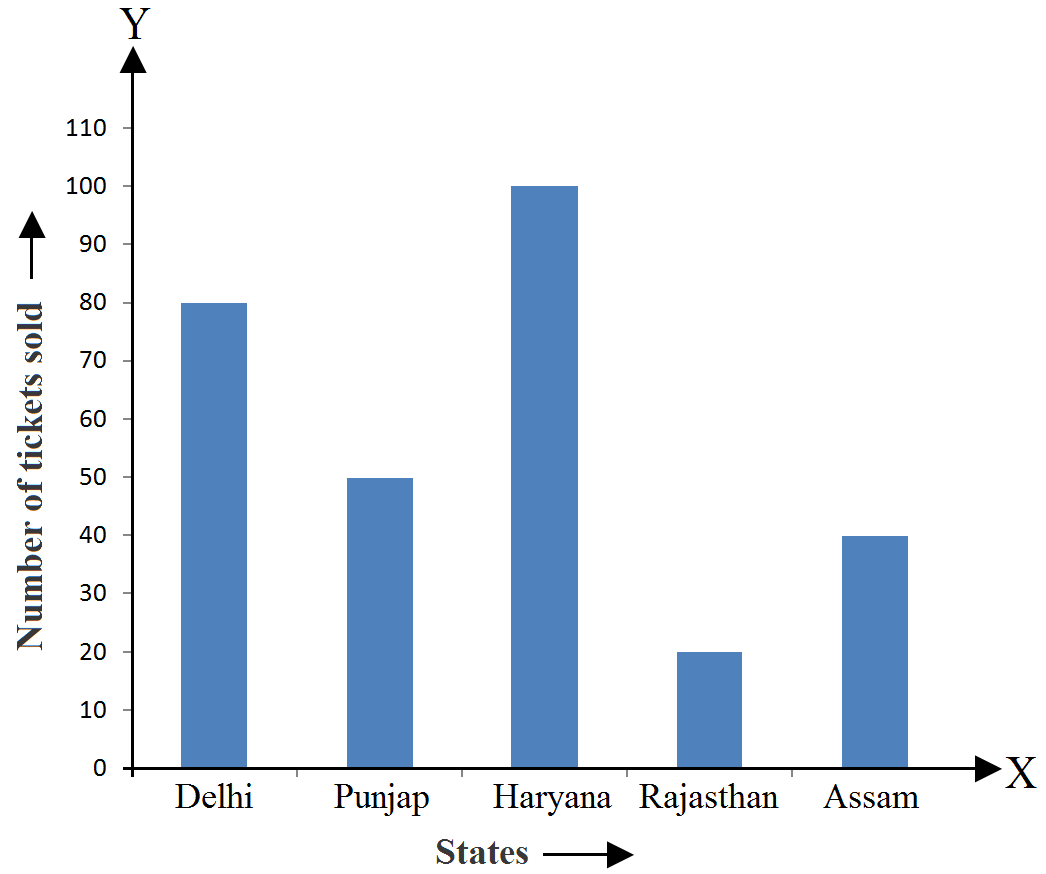
Read the bar graph shown in Fig and answer the following questions:
  1. What is the information given by the bar graph?
  2. How many tickets of Assam State Lottery were sold by the agent?
  3. Of which state, were the maximum number of tickets sold?
  4. State whether true or false.
The maximum number of tickets sold is threetimes the mlnimum number of tickets sold.
  1. Of which state were the minimum number of tickets sold?
$5 \frac{1}{2}-3 \frac{1}{3}$
Draw a line segment AB = 5.6cm. Draw the perpendicular bisector of AB.
Match the following columns on whole numbers:
S.No.
Column A
S.No.
Column B
(a)
137 + 63 = 63 + 137
(i)
Associativity of multiplication
(b)
(16 × 25) is a number
(ii)
Commutativity of multiplication
(c)
365 × 18 = 18 × 365
(iii)
Distributive law of multiplication over addition.
(d)
(d) (86 × 14) × 25 = 86 × (14 × 25)
(iv)
Commutativity of addition
(e)
23 × (80 + 5) = (23 × 80) + (23 × 5)
(v)
Closure property for multiplication
Write the reciprocals of the following numbers:
(1) 7
(2) $\frac{11}{3}$
(3) 2
(4) $\frac{6}{7}$
Draw an angle of 50° with the help of protractor. Draw a ray bisecting this angle.