Question
Construct an isosceles triangle ABC such that $\mathrm{AB}=6 \mathrm{~cm}, \mathrm{BC}=\mathrm{AC}=4 \mathrm{~cm}$. Bisect $\angle \mathrm{C}$ internally and mark a point P on this bisector such that $C P=5 \mathrm{~cm}$. Find the points which are 5 cm from $P$ and also 5 cm from the line $A B$.
Answer

Self

Need a full question paper?

Generate a complete, print-ready paper with questions like this in minutes — across 16+ boards, with answer keys.

Start Generating Free

Similar questions

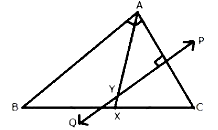
Given: AX bisects angle BAC and PQ is perpendicular bisector of AC which meets AX at point Y.

Prove: (i) X is equidistant from AB and AC.
(ii) Y is equidistant from A and C.
The mean monthly salary of $10$ members of a group is Rs.$1,445,$ one more member whose monthly salary is Rs.$1,500$ has joined the group. Find the mean monthly salary of $11$ members of the group.
Construct a triangle whose sides are 4.4 cm, 5.2 cm, and 7.1 cm. Construct its circumcircle. Write also the steps of construction.
A bus covers a distance of 240 km at a uniform speed. Due to heavy rain its speed gets reduced by 10km/h and as such it takes two hrs longer to cover the total distance. Assuming the uniform speed to be 'x' km/h, form an equation and solve it to evaluate 'x'.
Show that $A (3, -2)$ is a point of trisection of the line segment joining the points $(2, 1)$ and $(5, -8).$
Also, find the co-ordinates of the other point of trisection.
A certain number of metallic cones, each of radius $2 \ cm$ and height $3\ cm,$ are melted and recast into a solid sphere of radius $6 \ cm.$ Find the number of cones used.
A mango tree was planted $3$ years ago. The rate of growth is $20\%$ per annum. If at present, the height of the tree is $1$ m $8$ cm, how high was it when planted?
A straight line passes through $P (2,1)$ and cuts the $x$ and $y$-axis at points $A , B$ respectively. If $BP : PA =3: 1$, find :
(a) the coordinates of A and B
(b) the equation of the line AB
Sum of two natural numbers is 8 and the difference of their reciprocal is 2/15. Find the numbers.
If $a, b, c$ and $d$ are in proportion, prove that:
$
\frac{(a+c)^3}{(b+d)^3}=\frac{a(a-c)^2}{b(b-d)^2}
$