Draw a line segment AB = 3 cm. Draw the locus of a point P which moves at a distance of 5 cm from AB.
Question types
Loci question types
24 questions across 4 question groups — pick any mix to generate a Mathematics paper with step-by-step answer keys.
24
Questions
4
Question groups
5
Question types
Sample Questions
Loci questions
One sample from each question group in this chapter. Select any group above to see the full set with answer keys.
View full solution →
Draw two intersecting lines to include an angle of 30º. Use ruler and compasses to locate points which are equidistant from these lines and also 2 cm away from their point of intersection. How many such points exist?
Describe completely the locus of points in each of the following cases :
(i) mid-point of radii of a circle.
(ii) centre of a ball, rolling along a straight line on a level floor.
(iii) point in a plane equidistant from a given line.
(i) mid-point of radii of a circle.
(ii) centre of a ball, rolling along a straight line on a level floor.
(iii) point in a plane equidistant from a given line.
Construct $\angle \mathrm{ABC}=120^{\circ}$, where $\mathrm{AB}=\mathrm{BC}=5 \mathrm{~cm}$. Mark two points $\mathrm{D}, \mathrm{E}$ which satisfy both the following conditions (a) equidistant from BA and BC (b) at a distance of 5 cm from B . Point E is on the side of reflex $\angle \mathrm{ABC}$. Join $\mathrm{AE}, \mathrm{EC}$, $C D$ and $A D$. Describe the figures (i) $A E C D$ (ii) $A B D$ (iii) $A B E$.
View full solution →Construct the locus of points inside the triangle ABC, which are equidistant from B and C. Mark the point P which is equidistant from AB, BC and also equidistant from B and C.
Using ruler and compasses construct
(i) a triangle ABC in which AB = 5.5 cm, BC = 3.4 cm and CA = 4.9 cm.
(ii) the locus of points equidistant from A and C.
(iii) a circle touching AB at A and passing through C.
(i) a triangle ABC in which AB = 5.5 cm, BC = 3.4 cm and CA = 4.9 cm.
(ii) the locus of points equidistant from A and C.
(iii) a circle touching AB at A and passing through C.
Construct triangle ABC in which $\mathrm{AB}=6 \mathrm{~cm}, \mathrm{BC}=7 \mathrm{~cm}$ and $\angle \mathrm{ABC}=60^{\circ}$. Locate by construction the point P such that
(i) P is equidistant from $\mathrm{B}, \mathrm{C}$.
(ii) P is equidistant from BC and AC
(iii) Measure and record the length of PB.
View full solution →(i) P is equidistant from $\mathrm{B}, \mathrm{C}$.
(ii) P is equidistant from BC and AC
(iii) Measure and record the length of PB.
Construct an isosceles triangle ABC such that $\mathrm{AB}=6 \mathrm{~cm}, \mathrm{BC}=\mathrm{AC}=4 \mathrm{~cm}$. Bisect $\angle \mathrm{C}$ internally and mark a point P on this bisector such that $C P=5 \mathrm{~cm}$. Find the points which are 5 cm from $P$ and also 5 cm from the line $A B$.
View full solution →Construct a right angled triangle PQR such that $\mathrm{PQ}=6 \mathrm{~cm}, \mathrm{QR}=3.5 \mathrm{~cm}$ and $\angle \mathrm{PQR}=90^{\circ}$. Bisect $\angle \mathrm{P}$ internally and mark a point $Z$ on this bisector such that $P Z=4 \mathrm{~cm}$. Find the points which are 4 cm from $Z$ and also 4 cm from the line QR .
View full solution →Draw a line segment AB = 8 cm. Mark C, the mid-point of AB. Draw and describe the locus of a point which is
(a) 2 cm from AB (b) 4 cm from C. Mark the points E, F, G, H which satisfy both the above conditions.
(i) Describe the figure EFGH.
(ii) What kind of triangle is ECF?
(a) 2 cm from AB (b) 4 cm from C. Mark the points E, F, G, H which satisfy both the above conditions.
(i) Describe the figure EFGH.
(ii) What kind of triangle is ECF?
If $A$ and $B$ are fixed points, then the locus of a point, $P$ is such that $\angle A P B=90^{\circ}$ is the circle with $A B$ as :
- Adiameter
- Bradius
- Carc
- Dnone of these
The locus of a point which is equidistant from two given concentric circles of radii $r_1$ and $r_2$ is the circle of radius__________concentric with the given circles. It lies midway between them.
- A$r_1+r_2$
- B$\frac{r_1+r_2}{2}$
- C$\frac{r_1-r_2}{2}$
- D$r_1-r_2$
The locus of the __________ of all parallel chords of a circle is the diameter of the circle which is perpendicular to the given parallel chords.
- Aend points
- Bmid points
- Cpoints on the circumference
- Dnone of these
The locus of a point, which is inside a circle and is equidistant from two points on the circle, is the diameter of the circle which is __________ to the chord of the circle joining the given points.
- Aperpendicular
- Bparallel
- Cbisected
- Dnone of these
The locus of the centre of a wheel, which moves on a straight horizontal road, is a straight line parallel to the road and at a distance equal to the__________ of the wheel.
- Adiameter
- Bcircumference
- Cradius
- Dsame
Assertion (A) : In the figure, D is the mid-point of BC . If O lies on AD , then $\mathrm{OB}=\mathrm{OC}$.
Reason (R) : Every point on the perpendicular bisector of a line segment is equidistant from its end points.
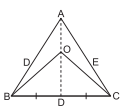
Reason (R) : Every point on the perpendicular bisector of a line segment is equidistant from its end points.
- AA is true, R is false.
- BA is false, R is true.
- ✓Both A and R are true, and R is the correct reason for A .
- DBoth A and R are true, and R is incorrect reason for A .
Answer: C.
View full solution →Assertion (A) : In the figure, $l$ is the angle bisetor of $\angle \mathrm{ABC}$. P is any point on $l$. The perpendicular distance of P from AB and BC is equal.
Reason (R) : Every point on the angle bisector of two intersecting lines is equidistant from the lines.
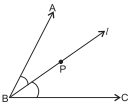
Reason (R) : Every point on the angle bisector of two intersecting lines is equidistant from the lines.
- AA is true, R is false.
- BA is false, R is true.
- ✓Both A and R are true, and R is the correct reason for A .
- DBoth A and R are true, and R is incorrect reason for A .
Answer: C.
View full solution →Generate a Loci paper free
Pick question groups from the list above, set marks and difficulty, and export a branded PDF with step-by-step answer keys. First 3 chapters free — no signup.