Question
Construct an isosceles triangle whose base is $9\ cm$ and altitude $5\ cm$. Construct another triangle whose side are $\frac34$ of the corresponding sides of the first isosceles triangle.
Answer


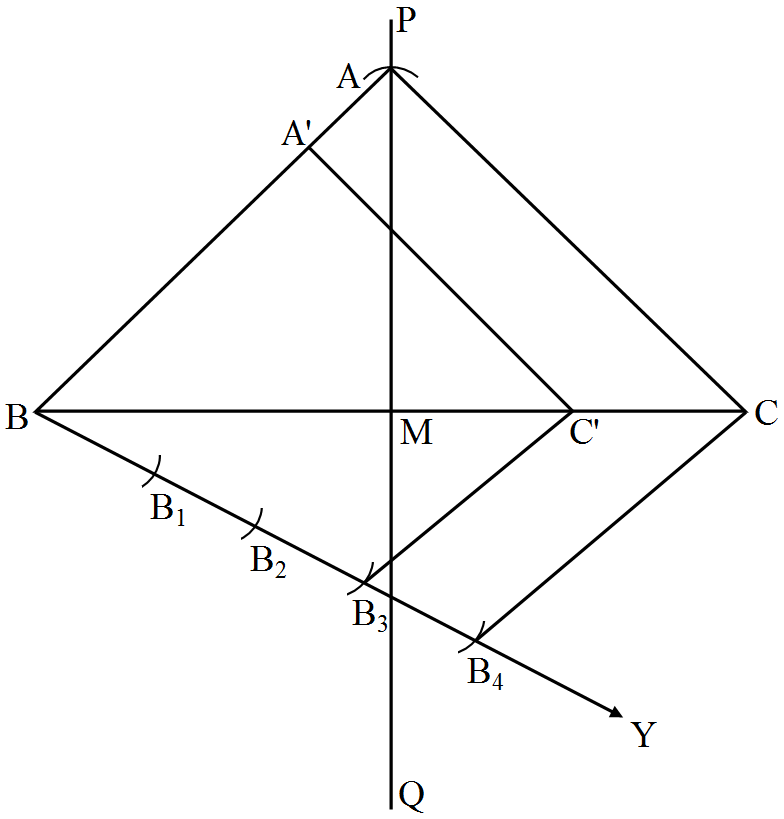
Steps of construction:
  1. Draw a line segment $BC = 9\ cm$
  2. Draw peependicular bisector $PQ$ of $BC$ Meeting it at $M.$
  3. Fron $QP$ cut-off a distance $MA = 5\ cm.$
  4. Join $AB$ and $AC.$
Thus, isosceles $\triangle\text{ABC}$ is obtained.
  1. Below $BC$, make an acute $\angle\text{CBX}.$
  2. Along $BX, $ mark off $4$ points $B_1, B_2, B_3, B_4, $ such that $BB_1, = B_1B_2 = B_1B_3 = B_3B_4.$
  3. Join $B_4C$
  4. From $B_3, $ draw $B_3C' || B_4C,$ meeting $BC $ at $C'.$
  5. From $C',$ draw $C' A' || CA$, meeting $AB$ at $A'.$
Thus, $\triangle\text{A}'\text{BC}'$ is the required triangle similar to $\triangle\text{ABC}$ Such that each side of $\triangle\text{A}'\text{BC}'$ is $\frac34\text{times}$ the corresponding side of $\triangle\text{ABC}.$

Need a full question paper?

Generate a complete, print-ready paper with questions like this in minutes — across 16+ boards, with answer keys.
Start Generating Free

Similar questions

An open metal bucket is in the shape of a frustum of a cone, mounted on a hollow cylindrical base made of the same metallic sheet. The diameters of the two circular ends of the bucket are $45\ cm$ and $25\ cm$, the total vertical height of the bucket is 40cm and that of the cylindrical base is 6cm. Find the area of the metallic sheet used to make the bucket. Also, find the volume of water the bucket can hold, in litres.
Draw a line segment $AB$ of length $5.4\ cm$. Divide it into six equal parts. Write the steps of construction.
Find the sum of the first 15 multiples of 8.
A lending library has a fixed charge for the first three days and an additional charge for each day thereafter. Mona paid ₹ 27 for a book kept for 7 days, while Tanvy paid ₹ 21 for the book she kept for 5 days. Find the fixed charge and the charge for each extra day.
If $(\tan\theta+\sin\theta)=\text{m}$ and $(\tan\theta-\sin\theta)=\text{n},$ prove that $\big(\text{m}^2-\text{n}^2\big)^2=16\text{mn}.$
Points A and B are 70km apart on a highway. A car starts from A and another car starts from B simultaneously. If they travel in the same direction, they meet in 7 hours. But, if they travel towards each other, they meet in 1 hour. Find the speed of each car.
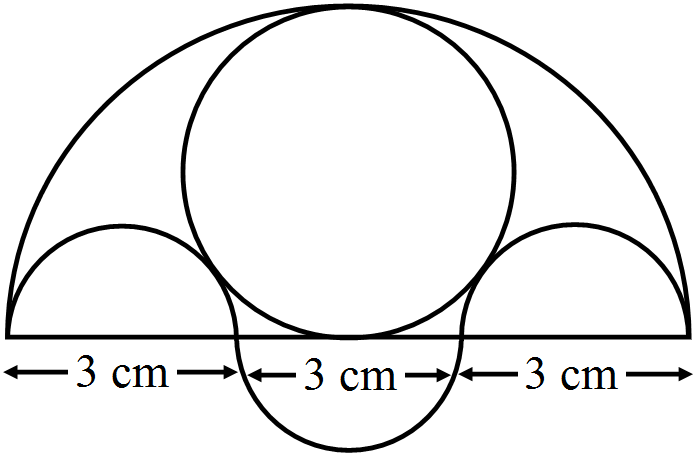
Three semicircles each of diameter 3cm, a circle of diameter 4.5,cm and a semicircle of radius 4.5cm are drawn in the given figure. Find the area of the shaded region. $\Big[\text{Use }\pi=\frac{22}{7}\Big]$
Find the mode of the following distribution:
Class interval
10-14
14-18
18-22
22-26
26-30
30-34
34-38
38-42
Frequency
8
6
11
20
25
22
10
4
In a $\triangle\text{ABC},\angle\text{B}=90^\circ,\angle\text{AB}=12\text{cm}$ and BC = 5cm.
Find:
  1. $\cos\text{A}$
  2. $\text{cosec}\text{A}$
  3. $\cos\text{C}$
  4. $\text{cosec}\text{C}.$
Solve the following systems of equations by using the method of cross multiplication:
$2ax + 3by = (a + 2b),$
$3ax + 2by = (2a + b).$