Question
If $(\tan\theta+\sin\theta)=\text{m}$ and $(\tan\theta-\sin\theta)=\text{n},$ prove that $\big(\text{m}^2-\text{n}^2\big)^2=16\text{mn}.$

Answer

We have $(\tan\theta+\sin\theta)=\text{m}$ and $(\tan\theta-\sin\theta)=\text{n}$
Now, $\text{LHS}=\big(\text{m}^2-\text{n}^2\big)^2$
$=\Big[(\tan\theta+\sin^2\theta)-(\tan\theta-\sin\theta)^2\Big]^2$
$=\Big[(\tan^2\theta+\sin^2\theta+2\tan\theta\sin\theta\\ \ \ -\big(\tan^2\theta-\sin^2\theta+2\tan\theta\sin\theta\big)\Big]^2$
$=\Big[(\tan^2\theta+\sin^2\theta+2\tan\theta\sin\theta\\ \ \ -\tan^2\theta-\sin^2\theta+2\tan\theta\sin\theta\big)\Big]^2$
$=\big(4\tan\theta\sin\theta\big)^2$
$=16\tan^2\theta\sin^2\theta$
$=16\frac{\sin^2\theta}{\cos^2\theta}\sin^2\theta$
$=16\frac{\big(1-\cos^2\theta\big)\sin^2\theta}{\cos^2\theta}$
$=16\big[\tan^2\theta\big(1-\cos^2\theta\big)\big]$
$=16\big(\tan^2\theta-\sin^2\theta\big)$
$=16(\tan\theta+\sin\theta)(\tan\theta-\sin\theta)$
$=16\text{mn}$ $\big[(\tan\theta+\sin\theta)(\tan\theta-\sin\theta)=\text{mn}\big]$
$\therefore\ \big(\text{m}^2-\text{n}^2\big)\big(\text{m}^2-\text{n}^2\big)=16\text{mn}$

Need a full question paper?

Generate a complete, print-ready paper with questions like this in minutes — across 16+ boards, with answer keys.
Start Generating Free

Similar questions

Solve the following quadratic equation:
$\frac{\text{x}-1}{\text{x}-2}+\frac{\text{x}-3}{\text{x}-4}=3\frac{1}{3},$
$\text{x}\neq2,4$
Solve the following quadratic equation:
$3^{(x+2)} + 3^{-x} = 10$
In a hospital, used water is collected in a cylindrical tank of diameter 2m and height 5m, After recycling this water is used to irrigate a park of hospital whose length is 25m and breadth is 20m. If the tank is filled completely then what will be the height of standing water used for irrigating the park? Write your views on recycling of water.
In a $\triangle\text{ABC},\ \angle\text{A}=\text{x}^\circ,$ $\angle\text{B}=(\text{3x}-2)^\circ,\ \angle\text{C}=\text{y}^\circ$ and $\angle\text{C}-\angle\text{B}=9^\circ$ Find the three angles.
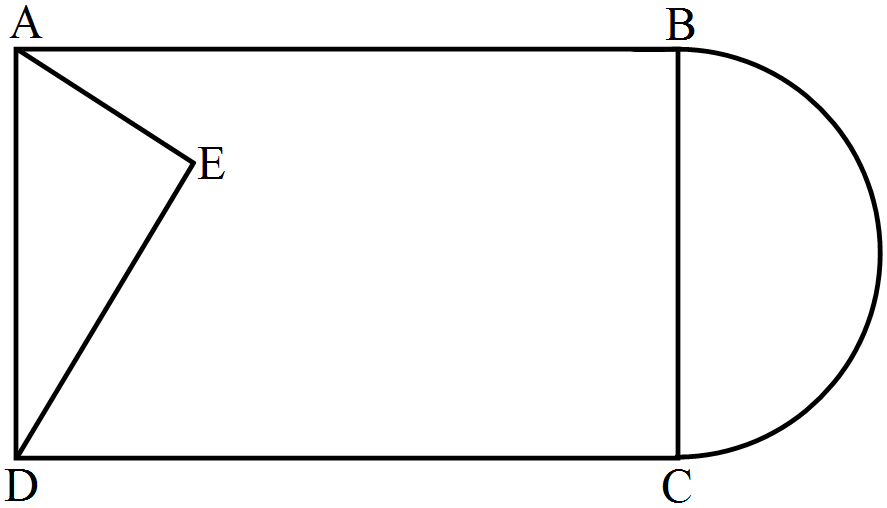
In the given figure, from a rectangular region $ABCD$ with $AB = 20cm$, a right triangle $AED$ with $AE = 9cm$ and $DE = 12cm$, is cut off. On the other end, taking $BC$ as diameter, a semicircle is added on outside the region. Find the area of the shaded region. $\big[\text{Use }\pi=3.14\big]$
In a $\triangle\text{ABC},\angle\text{B}=90^\circ$ and $\tan\text{A}=\frac{1}{\sqrt{3}}.$ Prove that:
  1. $\sin\text{A}\cdot\cos\text{C}+\cos\text{A}\cdot\sin\text{C}=1$
  2. $\cos\text{A}\cdot\cos\text{C}-\sin\text{A}\cdot\sin\text{C}=0$
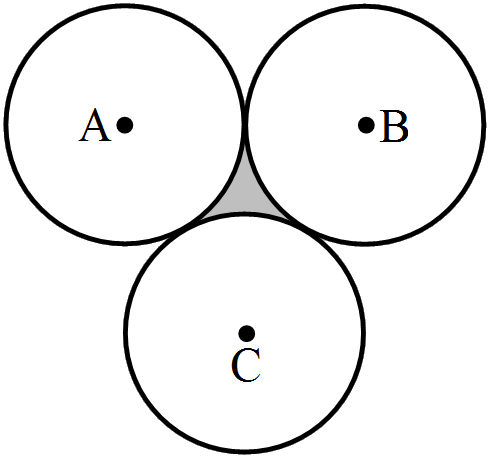
Three equal circles, each of radius 6cm, touch one another as shown in the figune. find the area enclosed between them. $\big[\text{Take }\pi=3.14\text{ and }\sqrt{3}=1.732.\big]$
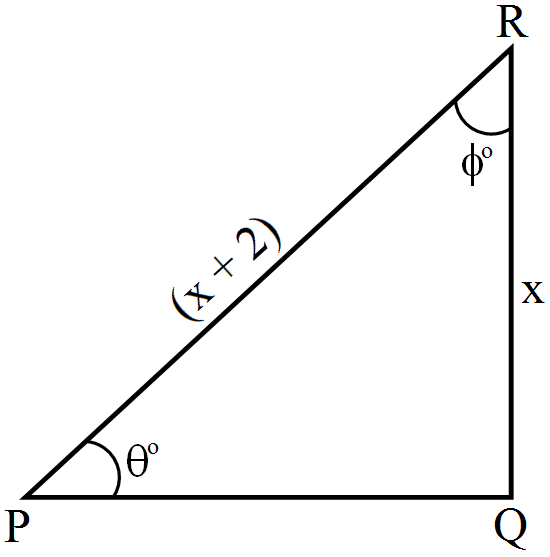
In the figure of $\triangle\text{PQR},\angle\text{P}=\theta^\circ$and $\angle\text{R}=\phi^\circ.$
Find:
  1. $\big(\sqrt{\text{x}+1}\big)\cot\phi$
  2. $\big(\sqrt{\text{x}^3+\text{x}^2}\big)\tan\theta$
  3. $\cos\theta$
The area of a rhombus is $480\ cm^2,$ and one of its diagonals measures 48cm.
Find:
  1. The length of the other diagonal.
  2. The length of each of its sides.
  3. Its perimeter.
A right triangle whose sides are 15cm and 20cm (other than hypotenuse), is made to revolve about its hypotenuse. Find the volume and surface area of the double cone so formed. (Choose value of $\pi$ as found appropriate)