Question
Construct the triangles with given measures.
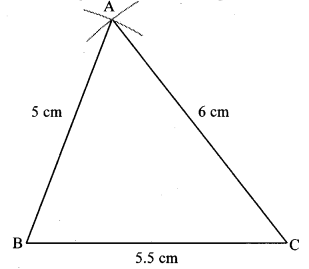
∆ABC: l(AB) = 5 cm, l(BC) = 5.5, l(AC) = 6 cm.
Answer


Image
Steps of construction :
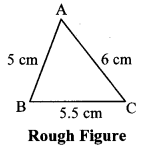
Step 1 : As shown in the rough figure, draw seg BC of length 5.5 cm as the base.
Step 2 : By taking a distance of 5 cm on the compass and placing the metal tip of the compass on point B, draw an arc on one side of BC.
Step 3 : By taking a distance 6 cm on the compass and placing the metal tip of the t compass on point C and draw an arc ’ such that it intersects the previous arc. Name the point as A.
Step 4 : Draw segments AB and AC to get the triangle. ∆ABC is the required triangle.
Image

Need a full question paper?

Generate a complete, print-ready paper with questions like this in minutes — across 16+ boards, with answer keys.

Start Generating Free

Similar questions

Construct a quadrilateral ABCD in which AB = 3.8cm, BC = 3.0cm, AD = 2.3cm, AC = 4.5cm and BD = 3.8cm.
The dimensions of a room are 12.5 m by 9 m by 7 m . There are 2 doors and 4 windows in the room each door measures 2.5 m by 1.2 m and each window 1.5 m by 1 m . Find the cost of painting the walls at Rs. 3.50 per square metre.
When two parallel lines are intersected by a transversal eight angles are formed. If the measure of one of these eight angles is given, can we find measures of remaining seven angles ?
Construct the triangles with given measures : ∆XYZ: m∠Y = 90°, l(XY) = 4.2 cm, l(XZ) = 7 cm.
Construct a quadrilateral ABCD in which BC = 7.5cm, AC = AD = 6cm, CD = 5cm and BD = 10cm.
Draw a sufficiently large ∆ABC.
Draw medians; seg AR, seg BQ and seg CP of ∆ABC.
Name the point of concurrence as G.
Measure the lengths of segments from the figure and fill in the boxes in the following table.
\begin{tabular}{|l|l|l|}
\hline$I(A G)=$ & $I(G R)=$ & $I(A G): I(G R)=$ \\
\hline$I(B G)=$ & $I(G Q)=$ & $I(B G): I(G Q)=$ \\
\hline$I(C G)=$ & $I(G P)=$ & $I(C G): I(G P)=$ \\
\hline
\end{tabular}

Observe that all of these ratios are nearly 2 : 1

Construct a quadrilateral ABCD given BC = 6.6cm, CD = 4.4cm, AD = 5.6cm and $\angle\text{C}=100^\circ$ and $\angle\text{C}=95^\circ.$
The following table shows the number of illiterate persons in the age group (10–58 years) in a town. Represent the given data by means of a histogram.
Age group (in years) 10-18 18-26
26-34
34-42
42-50
50-58
Number of illiterate persons 175 325
100
150
250
525
Hint. Take 1 small division = 5 persons.
Solve the following equation and also check your result in case:
$\Big[(2\text{x}+3)+(\text{x+5})\Big]^2+\Big[(2\text{x}+3)-(\text{x}+5)\Big]^2=10\text{x}^2+92$
The marks obtained (out of 20) by 30 students of a class in a test are given below:
7, 10, 8, 16, 13, 14, 15, 11, 18, 11, 15, 10, 7, 14, 20, 19, 15, 16, 14, 20, 10, 11, 14, 17, 13, 12, 15, 14, 16, 17.
Prepare a frequency distribution table for the above data using class intervals of equal width in which one class interval in 3-8 (including 2 and excluding 8). From the frequency distribution table so obtained, draw a histogram.