Question
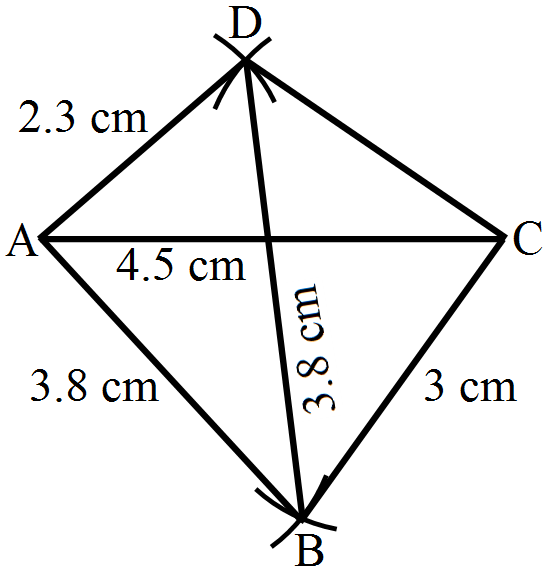
Construct a quadrilateral ABCD in which AB = 3.8cm, BC = 3.0cm, AD = 2.3cm, AC = 4.5cm and BD = 3.8cm.
Answer


Steps of construction:
Step I: Draw AC = 6cm.
Step II: With A as the centre and radius 3.8cm, draw an arc.
Step III: With C as the centre and radius 3.0cm, draw an arc to intersect the arc drawn in Step II at B.
Step IV: With B as the centre and radius 3.8cm, draw an arc on the other side of AC.
Step V: With A as the centre and radius 2.3cm, draw an arc to intersect the arc drawn in Step IV at D.
Step VI: Join BA, DA, BC and CD to obtain the required quadrilateral.

Need a full question paper?

Generate a complete, print-ready paper with questions like this in minutes — across 16+ boards, with answer keys.
Start Generating Free

Similar questions

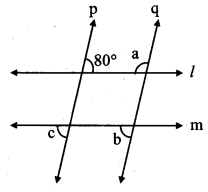
In the given figure, line p || line q, line l || line m. Find measures of ∠a, ∠b and ∠c, using the measures of given angles. Justify your answers.
Image
The sides of a rectangle are in the ratio 2 : 3 and its perimeter is 20cm. Draw the rectangle.
Write the cubes of all natural numbers between 1 and 10 and verify the following statements:
  1. Cubes of all odd natural numbers are odd.
  2. Cubes of all even natural numbers are even.
Draw a line m. Draw a line n which is parallel to line m at a distance of 4 cm from it.
In the given figure, ABCD is a trapezium in which AD || BC, $\angle\text{ABC}=90^\circ,$ AD = 16cm, AC = 41cm and BC = 40cm. Find the area of the trapezium.
If the rate of notebooks is Rs 240 per dozen, what is the cost of 3 notebooks ? Also find the cost of notebooks, 24 notebooks and 50 notebooks and complete the following table.
Number of notebooks (x)123924501
Cost (In Rupees) (y)240________2
In a parallelogram ABCD, the diagonals bisect each other at O. If $\angle\text{ABC}=30^\circ$, $\angle\text{BDC}=10^\circ$ and $\angle\text{CAB}=70^\circ$.
Find: $\angle\text{DAB},\angle\text{ADC},\angle\text{BCD},\angle\text{AOD},\angle\text{DOC},\angle\text{BOC}\\\angle\text{AOB},\angle\text{ACD},\angle\text{CAB},\angle\text{ADB},\angle\text{ACB},\angle\text{DBC}\\\text{and}\ \angle\text{DBA.}$
$\frac{7}{\text{x}}+35=\frac{1}{10}$
In ∆MORE, l(MO) = 5.8 cm, l(OR) = 4.4 cm, m∠M = 58°, m∠O = 105°, m∠R = 90°.
The breadth of a room is twice its height, one half of its length and the volume of the room is 512 cu.dm. Find its dimensions.