MCQ
Control rods used in nuclear reactors are, made of
  • A
    Stainless steel
  • B
    Graphite
  • Cadmium
  • D
    Plutonium

Answer

Correct option: C.
Cadmium
c
(c)

Need a full question paper?

Generate a complete, print-ready paper with questions like this in minutes — across 16+ boards, with answer keys.

Start Generating Free

Similar questions

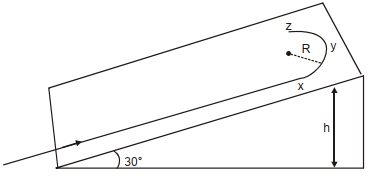
A student skates up a ramp that makes an angle $30^{\circ}$ with the horizontal. $He /$ she starts (as shown in the figure) at the bottom of the ramp with speed $v_0$ and wants to turn around over a semicircular path xyz of radius $R$ during which he/she reaches a maximum height $h$ (at point y) from the ground as shown in the figure. Assume that the energy loss is negligible and the force required for this turn at the highest point is provided by his/her weight only. Then ( $g$ is the acceleration due to gravity)

$(A)$ $v_0^2-2 g h=\frac{1}{2} g R$

$(B)$ $v_0^2-2 g h=\frac{\sqrt{3}}{2} g R$

$(C)$ the centripetal force required at points $x$ and $z$ is zero

$(D)$ the centripetal force required is maximum at points $x$ and $z$
Resonance is an example of
When light travels from air to water and from water to glass, again from glass to $C{O_2}$ gas and finally through air. The relation between their refractive indices will be given by
There are two force vectors, one of $5\, N$ and other of $12\, N $ at what angle the two vectors be added to get resultant vector of $17\, N, 7\, N $ and $13 \,N$ respectively
A horizontal overhead power line is at a height of $4\,m$ from the ground and carries a current of $100\,A$ from east to west. The magnetic field directly below it on the ground is $(\mu _0 = 4\pi \times 10^{-7}\,TmA^{-1})$
A double charged lithium atom is equivalent to hydrogen whose atomic number is $3$. The wavelength of required radiation for emitting electron from first to third Bohr orbit in $L{i^{ + + }}$ will be.......$\mathop A\limits^o $ (Ionisation energy of hydrogen atom is $13.6\,eV$)
A rod of mass $m$ and length $l$ is placed on smooth floor pivoted at its centre. A gun is mounted at one end, of mass $m$ without a shot. It fires a shot of mass $\frac{m}{{10}}$ with velocity $v$ relative to gun. The angular velocity of the rod will be
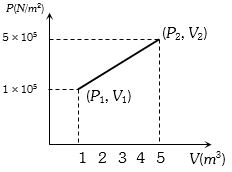
A system changes from the state $({P_1},\;{V_1})$ to $({P_2},{V_2})$ as shown in the figure. What is the work done by the system
The sum of two forces $\overrightarrow{\mathrm{P}}$ and $\overrightarrow{\mathrm{Q}}$ is $\overrightarrow{\mathrm{R}}$ such that $|\overrightarrow{\mathrm{R}}|=|\overrightarrow{\mathrm{P}}| .$ The angle $\theta$ (in degrees) that the resultant of $2 \overrightarrow{\mathrm{P}}$ and $\overrightarrow{\mathrm{Q}}$ will make with $\overrightarrow{\mathrm{Q}}$ is
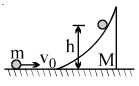
A particle of mass $m$ moving horizontally with $v_0$ strikes $a$ smooth wedge of mass $M$, as shown in figure. After collision, the ball starts moving up the inclined face of the wedge and rises to $a$ height $h$. The final velocity of the wedge $v_2$ is