Question
‘Controlling is a systematic process involving a series of steps'. Explain.

Answer

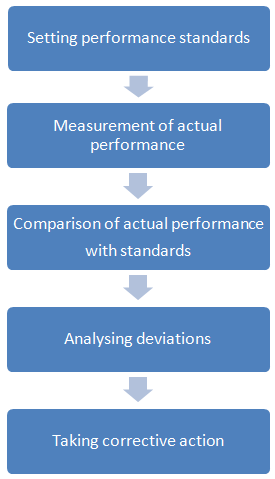
Steps in the process of controlling:
  1. Setting Performance Standards: The first step in the controlling process is setting up of performance standards. Standards are the criteria against which actual performance would be measured. Thus, standards serve as benchmarks towards which an organisation strives to work
  2. Measurement of Actual Performance: Once performance standards are set, the next step is measurement of actual performance. Performance should be measured in an objective and reliable manner. There are several techniques for measurement of performance. These include personal observation, sample checking, performance reports, etc.
  3. Comparing Actual Performance with Standards: This step involves comparison of actual performance with the standard. Such comparison will reveal the deviation between actual and desired results. Comparison becomes easier when standards are set in quantitative terms
  4. Analysing Deviations: Some deviation in performance can be expected in all activities. It is, therefore, important to determine the acceptable range of deviations. Also, deviations in key areas of business need to be attended more urgently as compared to deviations in certain insignificant areas. Critical point control and management by exception should be used by a manager in this regard.
  5. Taking Corrective Action: The final step in the controlling process is taking corrective action. No corrective action is required when the deviations are within acceptable limits. However, when the deviations go beyond the acceptable range, especially in the important areas, it demands immediate managerial attention so that deviations do not occur again and standards are accomplished.
​​​​​​​

Need a full question paper?

Generate a complete, print-ready paper with questions like this in minutes — across 16+ boards, with answer keys.

Start Generating Free

Similar questions

Distinguish between advertising and personal selling.
'Money is not the only motivator'. Then, what else is required to motivate employees? Explain.
The Director of Pico Limited decided to declare bonus issue of equity shares to the shareholders in its Annual General Meeting. Immediately one of the Director purchases 20,000 shares from market @ 30 per share and sold them @ 100 per share as bonus issue was declared and made capital gain from it.
Explain the various leadership styles.
There are two managers Bhuvan and Rajiv. Bhuvan is saying 'Controlling is forward looking' but Rajiv is saying 'Controlling is backward looking'. Who is correct? Explain why?
Explain by giving any three reasons why decentralisation is important in an organisation.
Or
It refers to systematic effort to delegate all authority to the lowest level except that which can be exercised at central points. Name it and explain its two importance.
With rapid advancements in the field of replacing manual work with machines, a Robot named 'Sujan? has been invented and developed and is likely to get the citizenship of the country of its origin.
It has led to a stage where machines are being used in place of human beings. 'Sujan’ is doing all types of work whether routine or hazardous and even answering the queries of people. However, this issue has to be carefully looked into keeping in mind the consumer attitude towards product innovations, problem of unemployment and its impact on the quality of life. Through the orders and decisions of various commissions and agencies at Centre, State or local level the Indian Government is playing a very significant role in balancing the use of human and machine power. Various dimensions of business environment are being discussed in the above para.
By quoting the lines from the above identify and explain any three dimensions.
Differentiate between formal and informal organization on the basis of the following:
  1. Meaning.
  2. Origin.
  3. Authority.
  4. Behaviour.
  5. Flow of communication.
  6. Nature.
Explain any four ways and means of consumer protection followed in India.
Explain the following techniques of scientific management:
  1. Time Study.
  2. Simplification of work.