Questions

6 Marks Question

🎯

Test yourself on this topic

36 questions · timed · auto-graded

Question 16 Marks
Explain briefly the relationship between controlling and planning.
Answer
Planning provides the goals or standards against which actual performance is measured. By comparing actual performance with some standard, managers can know whether they have actually been able to attain the goals. If there is any deviation it can be corrected. Therefore, we can say that planning is a prerequisite for controlling. The nature of corrective action required depends upon the extent of deviations from the standard. Therefore, planning provides the basis of control.
Controlling means ensuring that activities in an organisation are performed as per the plans. Controlling also ensures that an organisation’s resources are being used effectively and efficiently for the achievement of predetermined goals. Controlling is, thus, a goal-oriented function.
Relationship between planning and controlling:
  1. Controlling takes place on the basis of standards developed by planning because if the standards are not set in advance, managers have nothing to control.
  2. Planning without controlling is meaningless because once a plan becomes operational, controlling ensures that events conform to the plans.
  3. Planning is prescriptive whereas controlling is evaluative because planning prescribes an appropriate course of action while controlling evaluates whether decisions have been translated into desired actions.
  4. Planning and controlling both are forward looking because while plans are prepared for the future, controlling seeks to improve the future on the basis of the past experience.
  5. Planning and controlling are both looking back because, while planning is guided by past experiences, controlling compares the actual performance with the standards.
View full question & answer
Question 26 Marks
Explain the relationship between planning and controlling.
Answer
Relationship between planning and controlling:
  1. Planning and controlling are inseparable twins of management. A system of control presupposes the existence of certain standards. These standards of performance which serve as the basis of controlling are provided by planning. Once a plan becomes operational, controlling is necessary to monitor the progress, measure it, discover deviations and initiate corrective measures to ensure that events conform to plans. Thus, planning without controlling is meaningless.
  2. Controlling is blind without planning. If the standards are not set in advance, managers have nothing to control. When there is no plan, there is no basis of controlling. Planning is clearly a prerequisite for controlling.
  3. Planning seeks consistent, integrated and articulated programmes while controlling seeks to compel events to conform to plans.
  4. Planning is basically an intellectual process involving thinking, articulation and analysis to discover and prescribe an appropriate course of action for achieving objectives. Controlling, non the other hand, checks whether decisions have been translated into desired action. Planning is thus, prescriptive whereas, controlling is evaluative.
  5. Planning is looking ahead while controlling is looking back. However, the statement is only partially correct. Plans are prepared for future and are based on forecasts about future conditions. Therefore, planning involves looking ahead and is called a forwardlooking function.
Thus, planning and controlling are interrelated.
View full question & answer
Question 36 Marks
Describe briefly the steps in the process of controlling.
Answer
Controlling means ensuring that activities in an organisation are performed as per the plans. Controlling also ensures that an organisation’s resources are being used effectively and efficiently for the achievement of predetermined goals.
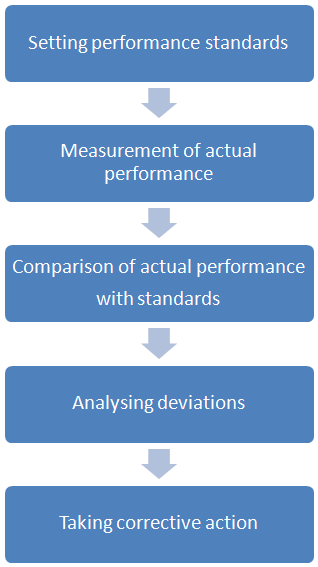
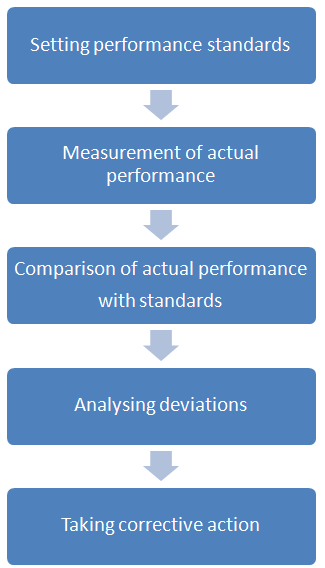
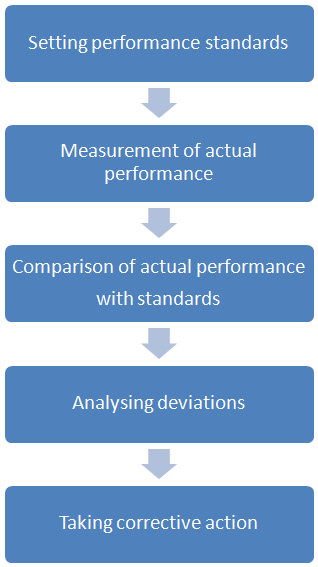
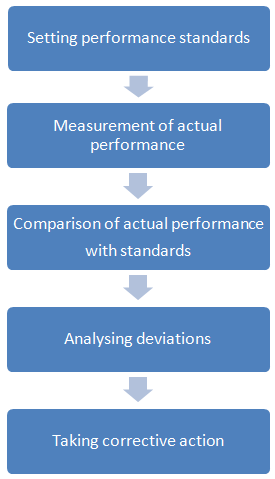
  1. Setting Performance Standards: The first step in the controlling process is setting up of performance standards. Standards are the criteria against which actual performance would be measured. Thus, standards serve as benchmarks towards which an organisation strives to work.
  2. Measurement of Actual Performance: Once performance standards are set, the next step is measurement of actual performance. Performance should be measured in an objective and reliable manner. There are several techniques for measurement of performance. These include personal observation, sample checking, performance reports, etc.
  3. Comparing Actual Performance with Standards: This step involves comparison of actual performance with the standard. Such comparison will reveal the deviation between actual and desired results. Comparison becomes easier when standards are set in quantitative terms
  4. Analysing Deviations: Some deviation in performance can be expected in all activities. It is, therefore, important to determine the acceptable range of deviations. Also, deviations in key areas of business need to be attended more urgently as compared to deviations in certain insignificant areas. Critical point control and management by exception should be used by a manager in this regard.
  5. Taking Corrective Action: The final step in the controlling process is taking corrective action. No corrective action is required when the deviations are within acceptable limits. However, when the deviations go beyond the acceptable range, especially in the important areas, it demands immediate managerial attention so that deviations do not occur again and standards are accomplished.
View full question & answer
Question 46 Marks
State the steps in the controlling process.
Answer
Controlling means ensuring that activities in an organisation are performed as per the plans. Controlling also ensures that an organisation’s resources are being used effectively and efficiently for the achievement of predetermined goals.
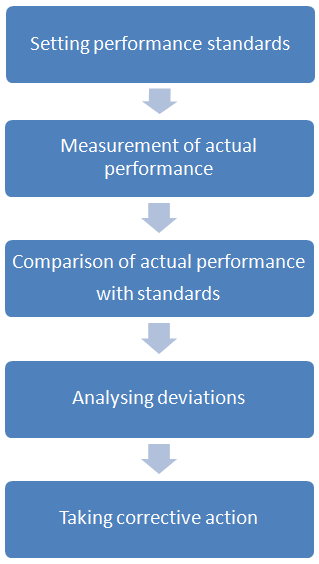
  1. Setting Performance Standards: The first step in the controlling process is setting up of performance standards. Standards are the criteria against which actual performance would be measured. Thus, standards serve as benchmarks towards which an organisation strives to work.
  2. Measurement of Actual Performance: Once performance standards are set, the next step is measurement of actual performance. Performance should be measured in an objective and reliable manner. There are several techniques for measurement of performance. These include personal observation, sample checking, performance reports, etc.
  3. Comparing Actual Performance with Standards: This step involves comparison of actual performance with the standard. Such comparison will reveal the deviation between actual and desired results. Comparison becomes easier when standards are set in quantitative terms.
  4. Analysing Deviations: Some deviation in performance can be expected in all activities. It is, therefore, important to determine the acceptable range of deviations. Also, deviations in key areas of business need to be attended more urgently as compared to deviations in certain insignificant areas. Critical point control and management by exception should be used by a manager in this regard.
  5. Taking Corrective Action: The final step in the controlling process is taking corrective action. No corrective action is required when the deviations are within acceptable limits. However, when the deviations go beyond the acceptable range, especially in the important areas, it demands immediate managerial attention so that deviations do not occur again and standards are accomplished.
View full question & answer
Question 56 Marks
What is meant by ‘Budgetary Control’? State any five advantages of Budgetary Control.
Answer
Budgetary control is a technique of managerial control in which all operations are planned in advance in the form of budgets and actual results are compared with budgetary standards to ensure accomplishment of organisational objectives.
Advantages of Budgetary control:
  1. It focuses on specific and time-bound targets leading to attainment of organisational objectives.
  2. It is a source of motivation to employees as they know the standards against which their performance will be appraised.
  3. It helps in optimum utilization of resources by proper allocation.
  4. It helps to achieve coordination among different departments of the organisation.
  5. It facilitates management by exception by stressing on those operations which significantly deviate from budgetary standards.
  6. It helps in judging accuracy of standards in the light of changes taking place in the organisation and in the environment.
View full question & answer
Question 66 Marks
What is meant by ‘Controlling’? State any five points of importance of Controlling.
Answer
Controlling is the process of ensuring that actual activities conform to planned activitiesImportance of controlling:
  1. Accomplishing organizational goals: The controlling function measures progress towards the organisational goals and brings to light the deviations, if any, and indicates corrective action.
  2. Judging accuracy of standards: A good control system enables management to verify whether the standards set are accurate and objective. An efficient control system keeps a careful check on the changes taking place in the organisation and in the environment and helps to review and revise the standards in light of such changes.
  3. Making efficient use of resources: By exercising control, a manager seeks to reduce wastage and spoilage of resources. Each activity is performed in accordance with predetermined standards and norms.
  4. Improving employee motivation: A good control system ensures that employees know well in advance what they are expected to do and what are the standards of performance on the basis of which they will be appraised.
  5. Ensuring order and discipline: Controlling creates an atmosphere of order and discipline in the organisation. It helps to minimize dishonest behaviour on the part of the employees by keeping a close check on their activities.
View full question & answer
Question 76 Marks
Explain the meaning of ‘Budgetary Control.’ Why is it considered an important technique of controlling?
Answer
Budgetary Control is a technique of managerial control in which all operations are planned in advance in the form of budgets. The actual results are compared with budgetary standards and necessary actions are taken to ensure accomplishment of organisational objectives.Budgetary control is considered an important technique of controlling because:
  1. It focuses on specific and time-bound targets.
  2. It is a source of motivation.
  3. It helps in optimum utilisation of resources by proper allocation.
  4. It helps to achieve coordination.
  5. It facilitates management by exception.
View full question & answer
Question 86 Marks
‘Controlling is a systematic process involving a series of steps'. Explain.
Answer
Steps in the process of controlling:
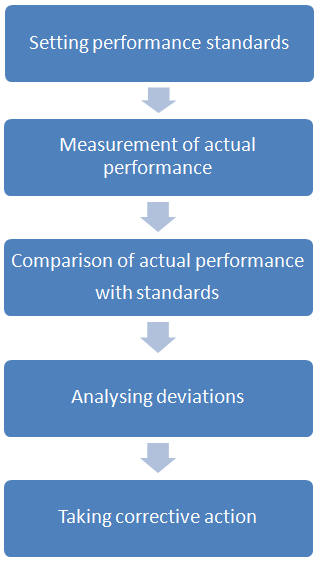
  1. Setting Performance Standards: The first step in the controlling process is setting up of performance standards. Standards are the criteria against which actual performance would be measured. Thus, standards serve as benchmarks towards which an organisation strives to work
  2. Measurement of Actual Performance: Once performance standards are set, the next step is measurement of actual performance. Performance should be measured in an objective and reliable manner. There are several techniques for measurement of performance. These include personal observation, sample checking, performance reports, etc.
  3. Comparing Actual Performance with Standards: This step involves comparison of actual performance with the standard. Such comparison will reveal the deviation between actual and desired results. Comparison becomes easier when standards are set in quantitative terms
  4. Analysing Deviations: Some deviation in performance can be expected in all activities. It is, therefore, important to determine the acceptable range of deviations. Also, deviations in key areas of business need to be attended more urgently as compared to deviations in certain insignificant areas. Critical point control and management by exception should be used by a manager in this regard.
  5. Taking Corrective Action: The final step in the controlling process is taking corrective action. No corrective action is required when the deviations are within acceptable limits. However, when the deviations go beyond the acceptable range, especially in the important areas, it demands immediate managerial attention so that deviations do not occur again and standards are accomplished.
​​​​​​​
View full question & answer
Question 96 Marks
What is meant by 'controlling'? Briefly, explain any three steps in the process of controlling.
Answer
Controlling means ensuring that activities in an organisation are performed as per the plans. Controlling also ensures that an organisation's resources are being used effectively and efficiently for the achievement of predetermined goals.Steps in the process of controlling:
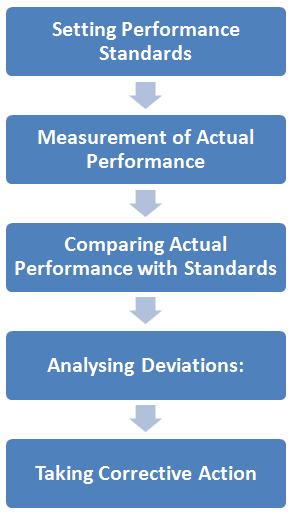
  1. Setting Performance Standards: The first step in the controlling process is setting up of performance standards. Standards are the criteria against which actual performance would be measured. Thus, standards serve as benchmarks towards which an organisation strives to work.
  2. Measurement of Actual Performance: Once performance standards are set, the next step is measurement of actual performance. Performance should be measured in an objective and reliable manner. There are several techniques for measurement of performance. These include personal observation, sample checking, performance reports, etc.
  3. Comparing Actual Performance with Standards: This step involves comparison of actual performance with the standard. Such comparison will reveal the deviation between actual and desired results. Comparison becomes easier when standards are set in quantitative terms.
  4. Analysing Deviations: Some deviation in performance can be expected in all activities. It is, therefore, important to determine the acceptable range of deviations. Also, deviations in key areas of business need to be attended more urgently as compared to deviations in certain insignificant areas. Critical point control and management by exception should be used by a manager in this regard.
  5. Taking Corrective Action: The final step in the controlling process is taking corrective action. No corrective action is required when the deviations are within acceptable limits. However, when the deviations go beyond the acceptable range, especially in the important areas, it demands immediate managerial attention so that deviations do not occur again and standards are accomplished.
View full question & answer
Question 106 Marks
‘Control is considered important for many reasons’. Explain any five such reasons.
Answer
Control is important for many reasons: Importance of controlling:
  1. Accomplishing organizational goals: The controlling function measures progress towards the organisational goals and brings to light the deviations, if any, and indicates corrective action.
  2. Judging accuracy of standards: A good control system enables management to verify whether the standards set are accurate and objective. An efficient control system keeps a careful check on the changes taking place in the organisation and in the environment and helps to review and revise the standards in light of such changes.
  3. Making efficient use of resources: By exercising control, a manager seeks to reduce wastage and spoilage of resources. Each activity is performed in accordance with predetermined standards and norms.
  4. Improving employee motivation: A good control system ensures that employees know well in advance what they are expected to do and what are the standards of performance on the basis of which they will be appraised.
  5. Facilitating Coordination in Action: Coordination among all the departments of the organisation is necessary in order to achieve the organisational objectives successfully. All the departments of the organisation are interdependent. For example, the supply of orders by the sales department depends on the production of goods by the production department.
  6. Ensuring Order and Discipline: Controlling ensures order and discipline. With its implementation, all the undesirable activities like theft, corruption, delay in work and uncooperative attitude are checked.
View full question & answer
Question 116 Marks
State any five points that highlight the importance of controlling.
Answer
  1. Accomplishing organizational goals: The controlling function measures progress towards the organisational goals and brings to light the deviations, if any, and indicates corrective action.
  2. Judging accuracy of standards: A good control system enables management to verfy whether the standards set are accurate and objective. An efficient control system keeps a careful check on the changes taking place in the organisation and in the environment and helps to review and revise the standards in light of such changes.
  3. Making efficient use of resources: By exercising control, a manager seeks to reduce wastage and spoilage of resources. Each activity is performed in accordance with predetermined standards and norms.
  4. Improving employee motivation: A good control system ensures that employees know well in advance what they are expected to do and what are the standards of performance on the basis of which they will be appraised.
  5. Ensuring order and discipline: Controlling creates an atmosphere of order and discipline in the organisation. It helps to minimize dishonest behaviour on the part of the employees by keeping a close check on their activities.
View full question & answer
Question 126 Marks
State any five points of importance of controlling function of management.
Answer
Importance of Controlling: Control is an indispensable function of management. Without control the best of plans can go awry. A good control system helps an organization in the following ways
  1. Accomplishing organizational goals: The controlling function measures progress towards the organisational goals and brings to light the deviations, if any, and indicates corrective action. It, thus, guides the organization and keeps it on the right track so that organisational goals might be achieved
  2. Judging accuracy of standards: A good control system enables management to verify whether the standards set are accurate and objective. An efficient control system keeps a careful check on the changes taking place in the organisation and in the environment and helps to review and revise the standards in light of such changes.
  3. Making efficient use of resources: By exercising control, a manager seeks to reduce wastage and spoilage of resources. Each activity is performed in accordance with predetermined standards and norms. This ensures that resources are used in the most effective and efficient manner.
  4. Improving employee motivation: A good control system ensures that employees know well in advance what they are expected ton do and what are the standards of performance on the basis of which they will be appraised. It, thus, motivates them and helps them to give better performance.
  5. Ensuring order and discipline: Controlling creates an atmosphere of order and discipline in the organisation. It helps to minimize dishonest behaviour on the part of the employees by keeping a close check on their activities. The box explains how an importexport company was able to track dishonest employees by using computer monitoring as a part of their control system.
View full question & answer
Question 136 Marks
Describe the relationship between controlling and planning.
Answer
Planning provides the goals or standards against which actual performance is measured. By comparing actual performance with some standard, managers can know whether they have actually been able to attain the goals. If there is any deviation it can be corrected. Therefore, we can say that planning is a prerequisite for controlling. The nature of corrective action required depends upon the extent of deviations from the standard. Therefore, planning provides the basis of control.Controlling means ensuring that activities in an organisation are performed as per the plans. Controlling also ensures that an organisation’s resources are being used effectively and efficiently for the achievement of predetermined goals. Controlling is, thus, a goal-oriented function.
Relationship between planning and controlling:
  1. Controlling takes place on the basis of standards developed by planning because if the standards are not set in advance, managers have nothing to control.
  2. Planning without controlling is meaningless because once a plan becomes operational, controlling ensures that events conform to the plans.
  3. Planning is prescriptive whereas controlling is evaluative because planning prescribes an appropriate course of action while controlling evaluates whether decisions have been translated into desired actions.
  4. Planning and controlling both are forward looking because while plans are prepared for the future, controlling seeks to improve the future on the basis of the past experience.
  5. Planning and controlling are both looking back because, while planning is guided by past experiences, controlling compares the actual performance with the standards.
View full question & answer
Question 146 Marks
State the relationship between ‘planning’ and ‘controlling’ functions of management.
Answer
  1. Planning and controlling are inseparable twins of management. A system of control presupposes the existence of certain standards. These standards of performance which serve as the basis of controlling are provided by planning. Once a plan becomes operational, controlling is necessary to monitor the progress, measure it, discover deviations and initiate corrective measures to ensure that events conform to plans. Thus, planning without controlling is meaningless.
  2. Controlling is blind without planning. If the standards are not set in advance, managers have nothing to control. When there is no plan, there is no basis of controlling. Planning is clearly a prerequisite for controlling.
  3. Planning seeks consistent, integrated and articulated programmes while controlling seeks to compel events to conform to plans.
  4. Planning is basically an intellectual process involving thinking, articulation and analysis to discover and prescribe an appropriate course of action for achieving objectives. Controlling, non the other hand, checks whether decisions have been translated into desired action. Planning is thus, prescriptive whereas, controlling is evaluative.
  5. Planning is looking ahead while controlling is looking back. However, the statement is only partially correct. Plans are prepared for future and are based on forecasts about future conditions. Therefore, planning involves looking ahead and is called a forwardlooking function.
Thus, planning and controlling are interrelated.
View full question & answer
Question 156 Marks
State any five points that highlight the importance of 'controlling' function of management.
Answer
Controlling means ensuring that activities in an organisation are performed as per the plans. Controlling also ensures that an organisation’s resources are being used effectively and efficiently for the achievement of predetermined goals. Controlling is, thus, a goal-oriented function.
Importance of controlling:
  1. Accomplishing organisational goals: It helps in accomplishing organisational goals by bringing to light, deviations if any and indicating corrective action.
  2. Making efficient use of resources: It helps in making efficient use of resources by ensuring that each activity is performed in accordance with pre-determined standards.
  3. Ensuring order and discipline: It ensures order and discipline among employees by keeping a close check on their activities.
  4. Improving employee motivation: It improves employee motivation as the employees’ know well in advance the standards of performance on the basis of which they will be appraised.
  5. Judging accuracy of standards: It helps in judging accuracy of standards in the light of changes taking place in the organisation and in the environment.
  6. Facilitating coordination in action: It facilitates coordination in action as each employee and department in governed by predetermined standards which are well coordinated with one another.
View full question & answer
Question 166 Marks
Explain the relationship between controlling and planning functions of management.
Answer
  1. Planning and controlling are inseparable twins of management. A system of control presupposes the existence of certain standards. These standards of performance which serve as the basis of controlling are provided by planning. Once a plan becomes operational, controlling is necessary to monitor the progress, measure it, discover deviations and initiate corrective measures to ensure that events conform to plans. Thus, planning without controlling is meaningless.
  2. Controlling is blind without planning. If the standards are not set in advance, managers have nothing to control. When there is no plan, there is no basis of controlling. Planning is clearly a prerequisite for controlling.
  3. Planning seeks consistent, integrated and articulated programmes while controlling seeks to compel events to conform to plans.
  4. Planning is basically an intellectual process involving thinking, articulation and analysis to discover and prescribe an appropriate course of action for achieving objectives. Controlling, non the other hand, checks whether decisions have been translated into desired action. Planning is thus, prescriptive whereas, controlling is evaluative.
  5. Planning is looking ahead while controlling is looking back. However, the statement is only partially correct. Plans are prepared for future and are based on forecasts about future conditions. Therefore, planning involves looking ahead and is called a forwardlooking function.
Thus, planning and controlling are interrelated.
View full question & answer
Question 176 Marks
Describe briefly the relationship between controlling and planning.
Answer
Planning provides the goals or standards against which actual performance is measured. By comparing actual performance with some standard, managers can know whether they have actually been able to attain the goals. If there is any deviation it can be corrected. Therefore, we can say that planning is a prerequisite for controlling. The nature of corrective action required depends upon the extent of deviations from the standard. Therefore, planning provides the basis of control.Controlling means ensuring that activities in an organisation are performed as per the plans. Controlling also ensures that an organisation’s resources are being used effectively and efficiently for the achievement of predetermined goals. Controlling is, thus, a goal-oriented function.
Relationship between planning and controlling:
  1. Controlling takes place on the basis of standards developed by planning because if the standards are not set in advance, managers have nothing to control.
  2. Planning without controlling is meaningless because once a plan becomes operational, controlling ensures that events conform to the plans.
  3. Planning is prescriptive whereas controlling is evaluative because planning prescribes an appropriate course of action while controlling evaluates whether decisions have been translated into desired actions.
  4. Planning and controlling both are forward looking because while plans are prepared for the future, controlling seeks to improve the future on the basis of the past experience.
  5. Planning and controlling are both looking back because, while planning is guided by past experiences, controlling compares the actual performance with the standards.
View full question & answer
Question 186 Marks
Explain the steps in the controlling process.
Answer
Controlling means ensuring that activities in an organisation are performed as per the plans. Controlling also ensures that an organisation’s resources are being used effectively and efficiently for the achievement of predetermined goals.
  1. Setting Performance Standards: The first step in the controlling process is setting up of performance standards. Standards are the criteria against which actual performance would be measured. Thus, standards serve as benchmarks towards which an organisation strives to work
  2. Measurement of Actual Performance: Once performance standards are set, the next step is measurement of actual performance. Performance should be measured in an objective and reliable manner. There are several techniques for measurement of performance. These include personal observation, sample checking, performance reports, etc.
  3. Comparing Actual Performance with Standards: This step involves comparison of actual performance with the standard. Such comparison will reveal the deviation between actual and desired results. Comparison becomes easier when standards are set in quantitative terms
  4. Analysing Deviations: Some deviation in performance can be expected in all activities. It is, therefore, important to determine the acceptable range of deviations. Also, deviations in key areas of business need to be attended more urgently as compared to deviations in certain insignificant areas. Critical point control and management by exception should be used by a manager in this regard.
  5. Taking Corrective Action: The final step in the controlling process is taking corrective action. No corrective action is required when the deviations are within acceptable limits. However, when the deviations go beyond the acceptable range, especially in the important areas, it demands immediate managerial attention so that deviations do not occur again and standards are accomplished.
View full question & answer
Question 196 Marks
Explain any four points that highlight the importance of controlling.
Answer
Importance of controlling:
  1. Accomplishing organizational goals: The controlling function measures progress towards the organisational goals and brings to light the deviations, if any, and indicates corrective action.
  2. Judging accuracy of standards: A good control system enables management to verify whether the standards set are accurate and objective. An efficient control system keeps a careful check on the changes taking place in the organisation and in the environment and helps to review and revise the standards in light of such changes.
  3. Making efficient use of resources: By exercising control, a manager seeks to reduce wastage and spoilage of resources. Each activity is performed in accordance with predetermined standards and norms.
  4. Improving employee motivation: A good control system ensures that employees know well in advance what they are expected to do and what are the standards of performance on the basis of which they will be appraised.
View full question & answer
Question 206 Marks
State the steps in the process of controlling.
Answer
Controlling means ensuring that activities in an organisation are performed as per the plans. Controlling also ensures that an organisation’s resources are being used effectively and efficiently for the achievement of predetermined goals.
  1. Setting Performance Standards: The first step in the controlling process is setting up of performance standards. Standards are the criteria against which actual performance would be measured. Thus, standards serve as benchmarks towards which an organisation strives to work.
  2. Measurement of Actual Performance: Once performance standards are set, the next step is measurement of actual performance. Performance should be measured in an objective and reliable manner. There are several techniques for measurement of performance. These include personal observation, sample checking, performance reports, etc.
  3. Comparing Actual Performance with Standards: This step involves comparison of actual performance with the standard. Such comparison will reveal the deviation between actual and desired results. Comparison becomes easier when standards are set in quantitative terms.
  4. Analysing Deviations: Some deviation in performance can be expected in all activities. It is, therefore, important to determine the acceptable range of deviations. Also, deviations in key areas of business need to be attended more urgently as compared to deviations in certain insignificant areas. Critical point control and management by exception should be used by a manager in this regard.
  5. Taking Corrective Action: The final step in the controlling process is taking corrective action. No corrective action is required when the deviations are within acceptable limits. However, when the deviations go beyond the acceptable range, especially in the important areas, it demands immediate managerial attention so that deviations do not occur again and standards are accomplished.
View full question & answer
Question 216 Marks
Explain any five points which highlight the importance of controlling function of management.
Answer
  1. Accomplishing organizational goals: The controlling function measures progress towards the organisational goals and brings to light the deviations, if any, and indicates corrective action.
  2. Judging accuracy of standards: A good control system enables management to verify whether the standards set are accurate and objective. An efficient control system keeps a careful check on the changes taking place in the organisation and in the environment and helps to review and revise the standards in light of such changes.
  3. Making efficient use of resources: By exercising control, a manager seeks to reduce wastage and spoilage of resources. Each activity is performed in accordance with predetermined standards and norms.
  4. Improving employee motivation: A good control system ensures that employees know well in advance what they are expected to do and what are the standards of performance on the basis of which they will be appraised.
  5. Ensuring order and discipline: Controlling creates an atmosphere of order and discipline in the organisation. It helps to minimize dishonest behaviour on the part of the employees by keeping a close check on their activities.
View full question & answer
Question 226 Marks
Explain the various steps in the process of controlling.
Answer
Controlling means ensuring that activities in an organisation are performed as per the plans. Controlling also ensures that an organisation’s resources are being used effectively and efficiently for the achievement of predetermined goals.Steps in the process of controlling:
  1. Setting Performance Standards: The first step in the controlling process is setting up of performance standards. Standards are the criteria against which actual performance would be measured. Thus, standards serve as benchmarks towards which an organisation strives to work.
  2. Measurement of Actual Performance: Once performance standards are set, the next step is measurement of actual performance. Performance should be measured in an objective and reliable manner. There are several techniques for measurement of performance. These include personal observation, sample checking, performance reports, etc.
  3. Comparing Actual Performance with Standards: This step involves comparison of actual performance with the standard. Such comparison will reveal the deviation between actual and desired results. Comparison becomes easier when standards are set in quantitative terms.
  4. Analysing Deviations: Some deviation in performance can be expected in all activities. It is, therefore, important to determine the acceptable range of deviations. Also, deviations in key areas of business need to be attended more urgently as compared to deviations in certain insignificant areas. Critical point control and management by exception should be used by a manager in this regard.
  5. Taking Corrective Action: The final step in the controlling process is taking corrective action. No corrective action is required when the deviations are within acceptable limits. However, when the deviations go beyond the acceptable range, especially in the important areas, it demands immediate managerial attention so that deviations do not occur again and standards are accomplished.
​​​​​​​
View full question & answer
Question 236 Marks
‘Planning and Controlling are inseparable twins of management'. How?
Answer
Planning and Controlling are inseparable twins of management: There is close and reciprocal relationship between planning and controlling because:
  1. Planning provides the basis (i.e. standards of performance) for controlling activities. If the standards are not established through planning the controlling activity cannot be performed.
  2. Controlling ensures that planned goals are achieved efficiently. It provides information about the performance level and the extent and causes of deviations, if any.
  3. Planning is incomplete without controlling and controlling ends with new plans.
  4. Planning based on facts revealed by controlling is realistic and meaningful.
  5. Planning and controlling both are forward and backward looking.
In short, planning and controlling are complimentary to each other as controlling makes planning more meaningful and planning, in turn, makes controlling more effective and purposeful.
View full question & answer
Question 246 Marks
Describe the relationship between ‘Planning’ and ‘Controlling’.
Answer
Relationship between planning and controlling:
  1. Planning and controlling are inseparable twins of management. A system of control presupposes the existence of certain standards. These standards of performance which serve as the basis of controlling are provided by planning. Once a plan becomes operational, controlling is necessary to monitor the progress, measure it, discover deviations and initiate corrective measures to ensure that events conform to plans. Thus, planning without controlling is meaningless.
  2. Controlling is blind without planning. If the standards are not set in advance, managers have nothing to control. When there is no plan, there is no basis of controlling. Planning is clearly a prerequisite for controlling.
  3. Planning seeks consistent, integrated and articulated programmes while controlling seeks to compel events to conform to plans..
  4. Planning is basically an intellectual process involving thinking, articulation and analysis to discover and prescribe an appropriate course of action for achieving objectives. Controlling, non the other hand, checks whether decisions have been translated into desired action. Planning is thus, prescriptive whereas, controlling is evaluative.
  5. Planning is looking ahead while controlling is looking back. However, the statement is only partially correct. Plans are prepared for future and are based on forecasts about future conditions. Therefore, planning involves looking ahead and is called a forwardlooking function.
Thus, planning and controlling are interrelated.
View full question & answer
Question 256 Marks
Briefly explain the importance of Controlling.
Answer
Importance of controlling:
  1. Accomplishing organizational goals: The controlling function measures progress towards the organisational goals and brings to light the deviations, if any, and indicates corrective action.
  2. Judging accuracy of standards: A good control system enables management to verify whether the standards set are accurate and objective. An efficient control system keeps a careful check on the changes taking place in the organisation and in the environment and helps to review and revise the standards in light of such changes.
  3. Making efficient use of resources: By exercising control, a manager seeks to reduce wastage and spoilage of resources. Each activity is performed in accordance with predetermined standards and norms.
  4. Improving employee motivation: A good control system ensures that employees know well in advance what they are expected to do and what are the standards of performance on the basis of which they will be appraised.
  5. Ensuring order and discipline: Controlling creates an atmosphere of order and discipline in the organisation. It helps to minimize dishonest behaviour on the part of the employees by keeping a close check on their activities.
View full question & answer
Question 266 Marks
Explain any four points highlighting the importance of controlling.
Answer
Importance of controlling
  1. Accomplishing organizational goals: The controlling function measures progress towards the organisational goals and brings to light the deviations, if any, and indicates corrective action.
  2. Judging accuracy of standards: A good control system enables management to verify whether the standards set are accurate and objective. An efficient control system keeps a careful check on the changes taking place in the organisation and in the environment and helps to review and revise the standards in light of such changes.
  3. Making efficient use of resources: By exercising control, a manager seeks to reduce wastage and spoilage of resources. Each activity is performed in accordance with predetermined standards and norms.
  4. Improving employee motivation: A good control system ensures that employees know well in advance what they are expected to do and what are the standards of performance on the basis of which they will be appraised.
  5. Ensuring order and discipline: Controlling creates an atmosphere of order and discipline in the organisation. It helps to minimize dishonest behaviour on the part of the employees by keeping a close check on their activities.
View full question & answer
Question 276 Marks
Explain the process of controlling.
Answer
Controlling means ensuring that activities in an organisation are performed as per the plans. Controlling also ensures that an organisation’s resources are being used effectively and efficiently for the achievement of predetermined goals.Steps in the process of controlling:
  1. Setting Performance Standards: The first step in the controlling process is setting up of performance standards. Standards are the criteria against which actual performance would be measured. Thus, standards serve as benchmarks towards which an organisation strives to work.
  2. Measurement of Actual Performance: Once performance standards are set, the next step is measurement of actual performance. Performance should be measured in an objective and reliable manner. There are several techniques for measurement of performance. These include personal observation, sample checking, performance reports, etc.
  3. Comparing Actual Performance with Standards: This step involves comparison of actual performance with the standard. Such comparison will reveal the deviation between actual and desired results. Comparison becomes easier when standards are set in quantitative terms
  4. Analysing Deviations: Some deviation in performance can be expected in all activities. It is, therefore, important to determine the acceptable range of deviations. Also, deviations in key areas of business need to be attended more urgently as compared to deviations in certain insignificant areas. Critical point control and management by exception should be used by a manager in this regard.
  5. Taking Corrective Action: The final step in the controlling process is taking corrective action. No corrective action is required when the deviations are within acceptable limits. However, when the deviations go beyond the acceptable range, especially in the important areas, it demands immediate managerial attention so that deviations do not occur again and standards are accomplished.
​​​​​​​
View full question & answer
Question 286 Marks
'Controlling is an indispensable function of management'. Do you agree? Give four reasons in support of your answer.
Answer
Control is an indispensable function of management. Without control the best of plans can go awr A good control system helps an organization in the following ways:
  1. Accomplishing organizational goals: The controlling function measures progress towards the organisational goals and brings to light the deviations, if any, and indicates corrective action. It, thus, guides the organization and keeps it on the right track so that organisational goals might be achieved.
  2. Judging accuracy of standards: A good control system enables management to verify whether the standards set are accurate and objective. An efficient control system keeps a careful check on the changes taking place in the organisation and in the environment and helps to review and revise the standards in light of such changes.
  3. Making efficient use of resources: By exercising control, a manager seeks to reduce wastage and spoilage of resources. Each activity is performed in accordance with predetermined standards and norms. This ensures that resources are used in the most effective and efficient manner.
  4. Improving employee motivation: A good control system ensures that employees know well in advance what they are expected to do and what are the standards of performance on the basis of which they will be appraised. It, thus, motivates them and helps them to give better performance.
View full question & answer
Question 296 Marks
What is meant by ‘Budgetary Control’? State its four advantages.
Answer
Budgetary control is a technique of managerial control in which all operations are planned in advance in the form of budgets and actual results are compared with budgetary standards. This comparison reveals the necessary actions to be taken so that organisational objectives are accomplished.Advantages of budgetary control:
  1. Budgeting focuses on specific and time-bound targets and thus, helps in attainment of organisational objectives.
  2. Budgeting is a source of motivation to the employees who know the standards against which their performance will be appraised and thus, enables them to perform better.
  3. Budgeting helps in optimum utilisation of resources by allocating them according to the requirements of different departments.
  4. Budgeting is also used for achieving coordination among different departments of an organisation and highlights the interdependence between them. For instance, sales budget cannot be prepared without knowing production programmes and schedules.
  5. It facilitates management by exception by stressing on those operations which deviate from budgeted standards in a significant way.
View full question & answer
Question 306 Marks
What is meant by ‘controlling’? Briefly, explain any three points of importance of controlling.
Answer
Controlling is the process of ensuring that actual activities conform to planned activities.Importance of controlling:
  1. Accomplishing organizational goals: The controlling function measures progress towards the organisational goals and brings to light the deviations, if any, and indicates corrective action.
  2. Judging accuracy of standards: A good control system enables management to verify whether the standards set are accurate and objective. An efficient control system keeps a careful check on the changes taking place in the organisation and in the environment and helps to review and revise the standards in light of such changes.
  3. Making efficient use of resources: By exercising control, a manager seeks to reduce wastage and spoilage of resources. Each activity is performed in accordance with predetermined standardsb and norms.
  4. Improving employee motivation: A good control system ensures that employees know well in advance what they are expected to do and what are the standards of performance on the basis of whichb they will be appraised.
  5. Ensuring order and discipline: Controlling creates an atmosphere of order and discipline in the organisation. It helps to minimize dishonest behaviour on the part of the employees by keeping a close check on their activities.
View full question & answer
Question 316 Marks
‘Planning and controlling are inter-dependent and inter-linked activities.' Explain.
Answer
Planning and controlling are interrelated and interlinked activities:
  1. Planning and controlling are inseparable twins of management. A system of control presupposes the existence of certain standards. These standards of performance which serve as the basis of controlling are provided by planning. Once a plan becomes operational, controlling is necessary to monitor the progress, measure it, discover deviations and initiate corrective measures to ensure that events conform to plans. Thus, planning without controlling is meaningless.
  2. Controlling is blind without planning. If the standards are not set in advance, managers have nothing to control. When there is no plan, there is no basis of controlling. Planning is clearly a prerequisite for controlling.
  3. Planning seeks consistent, integrated and articulated programmes while controlling seeks to compel events to conform to plans.
  4. Planning is basically an intellectual process involving thinking, articulation and analysis to discover and prescribe an appropriate course of action for achieving objectives. Controlling, non the other hand, checks whether decisions have been translated into desired action. Planning is thus, prescriptive whereas, controlling is evaluative.
  5. Planning is looking ahead while controlling is looking back. However, the statement is only partially correct. Plans are prepared for future and are based on forecasts about future conditions. Therefore, planning involves looking ahead and is called a forwardlooking function.
Thus, planning and controlling are interrelated.
View full question & answer
Question 326 Marks
Discuss the relationship between planning and controlling.
Answer
Planning and controlling are inseparable, they are twins of management. A system of control pre-supposes the existence of certain standards. These standards of performance which serve as the basis of controlling are provided by planning. Once a plan becomes operational controlling is necessary to monitor the progress, measure it, discover deviations and initiate corrective measures to ensure that events conform to plans.Planning is clearly a pre-requisite for controlling. Controlling cannot be accomplished with planning. With planning there is no pre-determined understanding of the desired performance, planning seeks consistent, integrated and articulated programmes while controlling seeks to compel events to conform to plans.
View full question & answer
Question 336 Marks
Explain the various steps involved in the process of control.
Answer
Controlling is a systematic process involving following steps:
  1. Setting Performance Standards: The first step in the controlling process is setting up of performance standards. Standards are the criteria against which actual performance would be measured. Standards can be set in both quantitative as well as qualitative terms.
Some of the qualitative standards are cost to be Incurred, product units to be produced, time to be spent in performing a task etc. Improving goodwill and motivation level of employees are examples of qualitative standards.
  1. Measurement of Actual Performance: Once performance standards are set, the next step is measurement of actual performance. Performance should be measured in an objective and reliable manner. Some of the techniques used for measuring the performance are personal observation. Sample checking performance reports etc.
  2. Comparing Actual Performance with Standards: This step involves comparison of actual performance with the standards. Such comparison will reveal the deviation between actual and desired results. Comparison becomes easier when standards are set in quantitative terms. For instance, performance of a worker In terms of units produced in a week can be easily measured against the standard output for the week.
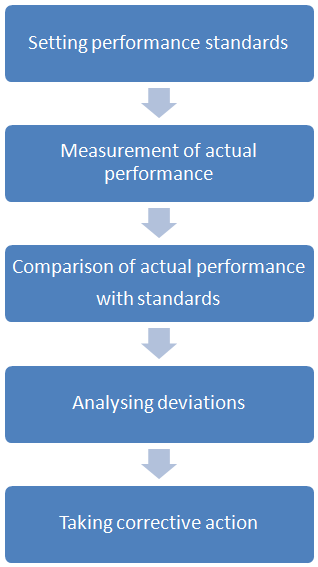
  3. Analysing Deviations: Some deviations in performance can be expected in all activities. It is therefore, important to determine the acceptable range of deviations. Also, deviations in key areas of business need to be attended more urgently as compared to deviations in certain insignificant areas. Critical point control and management by exception should be used by a manager in this regard.
  4. Taking Corrective Action: The final step in the controlling process is taking corrective action. No corrective action is required when the deviations are within acceptable limits. However, when the deviations go beyond the acceptable range. especially in the important areas. It demands immediate managerial attention so that deviations do not occur again and standards are accomplished. Incase the deviations cannot be corrected through managerial action. the standards may have to be revised.
View full question & answer
Question 346 Marks
Following are some behaviours that you and others might engage in on the job. For each item, choose the behaviour that management must keep a check to ensure an efficient control system.
  1. Biased performance appraisals.
  2. Using company’s supplies for personal use.
  3. Asking a person to violate company’s rules.
  4. Calling office to take a day off when one is sick.
  5. Overlooking boss’s error to prove loyalty.
  6. Claiming credit for someone else’s work.
  7. Reporting a violation on noticing it.
  8. Falsifying quality reports.
  9. Taking longer than necessary to do the job.
  10. Setting standards in consultation with workers.
You are also required to suggest the management how the undesirable behaviour can be controlled.
Answer
  1. Biased performance appraisal: This behaviour must be controlled. For this specific standards can be set with regard to performance. The performance can then be judged against the set standards. In this way the performance appraisal would be fair and just.
  2. Using the company supplies for personal use: This behaviour must be controlled. For this a proper record must be maintained of the supplies. The purpose and time of its use must also be recorded. In addition, action can be taken against those who found using company supplies for personal use.
  3. Asking a person to violate company rules: This behaviour must be controlled. Company rules and regulations must be communicated clearly to the employees. Also, the action that would be taken in case of violation of rules must also be made clear. The fear of adverse consequences would discourage the employees from violating company rules.
  4. Calling office to take a day off when one is sick: This is a good behaviour. The employees must inform in advance whenever there is a need to take an off. In this way his/her colleagues would be prepared to share the workload in his/her absence.
  5. Overlooking boss’s error to prove loyalty: This behaviour must be controlled. Errors committed of any kind must be reported, irrespective of the position of the person committing the error. Open and free communication must be encouraged in the organisation. Incentives can be given for providing suggestions and feedback.
  6. Claiming credit for someone else's behaviour: This behaviour must be controlled. For this the manager or the supervisor must maintain a proper record of who is given what responsibility and who is doing which task. Any incentive or appreciation must be given only after confirming properly that the person claiming the credit is actually the one who has done the task.
  7. Reporting a violation when one notices it: This is a good behaviour. Open and free communication must be encouraged in the organisation. Incentives can be given to the employees to provide suggestions and feedback.
  8. Falsifying quality reports: This behaviour must be controlled. For this a step by step analysis must be done wherein the progress and the quality of the task is examined at each step rather than only at the final step. In this way the chances of falsifying the reports would be minimised.
  9. Taking longer than usual to do jobs: This behaviour must be controlled. For this any task when given must be with a set time deadline. In case there is any deviation from the deadline the cause for it must be analysed and rectified at the earliest. Incentives can be given for completing the task within the set time deadline.
  10. Setting standards in consultation with the workers: This is a good behaviour. As the standards are set in consultation with the workers, a feeling of belongingness and responsibility is instilled in the workers. They are encouraged to follow the standards. This improves the overall efficiency and performance.
View full question & answer
Question 356 Marks
Explain the techniques of managerial control.
Answer
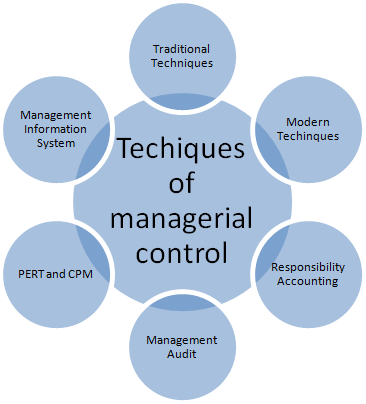
The various techniques of managerial control may be classified into broad categories:
  1. Traditional Techniques: Those techniques which have been used by the companies for a long time now are traditional techniques. However., these have not become obsolete and are still being used by companies.
  1. Personal Observation: Personal observation enables the manager to collect first hand information. It also creates a psychological pressure on the employees to perform well as they are aware that they are being observed personally in their job.
  2. Statistical Reports: Statistical analysis in the form of averages, percentages, ratios, correlation etc. Present useful information to the managers regarding performance of the organisation in various areas. Such information when presented in the form of charts, graphs, tables etc. enables the managers to read them more easily and allow a comparison to be made with performance in previous periods and also with the benchmarks.
  3. Break-even Analysis: It is a technique used by managers to study the relationship between costs, volume and profits. It determines the probable profits and losses at different levels of activity. The sales volume at which there is no profit. no loss is known as break-even point. It is a useful technique for the managers as it helps in estimating profits at different levels of activities.
  4. Budgetary Control: It is a technique of managerial control in which all operations are planned in advance in the form of budgets and actual results are compared with budgetary standards. This comparison reveals the necessary actions to be taken so that organisational goals are accomplished. A budget is a quantitative statement for a definite future period of time for the purpose of obtaining a given objective. It is also a statement which reflects the policy of that particular period. It will contain figures of forecasts both in terms of time and quantities.
  1. Modern Techniques Modern techniques of controlling are those which are of recent origin and are comparatively new in management literature. They provide a new thinking on the ways In which various aspects of an organisation can be controlled.
  1. Return on Investment: Return on Investment (ROI) is a useful technique which provides the basic yardstick for measuring whether or not invested capital has been used effectively for generating reasonable amount of return. It can be calculated as under
$\text{ROI}=\frac{\text{Net income}}{\text{Sales}}\times\frac{\text{Sales}}{\text{Total investment}}$
ROI provides top management an effective means of control for measuring and comparing performance of different departments. It also permits departmental managers to find out the problem which affects ROI in an adverse manner.
  1. Ratio Analysis: It refers to analysis of financial statements through computation of ratios. The most commonly used ratios are:
  • Liquidity Ratio: Which are calculated to determine short term solvency of business.
  • Solvency Ratios: Which are calculated to determine the long term solvency of business are known as Solvency ratios.
  • Profitability Ratio: Which are calculated to analyse the profitability position of a business.
  • Turnover Ratio: They are calculated to determine the efficiency of operations based on effective utilisation of resources.
  1. Responsibility Accounting: Responsibility accounting is a system of accounting in which different sections, divisions and departments of an organisation are set up as ‘responsibility centres’. The head of the centre is responsible for achieving the target set for his centre. Responsibility centres may be of the following types.
  1. Cost Centre: A cost or expense centre Is a segment of an organisation n which managers are held responsible for the cost Incurred in the centre but not for the revenues e.g., production department.
  2. Revenue Centre: A revenue centre is held responsible for generating revenue e.g.. marketing department.
  3. Profit Centre: A profit centre is responsible for both cost and revenue e.g., repair and maintenance department.
  4. Investment Centre: An investment centre is responsible not only for profits but also for investments made in the centre In the form of assets.
​​​​​​​
  1. Management Audit: Management audit refers to systematic appraisal of the overall performance of the management of an organisation. The purpose is to review the efficiency and effectiveness of management and to Improve its performance in future periods. It is helpful in identifying the deficiencies in the performance of management functions The main advantages are:
  1. Helps to locate weaknesses.
  2. It helps to improve control system.
  3. Ensures updating of existing managerial policies and strategies in the light of environmental changes.
  1. PERT and CPM: Programme evaluation and review technique and critical path method are important network techniques useful in planning and controlling These techniques are especially useful in planning, scheduling and Implementing time bound projects Involving performance of a variety of complex, diverse and inter-related activities These techniques deal with time scheduling and resource allocation for these activities and aims at effective execution of projects within given time schedule and structure of costs.
  2. Management Information System: MIS is a computer based Information system that provides information and support for effective managerial decision making A decision maker requires up-to-date accurate and timely information. MIS provides the required information to the managers by systematically processing a massive data generated In an organisation Thus, MIS is an important communication tool for managers.
View full question & answer
Question 366 Marks
Explain the importance of controlling in an organisation. What are the problems faced by the organisation in implementing an effective control system?
Answer
Control is an indispensable function of management Without control the best of plans can go away. A good control system helps an organisation in the following way.
  1. Accomplishing Organisational Goals: The controlling function measures progress towards the organisational goals and brings to light the deviations If any and indicates corrective action. It thus, guides the organisation and keeps it on the right track so that organisational goals might be achieved.
  2. Judging Accuracy of Standards: A good control system enables management to verify whether the standards set are accurate and objective an efficient control system keeps a careful check on the changes taking place in the organisation and in the environment and helps to review and revise the standards in light of such changes.
  3. Making Efficient Use of Resources: By exercising control a manager seeks to reduce wastage and spoilage of resources. Each activity is performed in accordance with pre-determined standards and norms. This ensures that resources are used in the most efficient and effective manner.
  4. Improving Employee Motivation: A good control system ensures that employees know well in advance what they are expected to do and what are the standards of performance on the basis of which they will be appraised. It, thus motivates them and helps them to give better performance.
  5. Ensuring Order and Discipline: Controlling creates an atmosphere of order and discipline In the organisation It helps to minimise dishonest behaviour on the part of the employees by keeping a close check on their activities.
  6. Facilitating Co-ordination in Action: Controlling provides direction to ai’ activities and efforts for achieving organisational goals Each department implemented employee is governed by pre-determined standards which are well co-ordination with one another This ensures that overall organizational objectives are accomplished.
Although controlling is an important function of management. It suffers from the following limitations also.
  1. Difficulty in Setting Quantitative Standards: Control system loses some of its effectiveness when standards cannot be defined in quantitative terms. This makes measurement of performance and their comparison with standards a difficult task. Employee morale, job satisfaction and human behaviour are such areas where this problem might arise.
  2. Little Control on External Factors: Generally an enterprise cannot control external factors such as government policies, technological changes competition etc.
  3. Resistance from Employees: Control is offer resisted by employees. They see it as a restriction on their freedom. For instance, employees might object when they are kept under a strict watch with the help of Closed Circuit Televisions (CCTVs).
  4. Costly Affair: Control is a costly affair as It Involves a lot of expenditure, time and effort. A small enterprise cannot afford to install an expensive control system. It cannot justify the expenses involved. Managers must ensure that the costs of installing and operating a control system should not exceed the benefits derived from it.
View full question & answer
6 Marks Question - Business Studies STD 12 Commerce Questions - Vidyadip