MCQ
Conventional flow of current will always be from:
  • $p$ type $\rightarrow n$ type
  • B
    $n$ type $\rightarrow p$ type
  • C
    $n$ Type $\rightarrow n$ type
  • D
    None of these

Answer

Correct option: A.
$p$ type $\rightarrow n$ type
The holes in the covalent bonds of $p-$type semiconductor. They appear to move towards $n-$type semiconductor. Because the electrons in the covalent bonds of $n-$type semiconductor $($not free electrons$)$ jump towards $p-$type semiconductor due to plenty of holes available in the covalent bonds at $p-$side.
Hence, conventional current flow from $p-$type to $n-$type.

Need a full question paper?

Generate a complete, print-ready paper with questions like this in minutes — across 16+ boards, with answer keys.
Start Generating Free

Similar questions

The output form of a full wave rectifier is
A milliammeter of range 10 mA has a coil of resistance 1 W. To use it as voltmeter of range 10 volt, the resistance that must be connected in series with it, will be
When a current passes through a wire whose different parts are maintained at different temperatures, evolution or absorption of heat all along the length of wire is known as
Tesla is a unit for measuring
A metal target with atomic number $Z=46$ is bombarded with a high energy electron beam. The emission of $X$-rays from the target is analyzed. The ratio $r$ of the wavelengths of the $K_\alpha$-line and the cut-off is found to be $r=2$. If the same electron beam bombards another metal target with $Z=41$, the value of $r$ will be
Two bulbs of $(40 \;W, 200\; V)$ and $(100\; W, 200 \;V)$. Then correct relation for their resistance
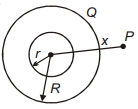
Two concentric hollow conducting spheres of radius $r$ and $R$ are shown. The charge on outer shell is $Q$. What charge should be given to inner sphere so that the potential at any point $P$ outside the outer sphere is zero?
When the light source is kept 20 cm away from a photo cell, stopping potential 0.6 V is obtained. When source is kept 40 cm away, the stopping potential will be
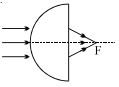
$A$ paraxial beam is incident on a glass $(n = 1.5)$ hemisphere of radius $R = 6\, cm$ in air as shown. The distance of point of convergence $F$ from the plane surface of hemisphere is......$cm$
A signal of $100 \,THz$ frequency can be transmitted with maximum efficiency by