MCQ
Cooling law is based upon
  • A
    Plank's law
  • B
    Prevost law
  • Kirchoff's law
  • D
    Kirchoff's law

Answer

Correct option: C.
Kirchoff's law
c

Need a full question paper?

Generate a complete, print-ready paper with questions like this in minutes — across 16+ boards, with answer keys.
Start Generating Free

Similar questions

In Vander Waals equation $\left[ P +\frac{ a }{ V ^{2}}\right][ V - b ]= RT$; $P$ is pressure, $V$ is volume, $R$ is universal gas constant and $T$ is temperature. The ratio of constants $\frac{a}{b}$ is dimensionally equal to .................
A block of mass m is placed on a smooth wedge of inclination 0. The whole system is accelerated horizontally so that the block does not slip on the wedge. The force exerted by the wedge on the block has a magnitude:
The acceleration vector of a particle in uniform circular motion averaged over the cycle is a null vector. This statement is
For a heat engine the heat taken from the hot source is $Q_1$. So,
Two waves are propagating along a taut string that coincides with the $x-$axis. The first wave has the wave function $y_1 = A cos [k(x - vt)]$ and the second has the wave function $y = A cos [k(x + vt) + \phi ]$.
The $K.E.$ and $P.E.$ of a particle executing $SHM$ with amplitude $A$ will be equal when its displacement is
Two bodies $A$ (of mass $1\,kg$) and $B$ (of mass $3\,kg$) are dropped from heights of $16\,m$ and $25\,m$ respectively . The ratio of the time taken by them to reach the ground is 
A missile is fired for maximum range at your town from a place $100\, km$ away from you. If the missile is first detected at its half way point, how much warning time will you have ? (Take $g = 10\, m/s ^2$) the maximum height of the missile is
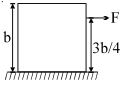
$A$ uniform cube of side $‘b’$ and mass $M$ rest on a rough horizontal table.$ A$ horizontal force $F$ is applied normal to one of the face at $a$ point, at $a$ height $3b/4$ above the base. What should be the coefficient of friction $(\mu )$ between cube and table so that is will tip about an edge before it starts slipping? 
Absolute zero $(0\, K)$ is that temperature at which