MCQ
Absolute zero $(0\, K)$ is that temperature at which
  • A
    Matter ceases to exist
  • B
    Ice melts and water freezes
  • Volume and pressure of a gas becomes zero
  • D
    None of these

Answer

Correct option: C.
Volume and pressure of a gas becomes zero
c
(c) We know that $P = {P_0}(1 + \gamma t)$ and $V = {V_0}(1 + \gamma t)$

and $\gamma = (1/273)/^\circ C$for $t = - 273^\circ C$, we have $P = 0$ and $V = 0$

Hence, at absolute zero, the volume and pressure of the gas become zero.

Need a full question paper?

Generate a complete, print-ready paper with questions like this in minutes — across 16+ boards, with answer keys.
Start Generating Free

Similar questions

A resonating column has resonant frequencies as $100Hz, 300Hz, 500Hz.$ Then it may:
The magnitudes of vectors $\vec A,\,\vec B$ and $\vec C$ are $3, 4$ and $5$ units respectively. If $\vec A + \vec B = \vec C$, the angle between $\vec A$ and $\vec B$ is
Four solids are shown in cross section. The sections have equal heights and equal maximum widths. They have the same mass. The one which has the largest rotational inertia about a perpendicular through the centre of mass is 
Standing stationary waves can be obtained in an air column even if the interfering waves are
The ratio of work done by an ideal monoatomic gas to the heat supplied to it in an isobaric process is
Train A is moving along two parallel rail tracks towards north with speed $72 \mathrm{~km} / \mathrm{h}$ and train B is moving towards south with speed $108 \mathrm{~km} / \mathrm{h}$. Velocity of train $B$ with respect to $A$ and velocity of ground with respect to $B$ are (in $\mathrm{ms}^{-1}$ ):
In which form, the energy is stored in a fuel?
A parachutist after bailing out falls $20\,\,m$ without friction. When parachute opens, it decelerates at $2\,\,m/s^2.$  He reached the ground with a speed with a speed of $4\,\,m/s.$  At what height, did he bail out ?......$m$
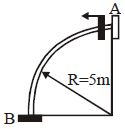
A bead of mass $\frac {1}{2}\,kg$ starts from rest from $A$ to move in a vertical plane along a smooth fixed quarter ring of radius $5\,m$, under the action of a constant horizontal force $F = 5\,N$ as shown. The speed of bead as it reaches the point $B$ is ................ $\mathrm{m}/ \mathrm{s}$ [Take $g = 10\,m/s^2$ ]
A body is falling freely under the action of gravity alone in vacuum. Which of the following quantities remain constant during the fall?