Question
Copper(I) compounds are white and are dimagnetic. While copper(II) compounds are coloured and paramagnetic, explain.

Answer

The electronic configuration of $Cu ^{+}( Z =28)$ is $1 s^2, 2 s^2 2 p^6, 3 s^2 3 p^6 3 d^{10}$, i.e., all orbitals are completely filled so it is dimagnetic in nature and form white compounds. The electronic configuration of $Cu ^{2+}( Z =27)$ is $1 s^2, 2 s^2 2 p^6, 3 s^2 3 p^6 3 p^9$ so it has 1 unpaired electron. Hence it is paramagnetic in nature and form coloured compounds.

Need a full question paper?

Generate a complete, print-ready paper with questions like this in minutes — across 16+ boards, with answer keys.
Start Generating Free

Similar questions

How is it that several transition metal act as catalysts ? Give two examples of reactions catalysed by them ?
If $6 \times 10^{20}$ electron are used in reduction of an ion to form an atom, then find the equivalent of the ion.
Aniline is a weaker base than ethyl amine. Explain.
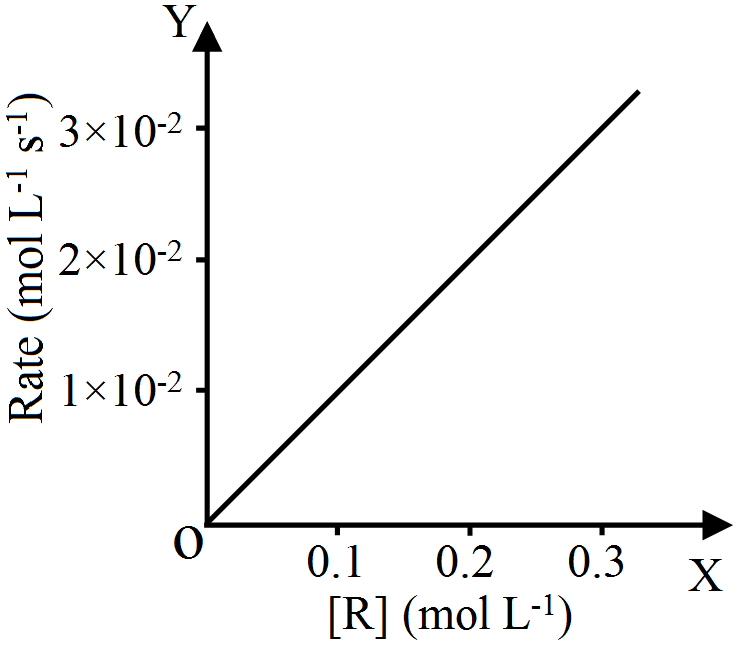
The rate for the reaction $R\rightarrow P$ is rate $= k[R]$. It has been shown graphically below. What is rate constant for the reaction?
Haloarenes are less reactive than haloalkanes and haloalkenes. Explain.
Note: In the following questions a statement of assertion followed by a statement of reason is given. Choose the correct answer out of the following choices.
  1. Both assertion and reason are true and the reason is the correct explanation of assertion.
  2. Both assertion and reason are true and the reason is not the correct explanation of assertion.
  3. Assertion is true but the reason is false.
  4. Both assertion and reason are false.
  5. Assertion is false but reason is true.
Assertion: Mercury cell does not give steady potential.
Reason: In the cell reaction, ions are not involved in solution.
When $\ce{MnO_2}$ is fused with $\ce{KOH}$ in the presence of $\ce{KNO}_3$ as an oxidizing agent, it gives a dark green compound $(A)$. Compound $(A)$ disproportionates in acidic solution to give purple compound $(B)$. An alkaline solution of compound $(B)$ oxidises $KI$ to compound $(C)$ whereas an acidified solution of compound $(B)$ oxidises $KI$ to $(D)$. Identify $(A), (B), (C),$ and $(D).$
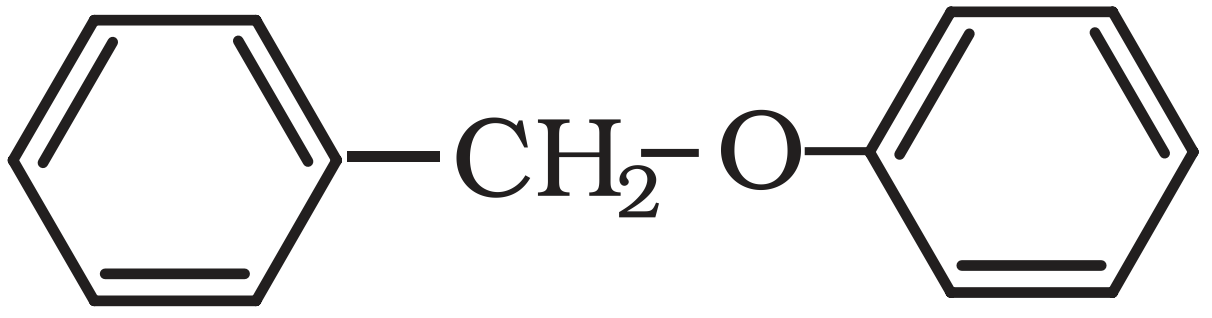
Give the major products that are formed by heating each of the following ethers with HI.
Explain the preparation of aldehydes and ketones by oxidation of alcohols with suitable examples.
Predict all the alkenes that would be formed by dehydrohalogenation of the halides with sodium ethoxide in ethanol and identify the major alkene :
1-Bromo-1-methylcyclohexane