Question
Correct relation for triode is

Answer

Electrostatic shielding theory shows that the electrostatic field in the vicinity of the cathode of a triode is proportional to $\left( E _{ c }+ E _{ b }\right) / \mu$, where $E _{ c }$ and $E _{ b }$ are the grid and anode voltages respectively.

Correct relation for triode is $\mu= g _{ m } \times r _{ p }$

Need a full question paper?

Generate a complete, print-ready paper with questions like this in minutes — across 16+ boards, with answer keys.

Start Generating Free

Similar questions

A shell is fired vertically upwards with a velocity $v_1$ from a trolley moving horizontally with velocity $v_2$. A person on the ground observes the motion of the shell as a parabola, whose horizontal range is ....
The condition for a uniform spherical mass $m$ of radius $r$ to be a black hole is [$G=$ gravitational constant and $g=$ acceleration due to gravity]
A particle moves in one dimensional field with total mechanical energy $E$ . If potential energy of particle is $V(x)$ , then
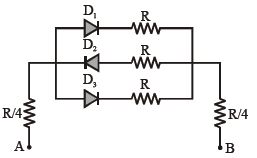
In the following circuits $PN$ -junction diodes $D_1, D_2$ and $D_3$ are ideal for the  following potential of $A$ and $B$, the correct increasing order of resistance between $A$ and $B$ will be

$(i)\, -10\,V, -5\,V$
$(ii)\, -4\,V, -12\,V$
A body projected vertically from the earth reaches a height equal to earth's radius before returning to the earth. The power exerted by the gravitational force is greatest
An artificial satellite revolves around a planet for which gravitational force $(F)$ varies with distance $r$ from its centre as $F \propto r^2$. If $v_0$ its orbital speed, then
A fixed volume of iron is drawn into a wire of length $L.$ The extension $x$ produced in this wire by a constant force $F$ is proportional to
A particle, moving with uniform speed $v$, changes its direction by angle $\theta$ in time $t$. Magnitude of its average acceleration during this time is
A body of mass $200\,gram$ is moving along $XY$ plane. Work performed by the force given by $\vec F = (2x\hat i + y\hat j)$ acting on it when the body gets displaced from $(0, 0)$ to $(1, 2)$ will be equal to ............... $\mathrm{unit}$
A uniform thin wooden plank $A B$ of length $L$ and mass $M$ is kept on a table with its $B$ end slightly outside the edge of the table. When an impulse $J$ is given to the end $B$, the plank moves up with centre of mass rising a distance $h$ from the surface of the table. Then,