MCQ
A particle moves in one dimensional field with total mechanical energy $E$ . If potential energy of particle is $V(x)$ , then
  • A
    Particle has zero speed where $V(x) = 0$
  • B
    Particle has zero acceleration where $V(x) = E$
  • C
    Particle has zero velocity where $\frac{{dV(x)}}{{dx}} = 0$
  • Particle has zero acceleration where $\frac{{dV(x)}}{{dx}} = 0$
Answer

Correct option: D.
Particle has zero acceleration where $\frac{{dV(x)}}{{dx}} = 0$
d

Need a full question paper?

Generate a complete, print-ready paper with questions like this in minutes — across 16+ boards, with answer keys.

Start Generating Free

Similar questions

Two identical particles each of mass $m$ go round a circle of radius $a$ under the action of their mutual gravitational attraction. The angular speed of each particle will be
When a glass rod is rubbed with silk, it
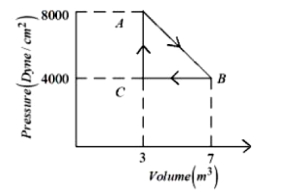
A thermodynamic system is taken from an original state $A$ to an intermediate state $B$ by a linear process as shown in the figure. It's volume is then reduced to the original value from $B$ to $C$ by an isobaric process. The total work done by the gas from $A$ to $B$ and $B$ to $C$ would be :
$\begin{matrix}
   O\,\,\,\,\,\,\,\,\,\,\,\,\,\,\,\,\,\,\,\,\,\,  \\
   ||\,\,\,\,\,\,\,\,\,\,\,\,\,\,\,\,\,\,\,\,\,\,  \\
   R-C-R\underset{(catalyst)}{\overset{HCN}{\longleftrightarrow}}  \\
\end{matrix}\begin{matrix}
   \,\,\,\,\,OH  \\
   |  \\
   R-C-R  \\
   |  \\
   \,\,\,\,CN  \\
\end{matrix}$

Which of following can be used as a catalyst in the above reaction?

The limiting friction between two bodies in contact is independent of
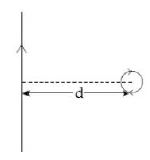
An infinitely long current carrying wire and a small current carrying loop are in the plane of the paper as shown. the radius of the loop is $a$ and distance of its centre from the wire is $d (d >> a)$. If the loop applies a force $F$ on the wire then
A particle of mass $m$ is at rest at the origin at time $t = 0$. It is subjected to a force $F(t) = F_0e^{-bt}$ in the $x$ -direction. Its speed $v(t)$ is depicted by which of  the  following curves ?
Two block of masses $10\,kg$ and $4\,kg$ are connected by a spring of negligible mass  and placed on a frictionless horizontal surface. An impulse gives a velocity of $14\, m/s$ to  the heavier block in the direction of the lighter block. The velocity of the centre of mass is ........ $m/s$.
In a triode amplifier, the value of maximum gain is equal to
A ray of monochromatic light suffers minimum deviation of ${38^o}$ while passing through a prism of refracting angle ${60^o}$. Refractive index of the prism material is