MCQ
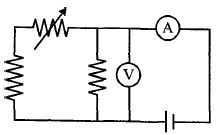
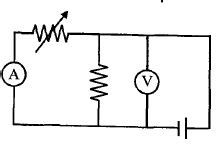
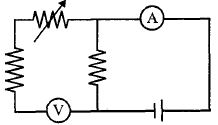
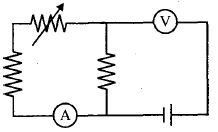
Correct set up to verify Ohm's law is

  • B

  • C

  • D

Answer

Correct option: A.

a
In ohm's law, we check $\mathrm{V}=$ $IR$ where $I$ is the corrent flowing through a resistor and $V$ is the potential difference across that resistor.

Only option $(a)$ fits the above criteria.

Remember that ammeter is connected in scries with resistance and vditmeter parallel with the resistance.
Need a full question paper?

Generate a complete, print-ready paper with questions like this in minutes — across 16+ boards, with answer keys.
Start Generating Free

Similar questions

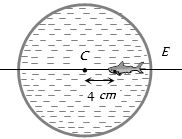
In a thin spherical fish bowl of radius $10 \,cm$ filled with water of refractive index $\left( {\mu = \frac{4}{3}} \right)$ there is a small fish at a distance of $4\, cm$ from the centre $C$ as shown in figure. Where will the image of fish appears, if seen from $E$.....$cm$
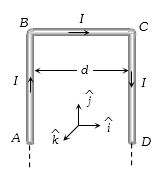
$AB$ and $CD$ are long straight conductor, distance $d$ apart, carrying a current $I$. The magnetic field at the midpoint of $BC$ is
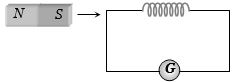
As shown in the figure, a magnet is moved with a fast speed towards a coil at rest. Due to this induced electromotive force, induced current and induced charge in the coil is $E,\;I$ and $Q$ respectively. If the speed of the magnet is doubled, the incorrect statement is
Two rods of same material and length have their electric resistance in ratio $1:2$. When both rods are dipped in water, the correct statement will be
A $10\,\mu F$ capacitor is charged to a potential difference of $1000\, V$. The terminals of the charged capacitor are disconnected from the power supply and connected to the terminals of an uncharged $6\, \mu F$ capacitor. What is the final potential difference across each capacitor?......$V$
The angle between the earth's magnetic and the earth's geographical axes is
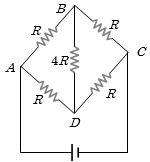
Five resistors of given values are connected together as shown in the figure. The current in the arm $BD$ will be
Energy per unit volume for a capacitor having area $A$ and separation $d$ kept at potential difference $V$ is given by
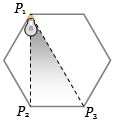
A light source is located at ${P_1}$ as shown in the figure. All sides of the polygon are equal. The intensity of illumination at ${P_2}$ is ${I_0}$. What will be the intensity of illumination at ${P_3}$
At what angle of incidence, the light reflected from a glass slab will become completely polarised, if the angle of refraction at that incident angle is $33.6^o$?.......$^o$