MCQ
Coulomb force and gravitational force follows the:
- AConservation law.
- BInverse square law.
- CBoth a and b.
- DNone.
Generate a complete, print-ready paper with questions like this in minutes — across 16+ boards, with answer keys.
A metal rod moves at a constant velocity in a direction perpendicular to its length. A constant uniform magnetic field exists in space in a direction perpendicular to the rod as well as its velocity. Select the correct statement(s) from the following
|
(a) The entire rod is at the same electric potential |
|
(b) There is an electric field in the rod |
|
(c) The electric potential is highest at the centre of the rod and decreases towards its ends |
|
(d) The electric potential is lowest at the centre of the rod and increases towards its ends |
In the shown arrangement of the experiment of the meter bridge if AC corresponding to null deflection of galvanometer is x, what would be its value if the radius of the wire AB is doubled
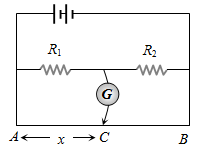
|
(a) x |
(b) x/4 |
(c) 4x |
(d) 2x |
$\text{n}_\text{p}\neq\text{n}_\text{e}$
Critical angle for light going from medium (i) to (ii) is q. The speed of light in medium (i) is v then speed in medium (ii) is
|
(a) v(1- cosθ) |
(b) v/sinθ |
(c) v/cosθ |
(d) v(1- sinθ) |
The energy of electron in the nth orbit of hydrogen atom is expressed as  . The shortest and longest wavelength of Lyman series will be
| (a) 910 Å, 1213 Å | (b) 5463 Å, 7858 Å | (c) 1315 Å, 1530 Å | (d) None of these |
Two bulbs are working in parallel order. Bulb A is brighter than bulb B. If  and
and  are their resistance respectively then
|
(a) |
(b) |
(c) |
(d) None of these |
Two identical bar magnets are placed on above the other such that they are mutually perpendicular and bisect each other. The time period of this combination in a horizontal magnetic field is T. The time period of each magnet in the same field is
|
(a) |
(b) |
(c) |
(d) |
A potentiometer consists of a wire of length 4 m and resistance 10 W. It is connected to cell of emf 2 V. The potential difference per unit length of the wire will be
|
(a) 0.5 V/m |
(b) 10 V/m |
(c) 2 V/m |
(d) 5 V/m |


