MCQ
Coulomb's Law agrees with________?
- ANewtons 3rd Law of Motion.
- BNewtons 1st Law of Motion.
- CNewtons 2nd Law of Motion.
- DAll of the above.
Explanation:
Coulomb's law agrees with Newton's 1st, 2nd and 3rd law of motion. Coulomb's law states that $\text{F}=\text{K}\frac{\text{q}_1\text{q}_2}{\text{r}^2}$ here the two charge particle is similar to the objects of the Newton's 1st law. Newton's 3rd law is same as the two similar charge particles repel to each other. Which coincides with Newton's 3rd law every action there is an equal and opposite reaction.
Generate a complete, print-ready paper with questions like this in minutes — across 16+ boards, with answer keys.
The kinetic energy of an electron revolving around a nucleus will be
| (a) Four times of P.E. | (b) Double of P.E. | (c) Equal to P.E. | (d) Half of its P.E. |
A 10 micro-farad capacitor is charged to 500 V and then its plates are joined together through a resistance of 10 ohm. The heat produced in the resistance is
|
(a) 500 J |
(b) 250 J |
(c) 125 J |
(d) 1.25 J |
$\sqrt{6}$ times faster.
$\sqrt{6}$ times slower.
Liquid oxygen remains suspended between two pole faces of a magnet because it is
|
(a) Diamagnetic |
(b) Paramagnetic |
(c) Ferromagnetic |
(d) Antiferromagnetic |
The magnetic moment of a current carrying loop is 2.1 
 . The magnetic field at a point on its axis at a distance of 1
  is
is
|
(a) 4.2 |
(b) 4.2 |
|
(c) 4.2 |
(d) 4.2 |
Image is formed for the short sighted person at
|
(a) Retina |
(b) Before retina |
|
(c) Behind the retina |
(d) Image is not formed at all |
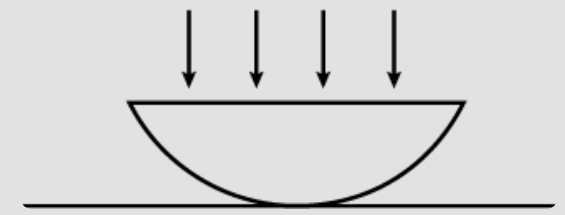
An object is placed at a distance of f/2 from a convex lens. The image will be
|
(a) At one of the foci, virtual and double its size |
|
(b) At 3f / 2, real and inverted |
|
(c) At 2f, virtual and erect |
|
(d) None of these |


