Questions · Page 1 of 7

M.C.Q [1M]

🎯

Test yourself on this topic

50 questions · timed · auto-graded

MCQ 11 Mark
If the net electric flux through a closed surface is zero, then we can infer:
  • A
    No net charge is enclosed by the surface.
  • B
    Uniform electric field exists within the surface.
  • C
    Electric potential varies from point to point inside the surface.
  • D
    Charge is present inside the surface.
Answer
  1. No net charge is enclosed by the surface.

Explanation:

  • Net electric flux is highly dependent on the net electric charge enclosed by the surface.
  • In a closed surface, if the net electric flux is zero, then the net electric charge will be also zero.
  • Since electric flux is defined as the rate of flow of electric field in a closed area and if the electric flux is zero, the overall electric charge within the closed boundary will be also zero.
View full question & answer
MCQ 21 Mark
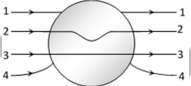
A metallic solid sphere is placed in a uniform electric field. The electric field lines follow the path(s) shown in figure as
Image
  • A
    1
  • B
    2
  • C
    3
  • 4
Answer
Correct option: D.
4
D
View full question & answer
MCQ 31 Mark
Two point positive charge of 1C are located at a distance 1 m from each other in the air. The value of the electric force of repulsion acting between the charges will be-
  • A
    Zero
  • B
    IN
  • C
    $8.85 \times 10^{-12} N$
  • $9 \times 10^9 N$
Answer
Correct option: D.
$9 \times 10^9 N$
D
View full question & answer
MCQ 41 Mark
Mark out the correct options.
  • A
    The total charge of the universe is constant.
  • B
    The total positive charge of the universe is constant.
  • C
    The total negative charge of the universe is constant.
  • D
    The total number of charged particles in the universe is constant.
Answer
  1. The total charge of the universe is constant.

Explanation:

The total charge (Positive + negative) oif the universe is constant.

View full question & answer
MCQ 51 Mark
When the object has no electric charge then the object is said to be:
  • A
    Charged.
  • B
    Electrified.
  • C
    Electrically neutral.
  • D
    None.
Answer
  1. Electrically neutral.
View full question & answer
MCQ 61 Mark
In a charge free region, electric field lines can be taken to be continuous curves:
  • A
    With breaks.
  • B
    Without breaks.
  • C
    Both a and b.
  • D
    None.
Answer
  1. Without breaks.
View full question & answer
MCQ 81 Mark
The ratio of electric force between two electrons to two protons separated by the same distance in air is:
  • A
    100
  • B
    106
  • C
    104
  • D
    None of these
Answer
  1. 100
View full question & answer
MCQ 91 Mark
The S.I. unit of electric flux is:
  • A
    Weber.
  • B
    Newton per coulomb.
  • C
    Volt × metre.
  • D
    Joule per coulomb.
Answer
  1. Volt × metre.
View full question & answer
MCQ 101 Mark
A hollow sphere of charge does not have electric field at:
  • A
    Outer point.
  • B
    Interior point.
  • C
    Beyond 2m.
  • D
    Beyond 100m.
Answer
  1. Interior point.
View full question & answer
MCQ 111 Mark
According to Coulomb’s law, the coulomb force measured between two point charges is directly proportional to:
  • A
    Product of magnitude of charges.
  • B
    Square of the distance between the two charges.
  • C
    Both a and b.
  • D
    None.
Answer
  1. Product of magnitude of charges.
View full question & answer
MCQ 141 Mark
The force that a unit positive charge would experiences if placed at that point is called as _____ due to charge at a point in space.
  • A
    Electric charge.
  • B
    Electric field.
  • C
    Both a and b.
  • D
    None.
Answer
  1. Electric field.
View full question & answer
MCQ 151 Mark
The electric field inside a spherical shell of uniform surface charge density is:
  • A
    Zero.
  • B
    Constant different from zero.
  • C
    Proportional to the distance from the curve.
  • D
    None of the above.
Answer
  1. Zero.
View full question & answer
MCQ 161 Mark
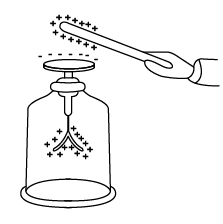
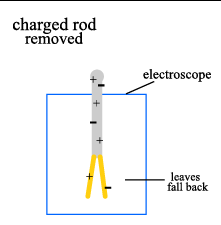
What happens when the end of the paper clip of electroscope is touched by hands?
  • A
    Electric current is produced.
  • B
    Foil strips remain as it is.
  • C
    Foil strips collapse.
  • D
    None of the above.
Answer
  1. Foil strips collapse.

Explanation:

When the paper clip of electroscope is touched by hands, the foil strips collapse because the charges on foil strips gets discharged through our body.


View full question & answer
MCQ 171 Mark
If a body is charged by rubbing it, its weight
  • A
    Remains precisely constant.
  • B
    Increases slightly.
  • C
    Decreases slightly.
  • D
    May increase slightly or may decrease slightly.
Answer
  1. May increase slightly or may decrease slightly.

Explanation:

If a body is charged by rubbing it, its weight may increase slightly or may decrease slightly.

View full question & answer
MCQ 181 Mark
Coulomb force and gravitational force follows the:
  • A
    Conservation law.
  • B
    Inverse square law.
  • C
    Both a and b.
  • D
    None.
Answer
  1. Inverse square law.
View full question & answer
MCQ 211 Mark
1C is the charge which is placed at a distance of 1m from the another charge of same magnitude in vacuum experiences an electrical force of repulsion of magnitude:
  • A
    9 × 10-9N
  • B
    9 × 109N
  • C
    109N
  • D
    10-9N
Answer
  1. 9 × 109N
View full question & answer
MCQ 221 Mark
Quantisation of charge implies:
  • A
    Charge cannot be destroyed.
  • B
    Charge exists on particles.
  • C
    There is a minimum permissible charge on a particle.
  • D
    Charge, which is a fraction of a coulomb is not possible.
Answer
  1. Charge, which is a fraction of a coulomb is not possible.
View full question & answer
MCQ 231 Mark
Two files lines can ____.
  • A
    Never cross each other.
  • B
    May cross each other.
  • C
    Both a and b.
  • D
    None.
Answer
  1. Never cross each other.
View full question & answer
MCQ 241 Mark
An electroscope is used:
  • A
    To detect presence of charge on a body.
  • B
    To determine the nature of charge on a body.
  • C
    To measure the exact amount of charge on a body.
  • D
    For both A and B.
Answer
  1. For both A and B.

Explanation:

Electroscope is a device which is use to detect whether a body is carrying charge and also to detect the nature of charge on the body.

View full question & answer
MCQ 251 Mark
If the sizes of charged bodies are very small compared to the distances between them, we treat them as ____________?
  • A
    Zero charges.
  • B
    Point charges.
  • C
    Single charge.
  • D
    No charges.
Answer
  1. Point charges.

Explanation:

If the sizes of charged bodies are very small compared to the distances between them, we treat them as point charges.

View full question & answer
MCQ 271 Mark
Which one of the following is a safe place during lightning?
  • A
    Under a tree
  • B
    Under a light post
  • C
    House with lightning arrester
  • D
    High wall
Answer
  1. House with lightning arrester

Explanation:

Lightning arrester arrests lightning and allows a safe path of electricity to ground. Thus it is a safe place inside a house that has a lightning arrester on the top of it. Else, electricity finds a high tower or tree or wall and travels through them to ground. Therefore these are not safe places to take shelter during lightning.

View full question & answer
MCQ 281 Mark
Electroscope is used:
  • A
    To detect and test small electric charges.
  • B
    To calculate the amount of electric charge flowing through the conductor in the given interval of time.
  • C
    To find out the presence of antimatter.
  • D
    To test the presence of magnetic field.
Answer
  1. To detect and test small electric charges.

Explanation:

Electroscope is an old electrical instrument, used to detect the presence and magnitude of electric charges on a body.

View full question & answer
MCQ 291 Mark
Charge motion within the Gaussian surface gives changing physical quantity:
  • A
    Electric field.
  • B
    Electric flux.
  • C
    Charge.
  • D
    Gaussian surface area.
Answer
  1. Electric field.
View full question & answer
MCQ 301 Mark
Three equal positive charges are kept at the corners of an equilateral triangle. What will be the vector sum of the forces acting on the particles?
  • A
    Directed towards the center.
  • B
    Directed radially outside.
  • C
    Acts along one of the sides of the triangle.
  • D
    Zero.
Answer
  1. Zero.

Explanation:

The magnitude of the force acting on each of the charges will be the same and they will differ from each other by 120 degrees. Therefore their resultant force will always be zero.

View full question & answer
MCQ 311 Mark
The materials having high resistance to the passage of electricity are called as:
  • A
    Conductors.
  • B
    Insulators.
  • C
    Semiconductors.
  • D
    None.
Answer
  1. Insulators.
View full question & answer
MCQ 321 Mark
The dimensions of electric field are:
  • A
    [M L T-3 A-1].
  • B
    [M L T-2 A-1].
  • C
    [M L T-3 A-2].
  • D
    None.
Answer
  1. [M L T-3 A-1].
View full question & answer
MCQ 341 Mark
Which of the following materials has a negative temperature coefficient of resistance?
  • A
    Copper
  • B
    Aluminium
  • C
    Carbon
  • D
    Brass
Answer
  1. Carbon

Explanation:

Carbon has a negative temperature coefficient of resistance.

View full question & answer
MCQ 351 Mark
Electric lines of force:
  • A
    Exist everywhere.
  • B
    Exist only in the immediate vicinity of electric charges.
  • C
    Exist only when both positive and negative charges are near one another.
  • D
    Are imaginary.
Answer
  1. Are imaginary.
View full question & answer
MCQ 361 Mark
If one penetrates a uniformly charged spherical cloud, electric field strength:
  • A
    Decreases directly as the distance from the centre.
  • B
    Increases directly as the distance from the centre.
  • C
    Remains constant.
  • D
    None of these.
Answer
  1. Decreases directly as the distance from the centre.
View full question & answer
MCQ 371 Mark
What happens when a glass rod is rubbed with silk?
  • A
    Gains protons from silk.
  • B
    Gains electrons from silk.
  • C
    Gives electrons to silk.
  • D
    Gives protons to silk.
Answer
  1. Gains protons from silk.

Explanation:

Excess electrons are transferred from glass to silk when a glass rod is rubbed with silk. Hence, the glass rod becomes positive, and silk becomes negative.

View full question & answer
MCQ 381 Mark
Two identically charged spheres when suspended by strings of equal lengths make an angle of 30 with each other. The angle remains the same when they are immersed in a liquid of density less than the density of the material of the spheres. Choose the correct option
  • A
    The electric force between them increases.
  • B
    The electric force between them decreases.
  • C
    The net downward force will increase.
  • D
    The net downward force will remain unchanged.
Answer
  1. The electric force between them decreases.
View full question & answer
MCQ 391 Mark
On rubbing, when one body gets positively charged and other negatively charged, the electrons transferred from positively charged body to negatively charged body are:
  • A
    Valence electrons only.
  • B
    Electrons of inner shells.
  • C
    Both valence electrons and electrons of inner shell.
  • D
    Yet to be established.
Answer
  1. Valence electrons only.
View full question & answer
MCQ 401 Mark
What do you understand by the static or frictional electricity?
  • A
    Discarging of two bodies on rubbing them together is called static or frictional electricity.
  • B
    Charging of two bodies on rubbing them together is called static or frictional electricity.
  • C
    Electricity which is static is called static or frictional electricity.
  • D
    Electricity on high friction bodies is called static or frictional electricity.
Answer
  1. Charging of two bodies on rubbing them together is called static or frictional electricity.

Explanation:

Static electricity is produced when a suitable combination of substances (e.g., glass rod and silk, ebonite rod and cat's skin, sealing wax and wool) are rubbed together and get electrified due to friction.

View full question & answer
MCQ 411 Mark
The device, which can be used to detect whether an object is charged, is:
  • A
    Telescope
  • B
    Microscope
  • C
    Electroscope
  • D
    None of the above
Answer
  1. Electroscope

Explanation:

Electroscope is a device that is used for detection and identification of charge on objects.

View full question & answer
MCQ 421 Mark
A point charge is kept at the centre of metallic insulated spherical shell. Then:
  • A
    Electric field out side the sphere is zero.
  • B
    Electric field inside the sphere is zero.
  • C
    Net induced charge on the sphere is zero.
  • D
    Electric potential inside the sphere is zero.
Answer
  1. Net induced charge on the sphere is zero.
View full question & answer
MCQ 431 Mark
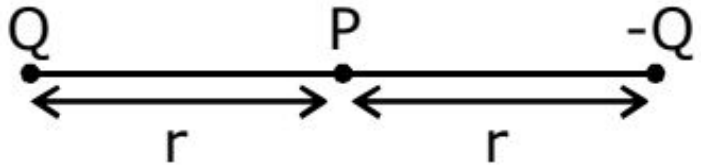
Which of the following quantities do not depend on the choice of zero potential or zero potential energy?
  • A
    Potential at a point.
  • B
    Potential difference between two points.
  • C
    Potential energy of a two-charge system.
  • D
    Change in potential energy of a two-charge system.
Answer
  1. Potential energy of a two-charge system.
  2. Change in potential energy of a two-charge system.

Explanation:

$\text{V}_\text{p}=\frac{\text{KQ}}{\text{r}}-\frac{\text{KQ}}{\text{r}}=0$

View full question & answer
MCQ 451 Mark
Gauss’s law is true for.
  • A
    Any closed surface.
  • B
    For particular surfaces
  • C
    Both a and b.
  • D
    None.
Answer
  1. Any closed surface.
View full question & answer
MCQ 461 Mark
The Gaussian surface:
  • A
    Can pass through a continuous charge distribution.
  • B
    Cannot pass through a continuous charge distribution.
  • C
    Can pass through any system of discrete charges.
  • D
    Can pass through a continuous charge distribution as well as any system of discrete charges.
Answer
  1. Cannot pass through a continuous charge distribution.
View full question & answer
MCQ 471 Mark
In electrolytes, the mobile charges are:
  • A
    Positive ions.
  • B
    Negative ions.
  • C
    Both a and b.
  • D
    None.
Answer
  1. Both a and b.
View full question & answer
MCQ 481 Mark
Number of electric lines of force emanating from 1C of positive charge in vacuum is:
  • A
    8.85 × 10⁻¹²
  • B
    9 × 10⁹
  • C
    $\frac{1}{4}\pi\times9\times10^{9}$
  • D
    1.13 × 10¹¹
Answer
  1. 1.13 × 10¹¹

Explanation:

$\phi$ from 1C of charge is $=\frac{\text{Q}_{\text{enclosed​}}}{\in_{\circ}}$

$=\frac{1}{8.8501\times10^{-12}}$

= 1.129 × 1011

View full question & answer
MCQ 501 Mark
The field lines of a single negative charge are:
  • A
    Radially outward.
  • B
    Radially inward.
  • C
    Both a and b.
  • D
    None.
Answer
  1. Radially inward.
View full question & answer
M.C.Q [1M] - Physics STD 12 Science Questions - Vidyadip