Question
Coulomb's Law is true for:

Answer

  1. All the distances
Explanation:
Coulomb's law is true for all distances whether it is small and large. Hence it is called a long range force.
Coulomb's force $\text{F}=\frac{\text{q}_1\text{q}_2}{4\pi\epsilon_\circ\text{r}^2}$
$\Rightarrow\text{F}\propto\frac{1}{\text{r}^2}$

Need a full question paper?

Generate a complete, print-ready paper with questions like this in minutes — across 16+ boards, with answer keys.
Start Generating Free

Similar questions

A capacitor is fully charged with a battery. Then the battery is removed and coil is connected with the capacitor in parallel, current varies as(a) Increases monotonically(b) Decreases monotonically(c) Zero  (d) Oscillates indefinitely
   
   
The breaking stress of a wire depends on:
  1. Material of the wire.
  2. Length of the wire.
  3. Radius of the wire.
  4. Shape of the cross-section.
Two parallel slits 0.6 mm apart are illuminated by light source of wavelength 6000 Å. The distance between two consecutive dark fringes on a screen 1 m away from the slits is (a) 1 mm(b) 0.01 mm (c) 0.1 m(d) 10 m
       
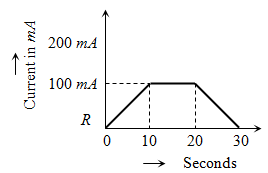
In a copper voltameter, mass deposited in $30$ second is $m \ gm.$ If the time$-$current graph is as shown in figure, $\text{ECE}$ of copper is
In which of the following decay the structure of the nucleus does not change ?
When light is incident on a metal surface the maximum kinetic energy of emitted electrons:
A voltmeter essentially consists of(a) A high resistance, in series with a galvanometer(b) A low resistance, in series with a galvanometer(c) A high resistance in parallel with a galvanometer(d) A low resistance in parallel with a galvanometer


Two electrons in an atom are moving in orbit of radii R and 9R respectively. The ratio of their frequencies will be:
In a single slit diffraction experiment first minimum for red light (660 nm) coincides with first maximum of some other wavelength l'. The value of l' is (a) 4400 Å(b) 6600 Å(c) 2000 Å(d) 3500 Å
       
A coil carrying electric current is placed in uniform magnetic field, then(a) Torque is formed(b) E.M.f. is induced(c) Both (a) and (b) are correct(d) None of these