MCQ
Coulomb's Law is true for:
- AAtomic distances (=10-11m)
- BNuclear distances (=10-15m)
- CCharged as well as uncharged particles
- DAll the distances
Explanation:
Coulomb's law is true for all distances whether it is small and large. Hence it is called a long range force.
Coulomb's force $\text{F}=\frac{\text{q}_1\text{q}_2}{4\pi\in_\circ\text{r}^2}$
$\Rightarrow\text{F}\propto\frac{1}{\text{r}^2}$
Generate a complete, print-ready paper with questions like this in minutes — across 16+ boards, with answer keys.
The core of a transformer is laminated so that
|
(a) Ratio of voltage in the primary and secondary may be increased |
|
(b) Rusting of the core may be stopped |
|
(c) Energy losses due to eddy currents may be reduced |
|
(d) Change in flux is increased |
If 200 MeV energy is released in the fission of a single  nucleus, the number of fissions required per second to produce 1 kilowatt power shall be (Given 1eV = 1.6
|
(a) 3.125 |
(b) 3.125 |
(c) 3.125 |
(d) 3.125 |
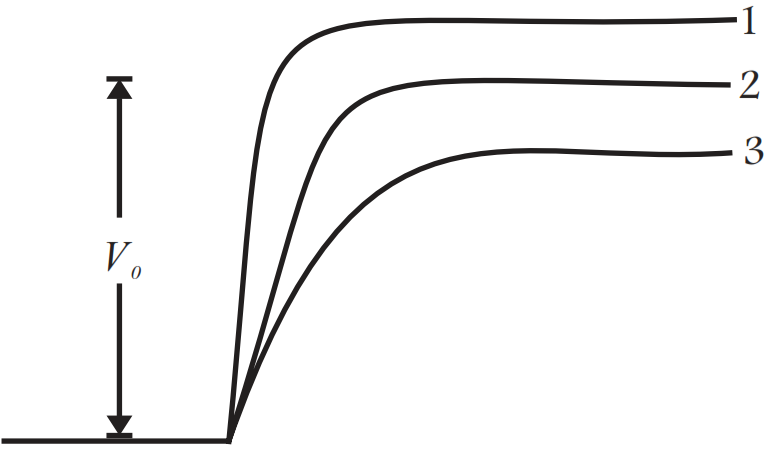
Stopping potential for photoelectrons
|
(a) Does not depend on the frequency of the incident light |
|
(b) Does not depend upon the nature of the cathode material |
|
(c) Depends on both the frequency of the incident light and nature of the cathode material |
|
(d) Depends upon the intensity of the incident light |
A vertical wire carrying a current in the upward direction is placed in horizontal magnetic field directed towards north. The wire will experience a force directed towards
|
(a) North |
(b) South |
(c) East |
(d) West |