Question
Covalent molecules formed by heteroatoms bound to have some ionic character. The ionic character is due to shifting of the electron pair towards A or B in the molecule AB . Hence, atoms acquire small and equal charge but opposite in sign. Such a bond which has some ionic character is described as a polar covalent bond. Polar covalent molecules can exhibit a dipole moment. The dipole moment is equal to the product of charge separation, q and the bond length, d for the bond. The unit of dipole moment is Debye. One Debye is equal to $10^{-18}$ esu cm.
The dipole moment is a vector quantity. It has both magnitude and direction. Hence, the dipole moment of molecules depends upon the relative orientation of the bond dipole, but not the polarity of bonds alone. The symmetrical structure shows a zero dipole moment. Thus, a dipole moment help to predict the geometry of the molecules. Dipole moment values can be used to distinguish between cis- and trans-isomers; ortho-, meta- and para-forms of a substance, etc. The percentage of ionic character of a bond can be calculated by the application of the following formula:
$
\% \text { ionic character }=\frac{\text { Experimental value dipole moment }}{\text { Theoretical value of dipole moment }} \times 100
$
Image
ii. A diatomic molecule has a dipole moment of 1.2 D . If the bond length is $1.0 \times 10^{-8} cm$, what fraction of charge does exist on each atom? (1)
iii. The dipole moment of $NF _3$ is very much less that of $NH _3$. Why? (2)
OR
A covalent molecule, $x-y$, is found to have a dipole moment of $1.5 \times 10^{-29} cm$ and a bond length 150 pm . What will be the percentage of ionic character of the bond? (2)

Answer


Image
ii. Fraction of electronic charge $=\frac{1.2 \times 10^{-10}}{4.8 \times 10^{-10}}=0.25$
iii. Because of different direction of moment of N-H and N-F bonds.
OR
$
\% \text { ionic character }=\frac{1.5 \times 10^{-29}}{2.4 \times 10^{-29}} \times 100=62.5
$

Need a full question paper?

Generate a complete, print-ready paper with questions like this in minutes — across 16+ boards, with answer keys.

Start Generating Free

Similar questions

Read the passage given below and answer the following questions from 1 to 5.

Chemistry deals with varieties of matter and change of one kind of matter into the other. Transformation of matter from one kind into another occurs through the various types of reactions. One important category of such reactions is Redox Reactions. Originally, the term oxidation was used to describe the addition of oxygen to an element or a compound. Because of the presence of dioxygen in the atmosphere (~20%), many elements combine with it and this is the principal reason why they commonly occur on the earth in the form of their oxides. The following reactions represent oxidation processes:

$2\text{Mg}(\text{s})\rightarrow2\text{MgO}\text{ (S)}$

$\text{S}(\text{s})+\text{O}_2(\text{g})\rightarrow\text{SO}_2\text{ g}$

the term “oxidation” is defined as the addition of oxygen/electronegative element to a substance or removal of hydrogen/ electropositive element from a substance. In the beginning, reduction was considered as removal of oxygen from a compound. However, the term reduction has been broadened these days to include removal of oxygen/electronegative element from a substance or addition of hydrogen/ electropositive element to a substance. According to the definition given above, the following are the examples of reduction processes:

$2\text{HgO}\text{S}\xrightarrow{\triangle}2\text{ Hg}(1)+\text{O}_2(\text{g})$

$2\text{HgCl}_2(\text{aq})+\text{SnCl}_2(\text{aq})\rightarrow\text{Hg}_2\text{Cl}_2(\text{s})+\text{SnCl}_4(\text{aq})$

In reaction simultaneous oxidation of stannous chloride to stannic chloride is also occurring because of the addition of electronegative element chlorine to it. It was soon realised that oxidation and reduction always occur simultaneously (as will be apparent by re-examining all the equations given above), hence, the word “redox” was coined for this class of chemical reactions.

The reactions:

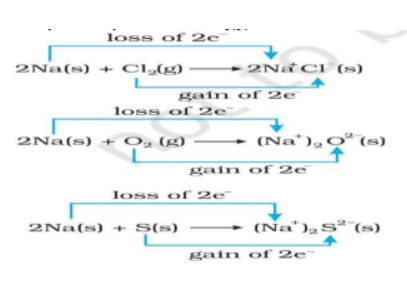
$2\text{Na}(\text{s})+\text{Cl2}\text{g}\rightarrow2\text{NaCl}(\text{s})$

$4\text{Na}(\text{s})+\text{O}_2\text{g}\rightarrow2\text{Na}_2\text{o}(\text{s})$

$2\text{Na}(\text{s})+\text{S}\text{(s)}\rightarrow2\text{Na}_2\text{S}(\text{s})$

are redox reactions because in each of these reactions sodium is oxidised due to the addition of either oxygen or more electronegative element to sodium. Simultaneously, chlorine, oxygen and sulphur are reduced because to each of these, the electropositive element sodium has been added. From our knowledge of chemical bonding we also know that sodium chloride, sodium oxide and sodium sulphide are ionic compounds and perhaps better written as Na+ Cl–(s), (Na+)2 O2–(s), and (Na+)2 S2 (s). Development of charges on the species produced suggests us to rewrite the reactions in the following manner:

For convenience, each of the above processes can be considered as two separate steps, one involving the loss of electrons and the other the gain of electrons. As an illustration, we may further elaborate one of these, say, the formation of sodium chloride.

$2\text{Na}(\text{s})\rightarrow2\text{Na}^+\text{g}+2\bar{\text{e}}$

$\text{Cl}_2\text{g}+2\bar{\text{e}}\rightarrow2\text{C}\bar{\text{I}}\text{ (g)}$

Each of the above steps is called a half reaction, which explicitly shows involvement of electrons. Sum of the half reactions gives the overall reaction

$2\text{Na}(\text{s})+\text{Cl}_2\text{(g)}\rightarrow2\text{Na}^+\text{CI}(\text{s})\text{ or } 2\text{NaCI}(\text{s})$

Above Reactions suggest that half reactions that involve loss of electrons are called oxidation reactions. Similarly, the half reactions that involve gain of electrons are called reduction reactions. To summarise, we may mention that

Oxidation: Loss of electron(s) by any species.

Reduction: Gain of electron(s) by any species.

Oxidising agent: Acceptor of electron(s).

Reducing agent: Donor of electron(s).

  1. Addition of electronegative element to a substance is known as..
  1. Oxidation
  2. Reduction
  3. Redox reaction
  4. All the above
  1. Removal of electronegative element to a substance is known as ..
  1. Oxidation
  2. Reduction
  3. Redox reaction
  4. All the above
  1. Acceptor of electrons is …
  1. Reducing Agent
  2. Catalytic Agent
  3. Oxidising Agent
  4. None of above
  1. Donor of electrons is…
  1. Organic Agent
  2. Catalytic Agent
  3. Oxidising Agent
  4. Reducing Agent
  1. Oxidation and Reduction occurs simultaneously is known as …
  1. Exothermic reaction
  2. Endothermic reaction
  3. Redox reaction
  4. Neutralization reaction


Read the passage given below and answer the following questions from (i) to (v).
Arrhenius Concept of Acids and Bases According to Arrhenius theory, acids are substances that dissociates in water to give hydrogen ions H+(aq) and bases are substances that produce hydroxyl ions OH(aq). The ionization of an acid HX (aq) can be represented by the following equations:
HX(aq) →  H+(aq) + X(aq)
or
HX (aq) + H2O(l) → H3O+(aq) + X(aq)
A bare proton, H+ is very reactive and cannot exist freely in aqueous solutions. Thus, it bonds to the oxygen atom of a solvent water molecule to give trigonal pyramidal hydronium ion, H3O+{[H ( H2O)]+} (see box). In this chapter we shall use H+(aq) and H3O+(aq) interchangeably to mean the same i.e., a hydrated proton. Similarly, a base molecule like MOH ionizes in aqueous solution according to the equation:
 MOH(aq) → M+(aq) + OH(aq)
The hydroxyl ion also exists in the hydrated form in the aqueous solution. Arrhenius concept of acid and base, however, suffers from the limitation of being applicable only to aqueous solutions and also, does not account for the basicity of substances like, ammonia which do not possess a hydroxyl group.
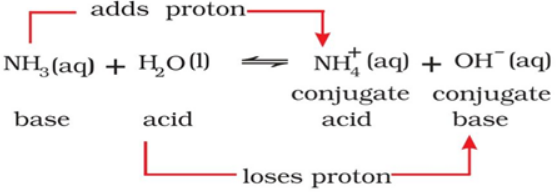
The Brönsted-Lowry Acids and Bases The Danish chemist, Johannes Brönsted and the English chemist, Thomas M. Lowry gave a more general definition of acids and bases. According to Brönsted-Lowry theory, acid is a substance that is capable of donating a hydrogen ion H+ and bases are substances capable of accepting a hydrogen ion, H+. In short, acids are proton donors and bases are proton acceptors. Consider the example of dissolution of NH3 in H2O represented by the following equation:

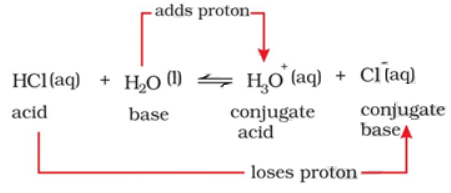
Hydronium and Hydroxyl Ions Hydrogen ion by itself is a bare proton with very small size (~10–15 m radius) and intense electric field, binds itself with the water molecule at one of the two available lone pairs on it giving H3O+. This species has been detected in many compounds (e.g., H3O+Cl –) in the solid state. In aqueous solution the hydronium ion is further hydrated to give species like H5O2+, H7O3+ and H9O4+. Similarly the hydroxyl ion is hydrated to give several ionic species like, H5O3 – and H7O4 – etc. The basic solution is formed due to the presence of hydroxyl ions. In this reaction, water molecule acts as proton donor and ammonia molecule acts as proton acceptor and are thus, called Lowry-Brönsted acid and base, respectively. In the reverse reaction, H+ is transferred from NH4+ to OH –. In this case, NH4+ acts as a Bronsted acid while OH acted as a Brönsted base. The acid-base pair that differs only by one proton is called a conjugate acid-base pair. Therefore, OH – is called the conjugate base of an acid  H2O and NH4+ is called conjugate acid of the base NH3. f Brönsted acid is a strong acid then its conjugate base is a weak base and vice- versa. It may be noted that conjugate acid has one extra proton and each conjugate base has one less proton. Consider the example of ionization of hydrochloric acid in water. HCl (aq) acts as an acid by donating a proton to H2O molecule which acts as a base.

It can be seen in the above equation, that water acts as a base because it accepts the proton. The species  H3O+ is produced when water accepts a proton from HCl. Therefore, Cl – is a conjugate base of HCl and HCl is the conjugate acid of base Cl –. Similarly,  H2O is a conjugate base of an acid  H3O+ and  H3O+ is a conjugate acid of base  H2O. It is interesting to observe the dual role of water as an acid and a base. In case of reaction with HCl water acts as a base while in case of ammonia it acts as an acid by donating a proton.
Lewis Acids and Bases G.N. Lewis in 1923 defined an acid as a species which accepts electron pair and base which donates an electron pair. As far as bases are concerned, there is not much difference between Brönsted-Lowry and Lewis concepts, as the base provides a lone pair in both the cases. However, in Lewis concept many acids do not have proton. A typical example is reaction of electron deficient species BF3 with NH3. BF3 does not have a proton but still acts as an acid and reacts with  NH3 by accepting its lone pair of electrons. The reaction can be represented by,
BF3  + : NH3 → BF3 : NH3
Electron deficient species like AlCl3, Co3+, Mg2+, etc. can act as Lewis acids while species like H2O, NH3, OH etc. which can donate a pair of electrons, can act as Lewis bases.
The pH Scale Hydronium ion concentration in molarity is more conveniently expressed on a logarithmic scale known as the pH scale. The pH of a solution is defined as the negative logarithm to base 10 of the activity (aH+) of hydrogen ion. In dilute solutions (< 0.01 M), activity of hydrogen ion (H+) is equal in magnitude to molarity represented by [H+]. It should be noted that activity has no units and is defined as:
$\text{a}=\frac{[\text{H}^+]}{\text{mol}\text{L}^{–1}}$
From the definition of pH, the following can be written,
$\text{pH}={–\log\text{a}_\text{H}^+=\frac{-\log[\text{H}^+]}{\text{mol}\text{L}^{–1}}}$
Thus, an acidic solution of HCl (10–2M) will have a pH = 2. Similarly, a basic solution of NaOH having [OH] =10–4M and [ H3O+] = 10–10M will have a pH = 10. At 25 °C, pure water has a concentration of hydrogen ions, [H+] = 10–7 M. Hence, the pH of pure water is given as:
 pH = –log(10–7) = 7
Acidic solutions possess a concentration of hydrogen ions, [H+] > 10–7M, while basic solutions possess a concentration of hydrogen ions, [H+] < 10–7M. thus, we can summarise that
Acidic solution has pH < 7
Basic solution has pH > 7
Neutral solution has pH = 7
Now again, consider the equation at 298K
Kw = [H3O+][OH] = 10–14
Taking negative logarithm on both sides of equation, we obtain
 –log Kw = – log{[ H3O+ ][OH– ]} 
= – log[H3O+] – log[OH–] 
= – log10–14
pKw = pH + pOH = 14
Note that although Kw may change with temperature the variations in pH with temperature are so small that we often ignore it. pKw  is a very important quantity for aqueous solutions and controls the relative concentrations of hydrogen and hydroxyl ions as their product is a constant. It should be noted that as the pH scale is logarithmic, a change in pH by just one unit also means change in [H+] by a factor of 10. Similarly, when the hydrogen ion concentration, [H+] changes by a factor of 100, the value of pH changes by 2 units. Now you can realise why the change in pH with temperature is often ignored.
Ionization Constants of Weak Acids Consider a weak acid HX that is partially ionized in the aqueous solution. The equilibrium can be expressed by:
HX(aq)+H2O(l) → H3O+(aq) + X(aq)
Initial concentration (M)
c 0 0
Let α be the extent of ionization Change (M) -cα +cα +cα Equilibrium concentration (M) c-cα cα cα Here, c = initial concentration of the undissociated acid, HX at time, t = 0. α = extent up to which HX is ionized into ions. Using these notations, we can derive the equilibrium constant for the above discussed acid- dissociation equilibrium:
$\text{Ka}=\frac{\text{c}^2\alpha^2}{\text{c}(1-\alpha)}=\frac{\text{c}\alpha^2}{1-\alpha}$
Ka  is called the dissociation or ionization constant of acid HX. It can be represented alternatively in terms of molar concentration as follows,
$\text{Ka}=\frac{[\text{H}^+][\text{X}^–]}{[\text{HX}]}$
At a given temperature T, Ka is a measure of the strength of the acid HX i.e., larger the value of Ka, the stronger is the acid. Ka is a dimensionless quantity with the understanding that the standard state concentration of all species is 1M.
  1. … is a substance that is capable of donating a hydrogen ion H+.
  1. Acid
  2. Base
  3. Neutral substances
  4. Alkaline
  1. … are proton acceptors.
  1. Acids
  2. Bases
  3. Neutral substances
  4. All the above
  1. According to …bases are substances that produce hydroxyl ions OH.
  1. Johannes Brönsted
  2. Thomas M. Lowry
  3. Arrhenius
  4. G. N. Lewis
  1. Brönsted acid is a strong acid then its conjugate base is a … base.
  1. Strong
  2. Medium
  3. Non
  4. Weak
  1. According to … an acid as a species which accepts electron pair.
  1. Johannes Brönsted
  2. Thomas M. Lowry
  3. Arrhenius
  4. G. N. Lewis
Read the passage given below and answer the following questions from (i) to (v).
A system in thermodynamics refers to that part of universe in which observations are made and remaining universe constitutes the surroundings. The surroundings include everything other than the system. System and the surroundings together constitute the universe. The universe = The system + The surroundings However, the entire universe other than the system is not affected by the changes taking place in the system. Therefore, for all practical purposes, the surroundings are that portion of the remaining universe which can interact with the system. Usually, the region of space in the neighbourhood of the system constitutes its surroundings.
The wall that separates the system from the surroundings is called boundary.
Types of the System We, further classify the systems according to the movements of matter and energy in or out of the system.
  1. Open System In an open system, there is exchange of energy and matter between system and surroundings. The presence of reactants in an open beaker is an example of an open system. Here the boundary is an imaginary surface enclosing the beaker and reactants.
  2. Closed System In a closed system, there is no exchange of matter, but exchange of energy is possible between system and the surroundings. The presence of reactants in a closed vessel made of conducting material e.g., copper or steel is an example of a closed system.
  3. Isolated System In an isolated system, there is no exchange of energy or matter between the system and the surroundings. The presence of reactants in a thermos flask or any other closed insulated vessel is an example of an isolated system.
The State of the System The system must be described in order to make any useful calculations by specifying quantitatively each of the properties such as its pressure (p), volume (V), and temperature (T) as well as the composition of the system. We need to describe the system by specifying it before and after the change. You would recall from your Physics course that the state of a system in mechanics is completely specified at a given instant of time, by the position and velocity of each mass point of the system. In thermodynamics, a different and much simpler concept of the state of a system is introduced. It does not need detailed knowledge of motion of each particle because, we deal with average measurable properties of the system. We specify the state of the system by state functions or state variables. The state of a thermodynamic system is described by its measurable or macroscopic (bulk) properties. We can describe the state of a gas by quoting its pressure (p), volume (V), temperature (T), amount (n) etc. Variables like p, V, T are called state variables or state functions because their values depend only on the state of the system and not on how it is reached. In order to completely define the state of a system it is not necessary to define all the properties of the system; as only a certain number of properties can be varied independently. This number depends on the nature of the system. Once these minimum number of macroscopic properties are fixed, others automatically have definite values. The state of the surroundings can never be completely specified; fortunately it is not necessary to do so.
By conventions of IUPAC in chemical thermodynamics. The q is positive, when heat is transferred from the surroundings to the system and the internal energy of the system increases and q is negative when heat is transferred from system to the surroundings resulting in decrease of the internal energy of the system.
Let us consider the general case in which a change of state is brought about both by doing work and by transfer of heat. We write change in internal energy for this case as: $ \triangle{\text{U}}=\text{q}+\text{w}$
For a given change in state, q and w can vary depending on how the change is carried out. However, $\text{q}+\text{w}=\triangle{\text{U}}$ will depend only on initial and final state. It will be independent of the way the change is carried out. If there is no transfer of energy as heat or as work (isolated system) i.e., if w = 0 and q = 0, then $ \triangle{\text{U}}=0.$ The equation i.e., $ \triangle{\text{U}}=\text{q}+\text{w}$ is mathematical statement of the first law of thermodynamics, which states that The energy of an isolated system is constant. It is commonly stated as the law of conservation of energy i.e., energy can neither be created nor be destroyed.
  1. $\triangle\text{U}=\ ....$
  1. q + w
  2. q + v
  3. q + m
  4. q + z
  1. Which of the following is not an example of state variable?
  1. Pressure
  2. Ionic radius
  3. Volume
  4. Amount
  1. $\triangle\text{U}=\text{q}+\text{w}$ is termed as …
  1. Third law of thermodynamics
  2. Second law of thermodynamics
  3. First law of thermodynamics
  4. None of above
  1. A … in thermodynamics refers to that part of universe in which observations are made.
  1. Universe
  2. System
  3. Surrounding
  4. Boundary
  1. Which of the following is a type if system ?
  1. Open system
  2. Closed system
  3. Lsolated system
  4. All the above
In order to explain the characteristic geometrical shapes of polyatomic molecules, Pauling introduced the concept of hybridisation. The orbitals undergoing hybridisation should have nearly the same energy. There are various type of hybridisations involving s, p and d-type of orbitals. The type of hybridisation gives the characteristic shape of the molecule or ion.

1. Why all the orbitals in a set of hybridised orbitals have the same shape and energy?
2. Out of $XeF _2$ and $SF _2$ which molecule has the same shape as $NO _2^{+}$ion?
3. Out of $XeF _4$ and $XeF _2$ which molecule doesn't have the same type of hybridisation as P (Phosphorus) has in $PF _5$ ?
OR
Unsaturated compounds undergo additional reactions. Why?
Read the passage given below and answer the following questions from 1 to 5.
After having some idea about the terms atomsand molecules, it is appropriate here tounderstand what do we mean by atomic andmolecular masses.One atomicmass unit is defined as a mass exactly equal to one-twelfth of the mass of one carbon – 12 atom.Molecular mass is the sum of atomic masses of the elements present in a molecule. It is obtained by multiplying the atomic mass of each element by the number of its atoms and adding them together. Some substances, such as sodium chloride, do not contain discrete molecules as their constituent units. In such compounds, positive (sodium ion) and negative (chloride ion) entities are arranged in a three dimensional structure. The mole, symbol mol, is the SI unit of amount of substance. One mole contains exactly 6.02214076× 10²³ elementary entities. This number is the fixed numerical value of the Avogadro constant, NA , when expressed in the unit mol–1 and is called the Avogadro number. The amount of substance, symbol n, of a system is a measure of the number of specified elementary entities. An elementary entity may be an atom, a molecule, an ion, an electron, any other particle or specified group of particles. It may be emphasised that the mole of a substance always contains the same number of entities, no matter what the substance may be. In order to determine this number precisely, the mass of a carbon–12 atom was determined by a mass spectrometer and found to be equal to 1.992648 × 10⁻²³ g. Knowing that one mole of carbon weighs 12 g, the number of atoms in it is equal to:
        12 g /mol C-12       .
1.992648 × 10²³  g / C- 12 atom. = 6.0221367 × 10²³ atoms/mol.
The mass of one mole of a substance in grams is called its molar mass. the molar mass in grams is numerically equal to atomic molecular/formula mass in u.An empirical formula represents the simplestwhole number ratio of various atoms present ina compound, whereas, the molecular formulashows the exact number of different types ofatoms present in a molecule of a compound. If the mass per cent of variouselements present in a compound is known, its empiricalformula can be determined. Molecular formulacan further be obtained if the molar mass isknown.Many a time, reactions are carried out with the Amounts of reactants that are different than The amounts as required by a balanced chemical reaction. In such situations, one Reactant is in more amount than the amount required by balanced chemical reaction. The reactant which is present in the least amount Many a time, reactions are carried out with the
amounts of reactants that are different than the amounts as required by a balanced chemical reaction. In such situations, one reactant is in more amount than the amount required by balanced chemical reaction. The reactant which is present in the least amount gets consumed after sometime and after that further reaction does not take place whatever be the amount of the other reactant. Hence, the reactant, which gets consumed first, limits the amount of product formed and is, therefore, called the limiting reagent.
  1. One atomic mass unit (amu) is defined as a mass exactly equal to one-twelfth of the mass of one …atom.
  1. Hydrogen – 1
  2. Carbon – 12
  3. Oxygen -12
  4. Chlorine – 35
  1. The mass of one mole of a substance in grams is called its..
  1. Atomic mass
  2. Molecular Weight
  3. Molecular mass
  4. Molar mass.
  1. … is the sum of atomic massesof the elements present in a molecule.
  1. Atomic mass
  2. Molecular Weight
  3. Molecular mass
  4. Molar mass.
  1. One mole contains exactly …elementary entities.
  1. 02214076 × 1021
  2. 02214076 × 1022
  3. 6.02214076 × 10²³
  4. 02214076 × 1024
  1. For which of the following compound , formula mass is preferred instead of molecular mass?
  1. NaCl
  2. C2H6
  3. N2
  4. H2O​
Read the passage given below and answer the following questions from (i) to (v).

The attractive force which holds variousconstituents (atoms, ions, etc.) together in differentchemical species is called a chemical bond. In order to explain the formation of chemicalbond in terms of electrons, a number ofattempts were made, but it was only in 1916when Kössel and Lewis succeededindependently in giving a satisfactoryexplanation. They were the first to providesome logical explanation of valence which wasbased on the inertness of noble gases. Lewis postulated that atoms achieve thestable octet when they are linked bychemical bonds. In the formation of amolecule, only the outer shell electrons takepart in chemical combination and they areknown as valence electrons. The inner shellelectrons are well protected and are generallynot involved in the combination process.G.N. Lewis, an American chemist introducedsimple notations to represent valenceelectrons in an atom. These notations arecalled Lewis symbols. For example, the Lewissymbols for the elements of second period areas under:
The bond formed, as a result of theelectrostatic attraction between thepositive and negative ions was termed as the electrovalent bond. The electrovalenceis thus equal to the number of unitcharge(s) on the ion.
Kössel and Lewis in 1916 developed animportant theory of chemical combinationbetween atoms known as electronic theoryof chemical bonding. According to this,atoms can combine either by transfer ofvalence electrons from one atom to another(gaining or losing) or by sharing of valenceelectrons in order to have an octet in theirvalence shells. This is known as octet rule. when two atoms share oneelectron pair they are said to be joined bya single covalent bond. In many compoundswe have multiple bonds between atoms. Theformation of multiple bonds envisagessharing of more than one electron pairbetween two atoms. If two atoms share twopairs of electrons, the covalent bondbetween them is called a double bond. Forexample, in the carbon dioxide molecule, wehave two double bonds between the carbonand oxygen atoms. Similarly in ethenemolecule the two carbon atoms are joined bya double bond. The Lewis dot structures provide a pictureof bonding in molecules and ions in termsof the shared pairs of electrons and theoctet rule. The Lewis dotstructures can be written by adopting thefollowing steps:
  • The total number of electrons required forwriting the structures are obtained byadding the valence electrons of thecombining atoms. For example, in the CH4molecule there are eight valence electronsavailable for bonding.
  • For anions, each negative charge wouldmean addition of one electron. Forcations, each positive charge would result in subtraction of one electron from the totalnumber of valence electrons. For example,for the CO32– ion, the two negative chargesindicate that there are two additionalelectrons than those provided by theneutral atoms.
  • Knowing the chemical symbols of thecombining atoms and having knowledgeof the skeletal structure of the compound, it is easyto distribute the total number of electronsas bonding shared pairs between theatoms in proportion to the total bonds.
  • In general the least electronegative atomoccupies the central position in themolecule/ion. For example in the NF3 andCO32–, nitrogen and carbon are the centralatoms whereas fluorine and oxygenoccupy the terminal positions.
  • After accounting for the shared pairs ofelectrons for single bonds, the remainingelectron pairs are either utilized for multiplebonding or remain as the lone pairs. Thebasic requirement being that each bondedatom gets an octet of electrons.
  1. … postulated that atoms achieve the stable octet when they are linked by chemical bonds.
  1. Lewis
  2. Debye
  3. Charles
  4. Sidgwick
  1. … in 1916 developed an important theory of chemical combination between atoms known as electronic theory of chemical bonding.
  1. Kössel
  2. Lewis
  3. Both a) & b)
  4. Sidgwick
  1. In the formation of a molecule, only the outer shell electrons take part in chemical combination and they are known as …
  1. Backscattered electrons
  2. Valence electrons
  3. Primary electrons
  4. Secondary electrons
  1. In the CH4 molecule there are … valence electrons available for bonding.
  1. 4
  2. 6
  3. 8
  4. 10
  1. The type of bond between atoms in a molecule of CO2 is:
  1. Ionic bond
  2. Metallic bond
  3. Hydrogen bond
  4. Covalent bond.
Read the passage given below and answer the following questions from (i) to (v).

The covalent bond may be classified into twotypes depending upon the types ofoverlapping:(i) Sigma(σ) bond, and (ii) pi($\pi$) bond

  1. Sigma(σ) bond: This type of covalent bondis formed by the end to end (head-on)overlap of bonding orbitals along theinternuclear axis. This is called as headon overlap or axial overlap. This can beformed by any one of the following typesof combinations of atomic orbitals.

s-s overlapping: In this case, there isoverlap of two half filled s-orbitals alongthe internuclear axis.

s-p overlapping: This type of overlapoccurs between half filled s-orbitals of oneatom and half filled p-orbitals of anotheratom.

p–p overlapping: This type of overlaptakes place between half filled p-orbitalsof the two approaching atoms.

  1. pi($\pi$) bond: In the formation of $\pi$ bondthe atomic orbitals overlap in such a waythat their axes remain parallel to each otherand perpendicular to the internuclear axis.The orbitals formed due to sidewiseoverlapping consists of two saucer type charged clouds above and below the planeof the participating atoms.
Basically the strength of a bond depends uponthe extent of overlapping. In case of sigma bond,the overlapping of orbitals takes place to alarger extent. Hence, it is stronger as comparedto the pi bond where the extent of overlappingoccurs to a smaller extent. Further, it isimportant to note that in the formation ofmultiple bonds between two atoms of amolecule, pi bond(s) is formed in addition to asigma bond. In order to explain the characteristicgeometrical shapes of polyatomic moleculeslike CH4,NH3 and H2O etc., Pauling introducedthe concept of hybridisation. According to himthe atomic orbitals combine to form new set ofequivalent orbitals known as hybrid orbitals.Unlike pure orbitals, the hybrid orbitals areused in bond formation. The phenomenon isknown as hybridisation which can be definedas the process of intermixing of the orbitals ofslightly different energies so as to redistributetheir energies, resulting in the formation of newset of orbitals of equivalent energies and shape.For example when one 2s and three 2p-orbitalsof carbon hybridise, there is the formation offour new sp3 hybrid orbitals. Salient features of hybridisation: The mainfeatures of hybridisation are as under:

  1. The number of hybrid orbitals is equal tothe number of the atomic orbitals that gethybridised.
  2. The hybridised orbitals are alwaysequivalent in energy and shape.
  3. The hybrid orbitals are more effective informing stable bonds than the pure atomicorbitals.
  4. These hybrid orbitals are directed in spacein some preferred direction to haveminimum repulsion between electronpairs and thus a stable arrangement.Therefore, the type of hybridisationindicates the geometry of the molecules. Important conditions for hybridisation
  5. The orbitals present in the valence shell of the atom are hybridised.
  6. The orbitals undergoing hybridisation should have almost equal energy.
  7. Promotion of electron is not essential condition prior to hybridisation.
  8. It is not necessary that only half filled orbitals participate in hybridisation.
some cases, even filled orbitals of valence shell take part in hybridisation.

There are various types of hybridisationinvolving s, p and d orbitals. The differenttypes of hybridisation are as under:

  1. sp hybridisation: This type ofhybridisation involves the mixing of one s andone p orbital resulting in the formation of twoequivalent sp hybrid orbitals. The suitableorbitals for sp hybridisation are s and pz, ifthe hybrid orbitals are to lie along the z-axis. Example of molecule having sphybridisationBeCl2: The ground state electronicconfiguration of Be is 1s22s2. In the exited stateone of the 2s-electrons is promoted to vacant 2p orbital to account for its bivalency.One 2s and one 2p-orbital gets hybridised toform two sp hybridised orbitals.
  2. sp2 hybridisation : In this hybridisationthere is involvement of one s and twop-orbitals in order to form three equivalent sp2hybridised orbitals. For example, in BCl3molecule, the ground state electronicconfiguration of central boron atom is1s22s22p1. In the excited state, one of the 2selectrons is promoted to vacant 2p orbital as a result boron has three unpaired electrons.These three orbitals (one 2s and two 2p)hybridise to form three sp2 hybrid orbitals.
  3. sp3 hybridisation: This type ofhybridisation can be explained by taking theexample of CH4 molecule in which there ismixing of one s-orbital and three p-orbitals ofthe valence shell to form four sp3 hybrid orbitalof equivalent energies and shape. There is 25%s-character and 75% p-character in each sp3hybrid orbital. The four sp3 hybrid orbitals soformed are directed towards the four cornersof the tetrahedron. The angle between sp3hybrid orbital is 109.5°.
  1. ....ntroduced the concept of hybridisation.
  1. Pauling
  2. Lewis
  3. Nyholm
  4. Gillespie
  1. Which of the following is an example of sp3 hybridization?
  1. BeCl2
  2. Ch4
  3. BCl3
  4. C2H4
  1. The angle between sp3 hybrid orbital is ….
  1. 109.5°
  2. 120°
  1. A sigma bond is formed by the overlapping of …
  1. s−s,
  2. s−p
  3. p−p
  4. All the above
  1. When one 2s and three 2p-orbitals of carbon hybridise, there is the formation of four new …  hybrid orbitals.
  1. sp3
  2. sp2
  3. sp
  4. None of above

Read the passage given below and answer the following questions from 1 to 5.

The term ‘hydrocarbon’ is self-explanatory which means compounds of carbon and hydrogen only. Hydrocarbons play a key role in our daily life. You must be familiar with the terms ‘LPG’ and ‘CNG’ used as fuels. LPG is the abbreviated form of liquified petroleum gas whereas CNG stands for compressed natural gas. Another term ‘LNG’ (liquified natural gas) is also in news these days. This is also a fuel and is obtained by liquifaction of natural gas. Petrol, diesel and kerosene oil are obtained by the fractional distillation of petroleum found under the earth’s crust. Coal gas is obtained by the destructive distillation of coal. Natural gas is found in upper strata during drilling of oil wells. The gas after compression is known as compressed natural gas. LPG is used as a domestic fuel with the least pollution. Kerosene oil is also used as a domestic fuel but it causes some pollution. Automobiles need fuels like petrol, diesel and CNG. Petrol and CNG operated automobiles cause less pollution. All these fuels contain mixture of hydrocarbons, which are sources of energy. Hydrocarbons are also used for the manufacture of polymers like polythene, polypropene, polystyrene etc. Higher hydrocarbons are used as solvents for paints. They are also used as the starting materials for manufacture of many dyes and drugs. Thus, you can well understand the importance of hydrocarbons in your daily life. In this unit, you will learn more about hydrocarbons.

Classification Hydrocarbons are of different types. Depending upon the types of carbon-carbon bonds present, they can be classified into three main categories – (i) saturated

(ii) unsaturated and

(iii) aromatic hydrocarbons. Saturated hydrocarbons contain carbon-carbon and carbon-hydrogen single bonds. If different carbon atoms are joined together to form open chain of carbon atoms with single bonds, they are termed as alkanes. On the other hand, if carbon atoms form a closed chain or a ring, they are termed as cycloalkanes. Unsaturated hydrocarbons contain carbon-carbon multiple bonds – double bonds, triple bonds or both. Aromatic hydrocarbons are a special type of cyclic compounds. You can construct a large number of models of such molecules of both types (open chain and close chain) keeping in mind that carbon is tetravalent and hydrogen is monovalent. For making models of alkanes, you can use toothpicks for bonds and plasticine balls for atoms. For alkenes, alkynes and aromatic hydrocarbons, spring models can be constructed.

Alkanes As already mentioned, alkanes are saturated open chain hydrocarbons containing carbon – carbon single bonds. Methane (CH4) is the first member of this family. Methane is a gas found in coal mines and marshy places. If  replace one hydrogen atom of methane by carbon and join the required number of hydrogens to satisfy the tetravalence of the other carbon atom,it get C2H6. This hydrocarbon with molecular formula C2H6 is known as ethane. Thus it can consider C2H6 as derived from CH4 by replacing one hydrogen atom by -CH3 group. Go on constructing alkanes by doing this theoretical exercise i.e., replacing hydrogen atom by –CH3 group. The next molecules will be C3H8, C4H10 …
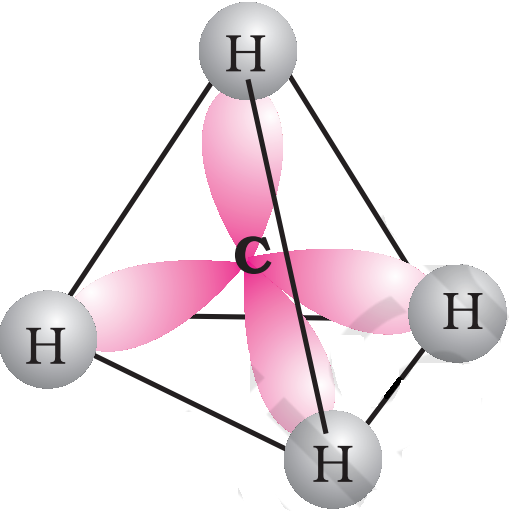
These hydrocarbons are inert under normal conditions as they do not react with acids, bases and other reagents. Hence, they were earlier known as paraffins (latin: parum, little; affinis, affinity). the general formula for alkanes is CHn + 2. It represents any particular homologue when n is given appropriate value. methane has a tetrahedral structure, in which carbon atom lies at the centre and the four hydrogen atoms lie at the four corners of a regular tetrahedron. All H-C-H bond angles are of 109.5°.

In alkanes, tetrahedra are joined together in which C-C and C-H bond lengths are 154 pm and 112 pm respectively. We have already read that C–C and C–H $\sigma$ bonds are formed by head-on overlapping of sp 3 hybrid orbitals of carbon and 1s orbitals of hydrogen atoms.

Difference in properties is due to difference in their structures, they are known as structural isomers. structural isomers which differ in chain of carbon atoms are known as chain isomers.

Preparation- Petroleum and natural gas are the main sources of alkanes. However, alkanes can be prepared by following methods:
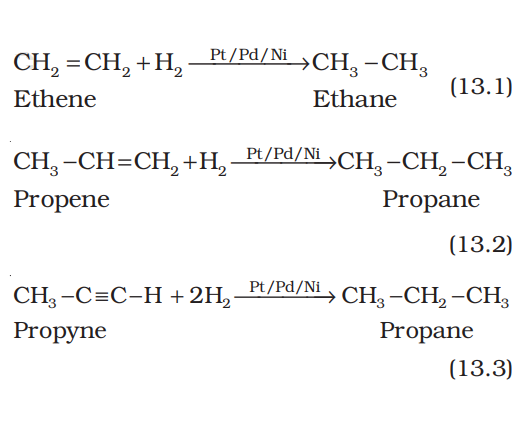
1) From unsaturated hydrocarbons Dihydrogen gas adds to alkenes and alkynes in the presence of finely divided catalysts like platinum, palladium or nickel to form alkanes. This process is called hydrogenation. These metals adsorb dihydrogen gas on their surfaces and activate the hydrogen – hydrogen bond. Platinum and palladium catalyse the reaction at room temperature but relatively higher temperature and pressure are required with nickel catalysts.

2) From alkyl halides

i) Alkyl halides (except fluorides) on reduction with zinc and dilute hydrochloric acid give alkanes.
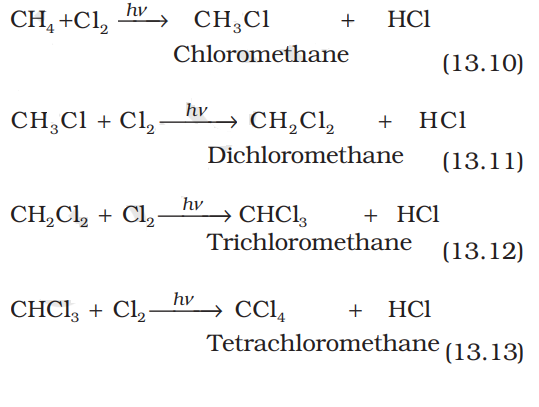
ii) Alkyl halides on treatment with sodium metal in dry ethereal (free from moisture) solution give higher alkanes. This reaction is known as Wurtz reaction and is used for the preparation of higher alkanes containing even number of carbon atoms.

  1. Which of the following catalyst is used for hydrogenation…
  1. platinum
  2. palladium
  3. nickel
  4. All the above
  1. LPG stands for ….
  1. Liquid Pressure Gas
  2. Liquefied Petroleum Gas
  3. Liquid Platinum Gas
  4. Liquid Processed Gas
  1. Difference in properties is due to difference in their structures, they are known as …. isomers.
  1. Functional
  2. Positional
  3. Structural
  4. Chain
  1. Structural isomers which differ in chain of carbon atoms are known as…  isomers.
  1. Functional
  2. Positional
  3. Structural
  4. Chain
  1. CNG Stands for ..
  1. Compressed Natural Gas
  2. Condensed Natural Gas
  3. Compressed Neutral Gas
  4. Compressed Neutral Gallium
Once an organic compound is extracted from a natural source or synthesised in the laboratory, it is essential to purify it. Various methods used for the purification of organic compounds are based on the nature of the compound and the impurity present in it. Finally, the purity of a compound is ascertained by determining its melting or boiling point. This is one of the most commonly used techniques for the purification of solid organic compounds. In crystallisation Impurities, which impart colour to the solution are removed by adsorbing over activated charcoal. In distillation Liquids having different boiling points vaporise at different temperatures. The vapours are cooled and the liquids so formed are collected separately. Steam Distillation is applied to separate substances which are steam volatile and are immiscible with water. Distillation under reduced pressure: This method is used to purify liquids having very high boiling points.

1. Which method can be used to separate two compounds with different solubilities in a solvent?
OR
Why chloroform and aniline are easily separated by the technique of distillation?
2. Distillation method is used to separate which type of substance?
3. Which technique is used to separate aniline from aniline water mixture?
IUPAC (International Union of Pure and Applied Chemistry) system of nomenclature. Common names are useful and in many cases indispensable, particularly when the alternative systematic names are lengthy and complicated. A systematic name of an organic compound is generally derived by identifying the parent hydrocarbon and the functional group(s) attached to it. By using prefixes and suffixes, the parent name can be modified to obtain the actual name. In a branched-chain compound, small chains of carbon atoms are attached at one or more carbon atoms of the parent chain. The small carbon chains (branches) are called alkyl groups. An alkyl group is derived from a saturated hydrocarbon by removing a hydrogen atom from carbon. Abbreviations are used for some alkyl groups. For example, methyl is abbreviated as Me, ethyl as Et, propyl as Pr and butyl as Bu.

1. Draw the structure of 3-Ethyl-4,4-dimethylheptane. (1)
2. How is the numbering in branched chain hydrocarbon done?
3. Derive the structure of 2-Chlorohexane. (2)
OR
Why $CH _4$ after becoming- $CH _3$ called a methyl group? (2)