Question types

Model Paper 2 question types

36 questions across 6 question groups — pick any mix to generate a Chemistry paper with step-by-step answer keys.

36
Questions
6
Question groups
5
Question types
Sample Questions

Model Paper 2 questions

One sample from each question group in this chapter. Select any group above to see the full set with answer keys.

Calculate the enthalpy change on freezing of 1.0 mol of water at $10.0^{\circ} C$ to the ice at $-10.0^{\circ} C . \Delta_{\text {fus }} H =6.03 kJ$ $\operatorname{mol}^{-1}$ at $0^{\circ} C$.
a. $C _{ P }\left[ H _2 O ( l )\right]=75.3 Jmol ^{-1} K^{-1}$
b. $C _{ P }\left[ H _2 O ( s )\right]=36.8 Jmol ^{-1} K^{-1}$
  • A
    $\Delta H =-5.231 kJmol ^{-1}$
  • $\Delta H =-7.151 kJ mol ^{-1}$
  • C
    $\Delta H =-6.114 kJmol ^{-1}$
  • D
    $\Delta H =-7.415 kJ mol ^{-1}$

Answer: B.

View full solution
In the following sequence of reactions, the alkene is converted to compound $B$ $CH _3 CH = CHCH _3 \xrightarrow{ O _3} A \xrightarrow{ H _2 O , Zn } B$
The compound $B$ ________________ is?
  • A
    $CH _3 CH _2 CHO$
  • $CH _3 CHO$
  • C
    $CH _3 COCH _3$
  • D
    $CH _3 CH _2 COCH _3$

Answer: B.

View full solution
Given $N _2(g)+3 H _2(g) \rightarrow NH _3(g) ; \Delta_r H ^{\circ}=-92.4 kJ mol ^{-1}$. What is the standard enthalpy of formation of $NH _3$ gas?
  • A
    $-41.3 kJ mol ^{-1}$
  • $-46.2 kJ mol ^{-1}$
  • C
    $-56.5 kJ mol ^{-1}$
  • D
    $-36.9 kJ mol ^{-1}$

Answer: B.

View full solution
An aqeous solution of compound A gives ethane on electrolysis. The compound A is _________________ ?
  • A
    Sodium propionate
  • Sodium acetate
  • C
    Sodium ethoxide
  • D
    Ethyl acetate

Answer: B.

View full solution
The elements charecterised by the filling of 4 f-orbitals, are:
  • A
    Alkali metals
  • B
    Alkaline earth metals
  • Lanthanoids
  • D
    Transition elements

Answer: C.

View full solution
The uncertainty in the position of a moving bullet of mass 10 g is $\Delta x m \Delta v =\frac{ h }{4 \pi}$. Calculate the uncertainty in its velocity?
View full solution
Q 113 Marks Question3 Marks
Describe what you need to do in the laboratory to test
i. the law of conservation of mass,
ii. the law of definite proportion
iii. the law of multiple proportions.
View full solution
Q 123 Marks Question3 Marks
How would you explain the fact that the first ionization enthalpy of sodium is lower than that of magnesium but its second ionization enthalpy is higher than that of magnesium?
View full solution
Q 133 Marks Question3 Marks
A photon of wavelength $4 \times 10^{-7} m$ strikes on the metal surface, the work function of metal being 2.13 eV . Calculate
i. the energy of the photon $( eV )$,
ii. the kinetic energy of emission,
iii. the velocity of the photoelectron. $\left(1 eV =1.6020 \times 10^{-19} J\right)$.
View full solution
Q 143 Marks Question3 Marks
Justify that the following reactions are redox reactions:
i. $CuO + H _2(g) \longrightarrow Cu ( s )+ H _2 O$ (g)
ii. $Fe _2 O _3$ (s) $+3 CO ( g ) \longrightarrow 2 Fe ( s )+3 CO _2$ (g)
iii. $4 BCl _3(g)+3 LiAlH _4(s) \longrightarrow 2 B_2 H _6(g)+3 LiCl ( s )+3 AlCl _3(s)$
View full solution
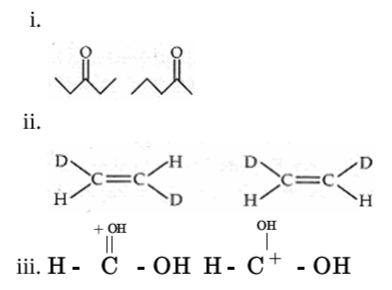
1. What is the relationship between the members of following pairs of structures? Are they structural or geometrical isomers or resonance contributors?
Image
2. A sample of 0.50 g of an organic compound was treated according to Kjeldahl's method. The ammonia evolved was absorbed in 50 mL of $0.5 M H _2 SO _4$. The residual acid required 60 mL of 0.5 M solution of NaOH for neutralisation. Find the percentage composition of nitrogen in the compound.
View full solution
On the basis of Le Chatelier principle explain how temperature and pressure can be adjusted to increase the yield of ammonia in the following reaction:
$
\begin{aligned}
& N_2(g)+3 H_2(g) \rightleftharpoons 2 NH_3(g) \\
& \Delta H=-92.38 kJmol^{-1}
\end{aligned}
$
What will be the effect of the addition of argon to the above reaction mixture at constant volume?
View full solution
Determine the degree of ionization and pH of a 0.05 M of ammonia solution. The ionization constant of ammonia can be taken from table given below.
Base$K _{ b }$
Dimethylamine, $\left( CH _3\right)_2 NH$$5.4 \times 10^{-4}$
Triethylamine, $\left( C _2 H _5\right)_3 N$$6.45 \times 10^{-5}$
Ammonia, $NH _3$ or $NH _4 OH$$1.77 \times 10^{-5}$
Quinine, (A plant product)$1.10 \times 10^{-6}$
Pyridine, $C _5 H _5 N$$1.77 \times 10^{-9}$
Aniline, $C _6 H _5 NH _2$$4.27 \times 10^{-10}$
Urea, $CO \left( NH _2\right)_2$$1.3 \times 10^{-14}$
Also, calculate the ionization constant of the conjugate acid of ammonia.
View full solution
Attempt any five of the following:
i. What is hydrogenation?
ii. Why do the $C - C$ bonds rather than $C - H$ bonds break during cracking of alkanes?
iii. Which conformation of ethane is more stable?
iv. What happens when 2-bromobutane is being treated with KOH (alcoholic)?
v. Identify the structure of A and B;
Image
vi. How will you separate propene from propyne?
vii. Why is t-butyl bromide more reactive towards $S _{ N } 1$ reaction as compared to n-butyl bromide?
View full solution
Assertion (A): In the dissociation of $PCl _5$ at constantp ressure and temperature, addition of helium at equilibrium increases the dissociation of $PCl _5$.
Reason (R): Helium reacts with $Cl _2$ and hence shifts the equilibrium in forward direction.
  • A
    Both A and R are true and R is the correct explanation of A.
  • B
    Both A and R are true but R is not the correct explanation of A.
  • A is true but R is false.
  • D
    A is false but R is true.

Answer: C.

View full solution
Assertion (A): In 285cm there are 3 significant figures.
Reason (R): Zero preceding to first non-zero digit are not significant.
  • A
    Both A and R are true and R is the correct explanation of A.
  • Both A and R are true but R is not the correct explanation of A.
  • C
    A is true but R is false.
  • D
    A is false but R is true.

Answer: B.

View full solution
Assertion (A): Components of a mixture of red and blue inks can be separated by distributing the components between stationary and mobile phases in paper chromatography.
Reason (R): The coloured components of inks migrate at different rates because paper selectively retains different components according to the difference in their partition between the two phases.
  • Both A and R are true and R is the correct explanation of A.
  • B
    Both A and R are true but R is not the correct explanation of A.
  • C
    A is true but R is false.
  • D
    A is false but R is true.

Answer: A.

View full solution
Assertion (A): Trans-2-butene on reaction with $Br _2$ gives a meso-2,3-dibromobutane.
Reason (R): The reaction involves the syn-addition of bromine.
  • A
    Both A and R are true and R is the correct explanation of A.
  • B
    Both A and R are true but R is not the correct explanation of A.
  • A is true but R is false.
  • D
    A is false but R is true.

Answer: C.

View full solution
Once an organic compound is extracted from a natural source or synthesised in the laboratory, it is essential to purify it. Various methods used for the purification of organic compounds are based on the nature of the compound and the impurity present in it. Finally, the purity of a compound is ascertained by determining its melting or boiling point. This is one of the most commonly used techniques for the purification of solid organic compounds. In crystallisation Impurities, which impart colour to the solution are removed by adsorbing over activated charcoal. In distillation Liquids having different boiling points vaporise at different temperatures. The vapours are cooled and the liquids so formed are collected separately. Steam Distillation is applied to separate substances which are steam volatile and are immiscible with water. Distillation under reduced pressure: This method is used to purify liquids having very high boiling points.

i. Which method can be used to separate two compounds with different solubilities in a solvent?
ii. Distillation method is used to separate which type of substance?
iii. Which technique is used to separate aniline from aniline water mixture?
OR
Why chloroform and aniline are easily separated by the technique of distillation?
View full solution
Covalent molecules formed by heteroatoms bound to have some ionic character. The ionic character is due to shifting of the electron pair towards A or B in the molecule AB . Hence, atoms acquire small and equal charge but opposite in sign. Such a bond which has some ionic character is described as a polar covalent bond. Polar covalent molecules can exhibit a dipole moment. The dipole moment is equal to the product of charge separation, q and the bond length, d for the bond. The unit of dipole moment is Debye. One Debye is equal to $10^{-18}$ esu cm.
The dipole moment is a vector quantity. It has both magnitude and direction. Hence, the dipole moment of molecules depends upon the relative orientation of the bond dipole, but not the polarity of bonds alone. The symmetrical structure shows a zero dipole moment. Thus, a dipole moment help to predict the geometry of the molecules. Dipole moment values can be used to distinguish between cis- and trans-isomers; ortho-, meta- and para-forms of a substance, etc. The percentage of ionic character of a bond can be calculated by the application of the following formula:
$
\% \text { ionic character }=\frac{\text { Experimental value dipole moment }}{\text { Theoretical value of dipole moment }} \times 100
$
Image
ii. A diatomic molecule has a dipole moment of 1.2 D . If the bond length is $1.0 \times 10^{-8} cm$, what fraction of charge does exist on each atom? (1)
iii. The dipole moment of $NF _3$ is very much less that of $NH _3$. Why? (2)
OR
A covalent molecule, $x-y$, is found to have a dipole moment of $1.5 \times 10^{-29} cm$ and a bond length 150 pm . What will be the percentage of ionic character of the bond? (2)
View full solution

Generate a Model Paper 2 paper free

Pick question groups from the list above, set marks and difficulty, and export a branded PDF with step-by-step answer keys. First 3 chapters free — no signup.

Download App