Question
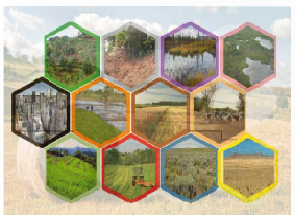
Crop Season: Different crops require different climatic conditions like temperature, moisture and photoperiods to grow well and complete their life cycle.
The Indian cropping season is classified into two main seasons- (i) Kharif and (ii) Rabi based on the monsoon.
The characteristics of these two main crop seasons are
Image
i. Mention the various cropping seasons in India.
ii. Differentiate between Rabi and Kharif crops.
iii. If there is low rainfall in a village throughout the year, what measures will you suggest to the farmers for better cropping?
OR
What is zaid crop? Give example.
Answer

i. The various cropping seasons in India are Rabi crop, Kharif crop and Zaid crop.
ii. Rabi crops are sown during the winter season which requires less water.Kharif crop is sown during the summer/rainy season which requires abundant water.
iii. Farmers are suggested to grow drought-resistant crops that can mature early. Along with this farmers are advised to use manure for their fields as it increases the water-holding capacity of the soil.
OR
There is a short season between Kharif and Rabi season in the months of March to July. The crops that grow in this season are Zaid crops. These crops are grown on irrigated lands and do not have to wait for monsoons. Some examples of Zaid types of crops are pumpkin, cucumber, and bitter gourd.

Need a full question paper?

Generate a complete, print-ready paper with questions like this in minutes — across 16+ boards, with answer keys.

Start Generating Free

Similar questions

What happens inside the matter during change of state? On increasing the temperature of solids, the kinetic energy of the particles increases. Due to the increase in kinetic energy, theParticles start vibrating with greater speed. The energy supplied by heat overcomes the forces of attraction between the particles. The particles leave their fixed positions and start moving more freely. A stage is reached when the solid melts and is converted to a liquid. The minimum temperature at which a solid melts to become a liquid at the atmospheric pressure is called its melting point.
The temperature of the system does not change after the melting point is reached, till all the ice melts. This happens even though we continue to heat the beaker, that is, we continue to supply heat. This heat gets used up in changing the state by overcoming the forces of attraction between the particles. The amount of heat energy that is required to change $1 \ kg$ of a solid into liquid at atmospheric pressure at its melting point is known as the latent heat of fusion. So, particles in water at $0^0 C (273 K)$$ have more energy as compared to particles in ice at the same temperature.
The temperature at which a liquid starts boiling at the atmospheric pressure is known as its boiling point. Boiling is a bulk phenomenon. Particles from the bulk of the liquid gain enough energy to change into the vapour state. A change of state directly from solid to gas without changing into liquid state is called sublimation and the direct change of gas to solid without changing into liquid is called deposition.
$i.)$ A change of state directly from solid to gas without changing into liquid state is called
$a.)$ Sublimation
$b.)$ Deposition
$c.)$ Boiling point
$d.)$ None of these
$ii.)$ The direct change of gas to solid without changing into liquid is called
$a.)$ Sublimation
$b.)$ Deposition
$c.)$ Boiling point
$d.)$ None of these
$iii.)$ The energy supplied by heat to solid is used to overcome the forces of attraction between the particles. True or false
$a.)$ True
$b.)$ False
$c.)$ None of these
$iv.)$ Define melting point and boiling point
$v.)$ Define latent heat of fusion
There are three liquids $A, B$ and $C$, all having different densities and different boiling points. Liquids $A$ and $C$ are organic in nature whereas liquid $B$ is considered to be inorganic. When liquids $A$ and $B$ are put together in a container, they form a single layer. On the other hand, when liquids $B$ and $C$ are mixed, they form two separate layers:
$a.$ Which process will you use to separate a mixture of $A$ and $B$ ?
$b.$ Which method will you use to separate a mixture of $B$ and $C$ ?
$c.$ Name the liquids which would behave like $(i) a (ii) B$ and $(iii) C .$
Read the following text carefully and answer the questions that follow:
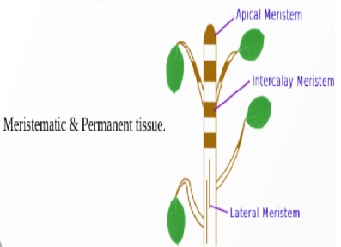
The tissue is a group of cells having similar origin, structure\& function. Study of tissues is called Histology. In unicellular organism (Amoeba) single cell performs all basic functions, whereas in multi-cellular organisms (Plants and Animals) shows division of labour as Plant tissue \& Animal tissues. Plant tissues are two types:
Image
Meristematic tissue:
The meristems are the tissues having the power of cell division. It is found on that region of the plant which grows.
Following are the types of Meristems:
The Apical meristems- It is present at the growing tip of the stem and roots and increases the length.
The lateral meristems- It present at the lateral side of stem and root (cambium) and increases the girth.
The intercalary meristems- It present at internodes or base of the leaves and increases the length between the nodes.
i. Which tissue help in the secondary growth of the plant?
ii. In what region of the plant does intercalary meristematic growth occur?
iil. Where does meristematic tissue mostly found in a plant?
Read the following text carefully and answer the questions that follow:
A solution of a solid in a liquid such as water can be prepared by adding it slowly to water with constant stirring at a certain temperature (room temperature). If the addition process is continued, a stage is ultimately reached in the dissolution process when no more of the solid dissolves. Rather it starts setlling at the bottom of the container such as a glass beaker. The solution at this stage is said to be saturated. The solubility of a solute is always expressed with respect to the saturated solution. It may be defined as the maximum amount of the solute that can be dissolved in 100 g of the solvent to form a saturated solution at a given temperature. Please remember that the role of temperature is very important. If temperature is increased, the solution becomes unsaturated. In case the temperature is decreased, the solution becomes supersaturated. As a result, crust of the solute gets deposited on the surface.
i. What do mean by the term Solubility?
ii. 20 g of a solute are dissolved in 500 g of the solvent. The solubility of the solute is:
iii. When a saturated solution becomes unsaturated?
OR
What do you mean by concentration of solution?
Read the following text carefully and answer the questions that follow:
A solution of a solid in a liquid such as water can be prepared by adding it slowly to water with constant stirring at a certain temperature $($room temperature$)$. If the addition process is continued, a stage is ultimately reached in the dissolution process when no more of the solid dissolves. Rather it starts setlling at the bottom of the container such as a glass beaker. The solution at this stage is said to be saturated. The solubility of a solute is always expressed with respect to the saturated solution. It may be defined as the maximum amount of the solute that can be dissolved in $100 g$ of the solvent to form a saturated solution at a given temperature. Please remember that the role of temperature is very important. If temperature is increased, the solution becomes unsaturated. In case the temperature is decreased, the solution becomes supersaturated. As a result, crust of the solute gets deposited on the surface.
$i.$ What do mean by the term Solubility?
$ii. 20 g$ of a solute are dissolved in 500 g of the solvent. The solubility of the solute is:
$iii.$ When a saturated solution becomes unsaturated?
OR
What do you mean by concentration of solution?
Archimedes’ principle, stated as follows: When a body is immersed fully or partiallyin a fluid, it experiences an upward force thatis equal to the weight of the fluid displacedby it. The upward force is known as up thrust or buoyant force. In fact, all objects experience a force of buoyancy when they are immersed in a fluid. The magnitude of this buoyant force depends on the density of the fluid.Objects having density less than that of the liquid in which they are immersed float on the surface of the liquid. If the density of the object is more than the density of the liquid in which it is immersed then it sinks in the liquid. Hence body will float or sink depends upon difference between density of body and fluid.
(i)The up thrust of the body is equal to the
$(a)$ Mass of liquid
$(b)$ Weight of liquid
$(c)$ Weight of liquid displaced by body
$(d)$ None of these
(ii) If the density of the object is more than the density of the liquid in which it is immersed then
$(a)$ It sinks in liquid
$(b)$ It floats on liquid
$(c)$ It comes out of liquid
$(d)$ None of these
(iii) When anybody immersed in liquid it experience a force called as
$(a)$ Gravitational force
$(b)$ Buoyancy force
$(c)$ Nuclear force
$(d)$ None of these
(iv) State Archimedes’ principle.
(v) Why does cube of plastic released deep down under the water come up to surface of water?

 
Muscular tissue consists of elongated cells, also called muscle fibres. This tissue is responsible for movement in our body. Muscles contain special proteins called contractile proteins, which contract and relax to cause movementWe can move some muscles by conscious will. Such muscles are called voluntary muscles. These muscles are also called skeletal muscles as they are mostly attached to bones and help in body movement. Under the microscope, these muscles show alternate light and dark bands or striations, hence they are also called striated muscles. The cells of this tissue are long, cylindrical, unbranched and multinucleate.
The movement of food in the alimentary canal or the contraction and relaxation of blood vessels are involuntary movements. We can’t control these muscle movement. The Smooth muscles or involuntary muscles control such movements. They are also found in the iris of the eye, in ureters and in the bronchi of the lungs. The cells are long with pointed ends (spindle-shaped) and uninucleate. They are also called unstriated muscles.
The muscles of the heart show rhythmic contraction and relaxation throughout life. These involuntary muscles are called cardiac. Heart muscle cells are cylindrical, branched and uninucleate.
(1) Which of the following muscle tissue are voluntary in nature?
$(a)$ Cardiac muscle
$(b)$ Smooth muscle
$(c)$ auto rhythmic muscle
$(d)$ None of the above
(2) The muscles whose contraction is under our control are known as
$(a)$ Voluntary muscles
$(b)$ Involuntary movements
$(c)$ Cardiac muscle
$(d)$ Unstrained muscle
(3) The smooth muscle are found in the
$(a)$ Iris of eye
$(b)$ Uterus
$(c)$ Bronchi of lungs
$(d)$ All of above
(4) Give the characteristic of striated muscles.
(5) Give the characteristic of unstriated muscles.
A solid mixture contains four constituents $P, Q, R$ and $S. P$ consists of tiny grains and it is mixed with cement for plastering the walls. $Q$ is a white solid which is recovered on a large scale from sea water by the process of evaporation. $R$ is in the form of tiny particles of a material whose corrosion is called rusting. And $S$ is a white solid which is used in making ordinary dry cells.
  1. What could $P, Q, R$ and $S$ be?
  2. How would you separate a mixture containing $P, Q, R$ and $S?$
Sound bounces off a solid or a liquid like a rubber ball bounces off a wall. Like light, soundgets reflected at the surface of a solid or liquid and follows the same laws of reflection. The directions in which the sound is incident and is reflected make equal angles with the normal to the reflecting surface at the point of incidence, and the three are in the same plane. If we clap near a suitable reflecting object such as a tall building or a mountain, we will hear the same sound again a little later. This sound which we hear is called an echo. The sensation of sound persists in our brain for about $0.1\ s$. To hear a distinct echo the time interval between the original sound and the reflected one must be at least $0.1\ s$. Hence, for hearingdistinct echoes, the minimum distance of theobstacle from the source of sound must be $17.2\ m$. Thisdistance will change with the temperature ofair. Another phenomenon of reflection of sound is reverberation.A sound created in a big hall will persist byrepeated reflection from the walls until it isreduced to a value where it is no longeraudible. The repeated reflection that resultsin this persistence of sound is called reverberation. Excessive reverberation is highly undesirable.
(i) Which of the following is true related to reflection of sound?
$(a)$ Directions in which the sound is incident and is reflected make equal angles with the normal to the reflecting surface at the point of incidence.
$(b)$ Incident wave reflected wave and normal lies in same plane
$(c)$ Both a and b are true.
$(d)$ None of these
(ii)For hearing distinct echoes, the minimum distance of the obstacle from the source of sound must be
$(a)$ $10m$
$(b)$ $20m$
$(c)$ $17.2m$
$(d)$ None of these
(iii) Excessive reverberation is
$(a)$ Desirable phenomenon
$(b)$ Undesirable phenomenon
$(c)$ Does not exist
$(d)$ None of these
(iv) A person makes sound near a obstacle and heard the echo after 1 s. What is the distance of the obstacle from the person if the speed of the sound, v is taken as 346 m/s?
(v) State law of reflection of sound.
Animalia are organisms which are eukaryotic, multicellular and heterotrophic. Their cells do not have cell-walls. They are further classified based on the extent and type of the body design differentiation found.
PORIFERA
Porifera means organisms with holes. These are non-motile animals attached to some solid support. There are holes or ‘pores’, all over the body, that helps in circulating water throughout the body to bring in food and oxygen. These animals are covered with a hard outside layer or skeleton. They are commonly called sponges, and are mainly found in marine habitats.
COELENTERATA
These are aquatic animals, show more body design differentiation. There is a cavity in the body. The body is made of twolayers of cells: one makes up cells on the outside of the body, and the other makes the inner lining of the body. Examples, Corals, Hydra, Jellyfish and sea anemones.
>
PLATYHELMINTHES
The body is bilaterally symmetrical, triploblastic. There is no true internal body cavity or coelom. The body is flattened dorsoventrally,hence these animals are called flatworms. They are either free-living or parasitic. Examples,Planarians, Liver flukes.
NEMATODES
The nematode body is bilaterally symmetrical, triploblastic, cylindrical. There are tissues, but no real organs, although a sort of body cavity or a pseudo coelom, is present. These are very familiar as parasitic worms causing diseases.Examples, the worms in the intestines (roundworm or pinworms).
ANNELIDA
Annelid body is bilaterally symmetrical, triploblastic, have a true body cavity. This allows true organs to be packaged in the body structure. These animals are found in a variety of aquatic habitats& land. Examples, Earthworms and leeches.
ARTHROPODA
This is probably the largest group of animals. These animals are bilaterally symmetrical and segmented. There is an open circulatory system, and so the blood does not flow in well-defined blood vessels. The coelomic cavity is blood-filled. They have jointed legs.Examples Butterflies, Houseflies.
MOLLUSCA
In the animals of this group, there is bilateral symmetry. The coelomic cavity is reduced. They have an open circulatory system and kidney-like organs for excretion. There is a foot that is used for moving around. Examples are snails and mussels.
ECHINODERMATA
Echinodermata are spiny skinned organisms. These are free-living marine animals. They are triploblastic and have a coelomic cavity. They also have a peculiar water-driven tube system that they use for moving around. They have hard calcium carbonate structures that they use as a skeleton. Examples are sea-stars and sea urchins.
PROTOCHORDATA
These animals are bilaterally symmetrical, triploblastic and have a coelom. They show a new feature i.e. notochord. The notochord is a long rod-like support structure that runs along the back of the animal separating the nervous tissue from the gut. It provides a place for muscles to attach for ease of movement. Protochordates may not have a proper notochord present at all stages in their lives or for the entire length of the animal. Examples are Balanoglossus, Herdmania and Amphioxus.
(1) Which of the following is a characteristic feature of Arthropod?
$(a)$ Body is bilaterally segmented
$(b)$ They have an open circulatory system
$(c)$ They have jointed legs
(d) All of the above
(2) Which of the following is not a characteristic feature ofEchinodermata?
$(a)$ Spiny skin
$(b)$ They have an open circulatory system
$(c)$ They have coelomic cavity
$(d)$ They have calcium carbonate skeleton
(3) Which of the following areexample of Arthropod?
$(a)$ Butterflies and Houseflies.
$(b)$ Balanoglossus and Herdmania.
$(c)$ Snails and Mussels.
$(d)$ Earthworms and Leeches.
(4) Give any three characteristic feature of Protochordates?
(5) Define Notochord.