MCQ
Crystal field stabilization energy for high spin $d^4$ octahedral complex is
- A$- 1.8 \Delta _o$
- B$- 1.6 \Delta _o + P$
- C$- 1.2 \Delta _o$
- ✓$- 0.6 \Delta _o$
electrons of lower energy d-orbitals would be higher than that required to place the electrons in the higher d-orbital.
Thus, pairing does not occur.
For high spin $d^{4}$ octahedral complex Crystal fleld stabilisation energy
$=(-3 \times 0.4+1 \times 0.6) \Delta_{0}$
$=(-1.2+0.6) \Delta_{0}=-0.6 \Delta_{0}$
Generate a complete, print-ready paper with questions like this in minutes — across 16+ boards, with answer keys.
$(I)$ Ionization energy $(II)$ Ionic radius
$(III)$ Bond energy of the $X_2$ molecule $(IV)$ Enthalpy of vaporisation
$[Figure]$ $\xrightarrow[{Heat}]{{NaOC{H_3}\left( {1\,eq.} \right)}}$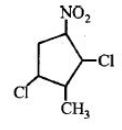

$\begin{array}{*{20}{c}}
{C{H_3}CH = C{H_2} + {H_2}O\overset {{H^ + }} \longleftrightarrow C{H_3} - CH - C{H_3}} \\
{\,\,\,\,\,\,\,\,\,\,\,\,\,\,\,\,\,\,\,\,\,\,\,\,\,\,\,\,\,\,\,\,\,\,\,\,\,\,\,\,\,\,\,\,\,\,\,\,\,\,\,\,\,\,\,\,\,\,\,\,\,\,\,\,\,\,\,\,\,|} \\
{\,\,\,\,\,\,\,\,\,\,\,\,\,\,\,\,\,\,\,\,\,\,\,\,\,\,\,\,\,\,\,\,\,\,\,\,\,\,\,\,\,\,\,\,\,\,\,\,\,\,\,\,\,\,\,\,\,\,\,\,\,\,\,\,\,\,\,\,\,\,\,\,\,\,\,OH}
\end{array}$
The reaction takes place in accordance with