MCQ
$Cu^{+2} + 2e^-\to Cu$ ,    $E^o = X_1$

$Cu^+ + e^-\to Cu$,      $E^o = X_2$

Calculate $E^o$ for $Cu^{+2} + e^-\to Cu^+$

  • A
    $2X_2 -X_1$
  • $2X_1 -X_2$
  • C
    $X_1 -X_2$
  • D
    $2X_2 -X_1$

Answer

Correct option: B.
$2X_1 -X_2$
b
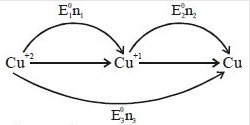
$\mathrm{E}_{1}^{0} \mathrm{n}_{1}+\mathrm{E}_{2}^{0} \mathrm{n}_{2}=\mathrm{E}_{3}^{0} \mathrm{n}_{3}$

$\mathrm{E}^{0} \times 1+\mathrm{X}_{2} \times 1=\mathrm{X}_{1} \times 2$

$\mathrm{E}^{0}=2 \mathrm{X}_{1}-\mathrm{X}_{2}$
Need a full question paper?

Generate a complete, print-ready paper with questions like this in minutes — across 16+ boards, with answer keys.
Start Generating Free

Similar questions

The partial pressures of $C{H_3}OH,\,CO$ and ${H_2}$ in the equilibrium mixture for the reaction $CO + 2{H_2}$ $\rightleftharpoons$ $CH_3OH$ at $427\,^oC$ are $2.0$, $1.0$ and $0.1$ $atm$ respectively. The value of ${K_P}$ for the decomposition of $C{H_3}OH$ to $CO$ and ${H_2}$ is
$\begin{array}{*{20}{c}}
  {C{H_3} - CH - C{H_3}\xrightarrow{{PB{r_3}}}X\xrightarrow{{{\text{Mg/ether}}}}Y\,\xrightarrow{{{{\text{H}}_2}{\text{O/}}{{\text{H}}^ + }}}} \\ 
  {|\,\,\,\,\,\,\,\,\,\,\,\,\,\,\,\,\,\,\,\,\,\,\,\,\,\,\,\,\,\,\,\,\,\,\,\,\,\,\,\,\,\,\,\,\,\,\,\,\,\,\,\,\,\,\,\,\,\,\,\,\,\,\,\,\,\,\,\,\,\,\,\,\,\,} \\ 
  {OH\,\,\,\,\,\,\,\,\,\,\,\,\,\,\,\,\,\,\,\,\,\,\,\,\,\,\,\,\,\,\,\,\,\,\,\,\,\,\,\,\,\,\,\,\,\,\,\,\,\,\,\,\,\,\,\,\,\,\,\,\,\,\,\,\,\,\,\,\,} 
\end{array}$ The final product is
The oxidation state of $Cr$ in $C{r_2}O_7^{2 - }$ is
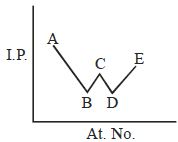
If $A$ to $E$ are element of a group from top to bottom then group can be
An optically active compound $'X'$ having molecular formula $C_4H_8O_3$ it evolves $CO_2$ with $NaHCO_3.\,'x'$ on treatment with $LiAlH_4$ gives achiral compound then $'x'$ is
In the reaction $N{H_3} + B{F_3} $ $\rightleftharpoons$ $ N{H_3} \to B{F_3},\,\,B{F_3}$ is
Which of the following expression is correct
Based on the following information arrange four metals, $A, B, C$ and $D$ in order of increasing ability to act as reducing agents

$(I)$ Only $C$ react with $0.10\, M\, HCl$ to give $H_2(g)$

$(II)$ When $A$ is added to solution of the other metal ions, metallic $D$ is formed but not $B$ or $C$

On the basis of the following $E^o$ values, the strongest oxidizing agent is

${[Fe\,{(CN)_6}]^{4 - }}\, \to \,{[Fe{(CN)_6}]^{3 - }}\, + \,{e^ - }\,;\,$ ${E^o}\, = \, - \,0.35\,V$

$\,F{e^{2 + }}\, \to \,F{e^{3 + }}\, + \,{e^ - }\,;$                                 ${E^o}\, = \, - \,0.77\,V$

The distance between two adjuscent carbonn atoms is maximum in