MCQ
$Cu^{2+} + 2e^-\to Cu$. On increasing $[Cu^{2+}]$ concentration, electrode potential
- ✓Increases
- BDecreases
- CWill remain unchanged
- DFirst increases, then decreases
$\mathrm{E}_{\mathrm{Cu}^{2+} / \mathrm{Cu}}=\mathrm{E}_{\mathrm{Cu}^{2+} / \mathrm{Cu}}^{0}-\frac{0.06}{2} \log \left|\frac{1}{\mathrm{Cu}^{2+}}\right|$
$=\mathrm{E}_{\mathrm{Cu}^{2+} / \mathrm{Cu}}^{0}+\frac{0.06}{2} \log \left|\mathrm{Cu}^{2+}\right|$
$\left|\mathrm{Cu}^{2+}\right|$ increases, $\mathrm{E}_{\mathrm{Cu}^{2+} / \mathrm{Cu}}$ also increases
Generate a complete, print-ready paper with questions like this in minutes — across 16+ boards, with answer keys.
| Column-$I$ | Column-$II$ |
| $(A)$ $\left[\mathrm{Co}\left(\mathrm{NH}_3\right)_4\left(\mathrm{H}_2 \mathrm{O}\right)_2\right] \mathrm{Cl}_2$ | $(p)$ geometrical isomers |
| $(B)$ $\left[\mathrm{Pt}\left(\mathrm{NH}_3\right)_2 \mathrm{Cl}_2\right]$ | $(q)$ paramagnetic |
| $(C)$ $\left[\mathrm{Co}\left(\mathrm{H}_2 \mathrm{O}\right)_5 \mathrm{Cl}\right] \mathrm{Cl}$ | $(r)$ diamagnetic |
| $(D)$ $\left[\mathrm{Ni}\left(\mathrm{H}_2 \mathrm{O}\right)_6\right] \mathrm{Cl}_2$ | $(s)$ metal ion with $+2$ oxidation state |
Which one of the following options represents identical molecules?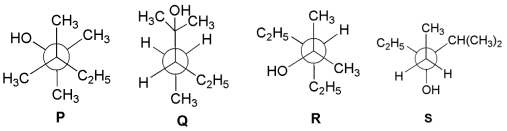
$A \to B$ ${k_1} = {10^{15}}{e^{ - 25000/8.34\,T}}$
$C \to D$ ${k_2} = {10^{14}}{e^{ - 15000/8.34\,T}}$
Calculate the approximate temperature at which $k_1 = k_2$ ...... $K$
$2Al{(s)}+6HCl{(aq)} \rightarrow 2Al^{^{3+}}{(aq)}+6Cl^-{(aq)} +3H_2{(g)}$