MCQ
Cuprous ion is colourless while cupric ion is coloured because
  • A
    Both have half filled $p $ and $d-$ orbitals
  • B
    Cuprous ion has incomplete $d-$ orbital and cupric ion has a complete $d-$ orbital
  • C
    Both have unpaired electrons in the $d-$ orbitals
  • Cuprous ion has a complete $ d-$ orbital and cupric ion has an incomplete $ d-$ orbital

Answer

Correct option: D.
Cuprous ion has a complete $ d-$ orbital and cupric ion has an incomplete $ d-$ orbital
d
It’s Obvious.
 

Need a full question paper?

Generate a complete, print-ready paper with questions like this in minutes — across 16+ boards, with answer keys.

Start Generating Free

Similar questions

What is the effect of the addition of sugar on the boiling and freezing points of water
The rate constant, the activation energy and the arrhenius parameter of a chemical reaction at ${25\,^o}C$ are $3.0 \times {10^{ - 4}}\,{s^{ - 1}}$, $104.4\,kJ\,mo{l^{ - 1}}$ and $6.0 \times {10^{14}}\,{s^{ - 1}}$ respectively. The value of the rate constant as $T \to \infty $ is
Starting with three different amino acid molecules, how many different tripeptide molecules are formed
$SO_2$ is a strong reducing agent however it can also act as an oxidising agent. Which of the following shows its oxidising nature ?
Choose the correct option having all the elements with $\mathrm{d}^{10}$ electronic configuration from the following:
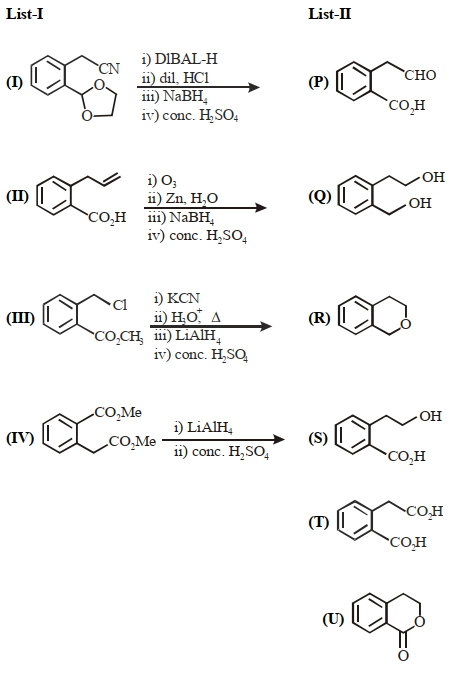
Answer the following by appropriately matching the lists based on the information given in the paragraph $List-I$ includess starting materials and reagents of selected chemical reactions. $List-II$ gives structures of compounds that may be formed as intermediate products and/or final products from the reactions of $List-I$

($1$) Which of the following options has correct combination considering $List-I$ and $List-II$?

$(1) (III), (S), (R)$ $(2) (IV), (Q), (R)$ $(3) (III), (T), (U)$ $(4) (IV), (Q), (U)$

($2$) Which of the following options has correct combination considering $List-I$ and $List-II$?

$(1) (I), (Q), (T), (U)$ $(2) (II), (P), (S), (U)$ $(3) (II), (P), (S), (T)$ $(4) (I), (S), (Q), (R)$

Give the answer quetion ($1$) and ($2$)
Which of the following does not show mutarotation
Which one is used as a food preservative
Standard electrode potential for Daniell cell is 1.1 V. What will be the standard Gibbs energy for the reaction:
$Zn _{( s )}+ Cu _{( aq )}^{2+} \rightarrow Zn _{( aq )}^{2+}+ Cu _{( s )}\left( F =96487 C mol ^{-1}\right)$
Which one has the highest percentage of nitrogen