MCQ
Curie temperature is the temperature above which:
  • A
    Paramagnetic material becomes ferromagnetic material.
  • B
    Ferromagnetic material becomes diamgnetic material.
  • Ferromagnetic material becomes paramagnetic material.
  • D
    Paramagnetic material becomes diamagnetic material.
Answer

Correct option: C.
Ferromagnetic material becomes paramagnetic material.
The Curie temperature $(T_C)$ is the temperature at which certain materials lose their permanent magnetic properties, to be replaced by induced magnetism, that is, they go from becoming ferromagnetic to paramagnetic.
Above curie temperature, ferromagnetic material behaves as paramegnetic material.

Need a full question paper?

Generate a complete, print-ready paper with questions like this in minutes — across 16+ boards, with answer keys.

Start Generating Free

Similar questions

Two tangent galvanometer coils of same radius connected in series. The current flowing produces deflection of $60^o$ and $45^o$. The ratio of number of turns in coil is
Hydrogen atom excites energy level from fundamental state to $n = 3.$ Number of spectrum lines according to Bohr, is
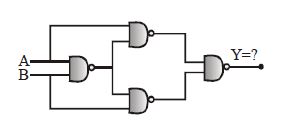
In the following logic circuit the sequence of the inputs ${A}, {B}$ are $(0,0),(0,1),(1,0)$ and $(1,1)$. The output $Y$ for this sequence will be :
A glass hemisphere of radius 0.04 m and R.I. of the material 1.6 is placed centrally over a cross mark on a paper
(i) with the flat face;
(ii) with the curved face in contact with the paper. In each case the cross mark is viewed directly from above. The position of the images will be
When an electron in a hydrogen atom makes a transition from $2^{nd}$ excited state to ground state, it emits a photon of frequency $f$ . The frequency of photon emitted when an electron of $Li^{++}$ makes a transition from $1^{st}$ excited state to ground state is
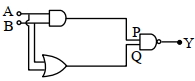
Select the outputs $Y$ of the combination of gates shown below for inputs $A = 0, B = 0; A = 1$, $B = 1$ and $A = 0, B = 1$ respectively
The phase difference between input and output voltages of a $\ce{CE}$ circuit is
A wire of fixed length is wound on a solenoid of length $l$ and radius $r$. Its self-inductance is found to be $L$. Now, if the same wire is wound on a solenoid of length $\frac{1}{2}$ and radius $\frac{\text{r}}{2},$ then the self$-$inductance will be
Let $\rho (r)\, = \frac{Q}{{\pi {R^4}}}\,r$ be the volume charge density distribution for a solid sphere of radius $R$ and total charge $Q$. For a point $'p'$ inside the sphere at distance $r_1$ from the centre of the sphere, the magnitude of electric field is
The energy of a charged capacitor is given by the expression (q = charge on the conductor and C = its capacity)