MCQ
Current carrier in conductors is ____?
- AElectron
- BProton
- CNeutron
- DPositron
Explanation:
Conductors have lots of free electrons that can carry electricity if the potential difference is applied across them. Protons are positively charged particle and Neutron are electrically neutral. They don’t carry electricity in conductors.
Generate a complete, print-ready paper with questions like this in minutes — across 16+ boards, with answer keys.
In  nucleus, there are
|
(a) 138 protons and 88 neutrons |
(b) 138 neutrons and 88 protons |
|
(c) 226 protons and 88 electrons |
(d) 226 neutrons and 138 electrons |
At any instant the ratio of the amount of radioactive substances is 2 : 1. If their half lives be respectively 12 and 16 hours, then after two days, what will be the ratio of the substances
|
(a) 1 : 1 |
(b) 2 : 1 |
(c) 1 : 2 |
(d) 1 : 4 |
A closely wound flat circular coil of 25 turns of wire has diameter of 10 cm and carries a current of 4 ampere. Determine the flux density at the centre of a coil
|
(a) 1.679 |
(b) 2.028 |
|
(c) 1.257 |
(d) 1.512 |
The self inductance of a coil is L. Keeping the length and area same, the number of turns in the coil is increased to four times. The self inductance of the coil will now be
|
(a) |
(b) L |
(c) 4 L |
(d) 16 L |
Force of attraction between two point charges Q and -Q separated by d metre is  . When these charges are placed on two identical spheres of radius R = 0.3d whose centres are d metre apart, the force of attraction between them is
|
(a) Greater than
|
(b) Equal to
|
(c) Less than |
(d) Less than |
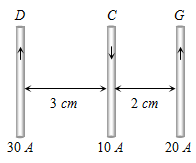
Three long, straight parallel wires carrying current, are arranged as shown in figure. The force experienced by a 25 cm length of wire C is
|
(a) 10-3 N |
(b) 2.5 ×10⁻³ N |
(c) Zero |
(d) 1.5 × 10⁻³ N |


