MCQ
Current in the circuit is wattless, if.
  • A
    Inductance in the circuit is zero
  • Resistance in the circuit is zero
  • C
    Current is alternating
  • D
    Resistance and inductance both are zero

Answer

Correct option: B.
Resistance in the circuit is zero

Current in the circuit is wattless,
Because power $=i^2 R$, if $R=0$, then $P=0$.

Need a full question paper?

Generate a complete, print-ready paper with questions like this in minutes — across 16+ boards, with answer keys.
Start Generating Free

Similar questions

To draw maximum current from a combination of cells, how should the cells be grouped
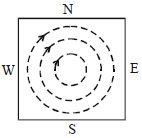
A metal sheet placed in magnetic field, which changes from zero to maximum. If figure  showns direction of eddy currents then direction of magnetic field is
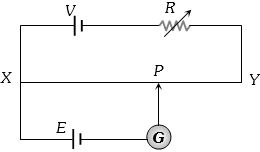
A potentiometer circuit shown in the figure is set up to measure $e.m.f.$ of a cell $E$. As the point $P$ moves from $X$ to $Y$ the galvanometer $G$ shows deflection always in one direction, but the deflection decreases continuously until $Y$ is reached. In order to obtain balance point between $X$ and $Y$ it is necessary to
Which of the following is the radio isotope in this pair? $39​\text{K}\\19$,$40\text{K}\\19$
Light from a hydrogen discharge tube is incident on the cathode of a photoelectric cell the work function of the cathode surface is $4.2\ eV$. In order to reduce the photo-current to zero the voltage of the anode relative to the cathode must be made ........... $V$
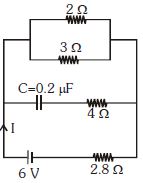
In the given figure the steady state current $I$ is ................. $\mathrm{A}$
The ratio of the speed of the electrons in the ground state of hydrogen to the speed of light in vacuum is
The magnetic field around a long straight current carrying wire is:
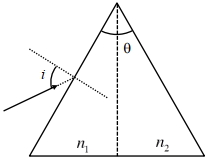
For a prism of prism angle $\theta=60^{\circ}$, the refractive indices of the left half and the right half are, respectively, $n_1$ and $n_2\left(n_2 \geq n_1\right)$ as shown in the figure. The angle of incidence $i$ is chosen such that the incident light rays will have minimum deviation if $n_1=n_2=n=1.5$. For the case of unequal refractive indices, $n_1=n$ and $n_2=n+\Delta n$ (where $\Delta n \ll n$ ), the angle of emergence $e=i+\Delta e$.

Which of the following statement($s$) is (are) correct?

$(A)$ The value of $\Delta e$ (in radians) is greater than that of $\Delta n$

$(B)$ $\Delta e$ is proportional to $\Delta n$

$(C)$ $\Delta e$ lies between 2.0 and 3.0 milliradians, if $\Delta n=2.8 \times 10^{-3}$

$(D)$ $\Delta e$ lies between 1.0 and 1.6 milliradians, if $\Delta n=2.8 \times 10^{-3}$
The transistors provide good power amplification when they are used in