Question
Current is allowed to flow in a metallic wire at a constant potential difference. When the wire becomes hot, cold water is poured on half of its portion. By doing so, its other half portion becomes still more hot. Explain its reason.

Answer

When cold water is poured on half the wire, the resistance of this portion decreases, and hence the current $\text{I}=\frac{\text{V}}{\text{R}}$ in whole wire increases and so the other half portion becomes still more hot.

Need a full question paper?

Generate a complete, print-ready paper with questions like this in minutes — across 16+ boards, with answer keys.
Start Generating Free

Similar questions

$12J$ of work has to be done against an existing electric field to take a charge of $0.01C$ from $A$ to $B.$ How much is the potential difference $V_B - V_A?$
What was the difficulty with the wave theory ? How was this difficulty explained using Maxwell's Electro-magnetic wave theory ?
Light falls from glass $(\mu=1.5)$ to air. Find the angle of incidence for which the angle of deviation is 90°.
If a compressed spring is dissolved in acid, what happened to the elastic potential energy of the spring?
What is electron emission ? Explain its types.
Using Bohr’s postulates of the atomic model, derive the expression for radius of $n^{th}$ electron orbit. Hence obtain the expression for Bohr’s radius.
In double$-$slit experiment using light of wavelength $600\ nm,$ the angular width of a fringe formed on a distant screen is $0.1^\circ .$ What is the spacing between the two slits?
Two point electric charges of unknown magnitude and sign are placed at some distance ‘d’ apart. The electric field intensity is zero at a point, not between the charges but on the line joining them.
Write two essential conditions for this to happen.
Can the potential barrier across a p-n junction be measured by simply connecting a voltmeter across the junction?
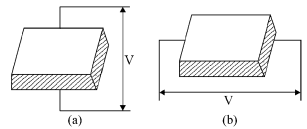
In a given figure, a rectangular object is shown. Its length is I, breadth is 0.5 I and thickness 0.25 I . To measure its resistance, potential difference $V$ is applied in two ways [figure (a) and (b)]. In which arrangement, the resistance of the substance will be more?
Image