Question
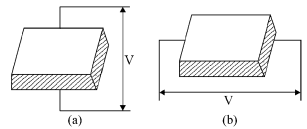
In a given figure, a rectangular object is shown. Its length is I, breadth is 0.5 I and thickness 0.25 I . To measure its resistance, potential difference $V$ is applied in two ways [figure (a) and (b)]. In which arrangement, the resistance of the substance will be more?
Image

Answer

If resistance in both states is $R_1$ and $R_2$
By definition of resistance,$R =\rho \frac{l}{A}$
$R _1=\frac{\rho(0.25 l)}{(l)(0.5 l)}=\frac{\rho}{2 l}$
and $R _2=\frac{(\rho)(l)}{(0.5 l)(0.25 l)}=\frac{8 \rho}{l}$
i.e. $\quad R _2> R _1$
Although the resistance of substance does not depend on potential difference and current but depends on the area of the cross section from which current enters.

Need a full question paper?

Generate a complete, print-ready paper with questions like this in minutes — across 16+ boards, with answer keys.

Start Generating Free

Similar questions

A cell of emf ‘E’ and internal resistance ‘r’ is connected across a variable resistor ‘R’. Plot a graph showing the variation of terminal potential ‘V’ with resistance R. Predict from the graph the condition under which ‘V’ becomes equal to ‘E’.
An electric field $\vec{\text{E}}=\vec{\text{i}}\text{Ax}$ exists in the space, where $A= 10Vm^{-2}.$ Take the potential at $(10m, 20m)$ to be zero. Find the potential at the origin.
Explain the dependence of the electric potential generated at a great distance due to a small electric dipole, when the point of observation is (i) in the axial position, and (ii) in the equatorial position.
In the first excited state of the hydrogen atom, its radius is found to be $21.2 \times 10^{-11} m$. Calculate its Bohr radius in the ground state. Also, calculate the total energy of the atom in the second excited state.
An electron beam projected along the positive X-axis deflects along the positive Y-axis. If this deflection is caused by a magnetic field, what is the direction of the field? Can we conclude that the field is parallel to the Z-axis?
A 12·5 eV electron beam is used to excite a gaseous hydrogen atom at room temperature. Determine the wavelengths and the corresponding series of the lines emitted.
Explain destructive interference using proper $($appropriate$)$ example.
A parallel plate capacitor made of circular plates each of radius $R = 6.0 \ cm$ has a capacitance $C = 100 pF$. The capacitor is connected to a $230 V$ ac supply with a $($angular$)$ frequency of $300 \ \text{rad s}_{^{-1}}.$
  1. What is the rms value of the conduction current?
  2. Is the conduction current equal to the displacement current?
  3. Determine the amplitude of $B$ at a point $3.0 \ cm$ from the axis between the plates.
The angular magnification of a system is less than one. Does it mean that the image formed is inverted?
A neutron having kinetic energy 12.5eV collides with a hydrogen atom at rest. Nelgect the difference in mass between the neutron and the hydrogen atom and assume that the neutron does not leave its line of motion. Find the possible kinetic energies of the neutron after the event.