Question
Current is allowed to flow in a metallic wire at a constant potential difference. When the wire becomes hot, cold water is poured on half of its portion. By doing so, its other half portion becomes still more hot. Explain its reason.

Answer

When cold water is poured on half the wire, the resistance of this portion decreases, and hence the current $\text{I}=\frac{\text{V}}{\text{R}}$ in whole wire increases and so the other half portion becomes still more hot.

Need a full question paper?

Generate a complete, print-ready paper with questions like this in minutes — across 16+ boards, with answer keys.
Start Generating Free

Similar questions

Distinguish between intrinsic and extrinsic semiconductors. Although in an extrinsic semiconductor $n_e \neq n_h$, yet it is electrically neutral. Why?
In a solenoid, there are 500 turns/meter and current flowing in it is 5 A . Length of the solenoid is 0.5 m and its radius is 1 cm . Calculate the intensity of magnetic field inside the solenoid.
Consider a gold nucleus to be a sphere of radius 6.9 fermi in which protons and neutrons are distributed. Find the force of repulsion between two protons situated at largest separation. Why do these protons not fly apart under this repulsion?
A hollow spherical body of inner and outer radii 6cm and 8cm respectively floats half submerged in water. Find the density of the material of the sphere.
A glass contains some water at room temperature 20°C. Refrigerated water is added to it slowly. When the temperature of the glass reaches 10°C, small droplets condense on the outer surface. Calculate the relative humidity in the room. The boiling point of water at a pressure of 17.5mm of mercury is 20°C and at 8.9mm of mercury it is 10°c.
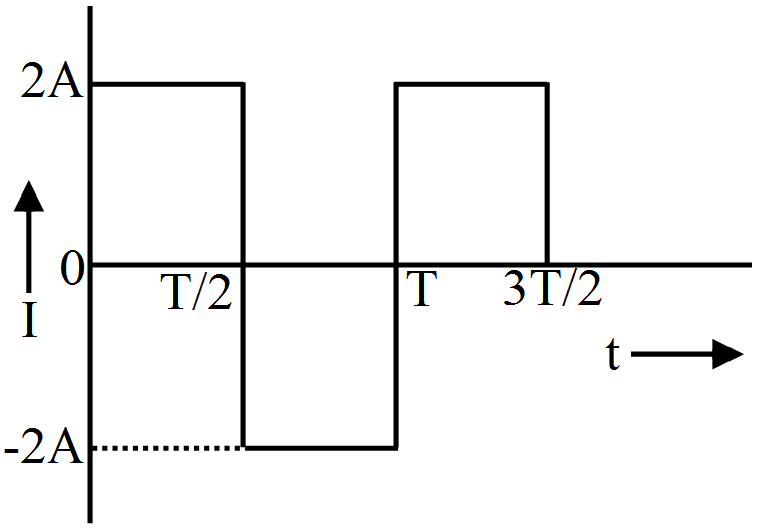
What is the rms value of alternating current shown in figure?
A beam of protons with a velocity $4 \times 10^5\ m / s$ enters a uniform magnetic field of $0.3 T$ at an angle $60^{\circ}$ to the magnetic field. Find the radius of the helical path taken by the proton beam. Also find the pitch of the helix mp $=1.67 \times 10^{-27} k$
Consider Experiment 6.2. (a) What would you do to obtain a large deflection of the galvanometer? (b) How would you demonstrate the presence of an induced current in the absence of a galvanometer?
The electric field and electric potential at any point due to a point charge kept in air is $20 NC^{-1}$ and $10 NC^{-1}$ respectively. Compute the magnitude of this charge.
A and B are two conducting spheres of equal radius, in which sphere $A$ is solid and sphere $B$ is hollow. Both are charged to the same potential. What will be the relation between the charges on both the spheres?