Question
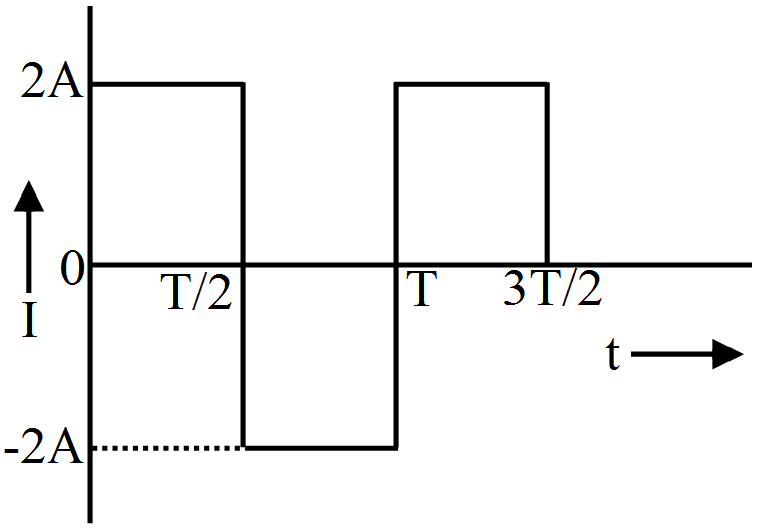
What is the rms value of alternating current shown in figure?

Answer

$(\text{I}^2)_{\text{mean}}=\frac{\int\limits^{\text{T}}_{0}\text{I}^2\text{dt}}{\int\text{dt}}=\frac{\int\limits^{\frac{\text{T}}{2}}_0(2)^2\text{dt}+\int\limits^{\text{T}}_{\frac{\text{T}}{2}}(-2)^2\text{dt}}{\text{T}}=\frac{\int\limits^{\text{T}}_04\text{dt}}{\text{T}}=4$
$\text{I}_{\text{rms}}=\sqrt{4}=2\text{A}$

Need a full question paper?

Generate a complete, print-ready paper with questions like this in minutes — across 16+ boards, with answer keys.
Start Generating Free

Similar questions

What is optically denser and optically rarer medium?
Explain network, junction point (branch point) and loop.
What is absolute refractive index? On what factors does it depend ?
Balmer series was observed and analysed before the other series. Can you suggest a reason for such an order?
Answer the following question:
Quarks inside protons and neutrons are thought to carry fractional charges [(+2/3)e ; (–1/3)e]. Why do they not show up in Millikan’s oil-drop experiment?
Distinguish between polarised and unpolarized light. Does the intensity of polarised light emitted by a Polaroid depend on its orientation? Explain briefly.
The vibrations in a beam of polarised light make an angle of 60° with the axis of the polaroid sheet. What percentage of light is transmitted through the sheet?
A ferry boat has internal volume $1m^3$ and weight 50kg.
  1. Neglecting the thickness of the wood, find the fraction of the volume of the boat immersed in water.
  2. If aleak develops in the bottom and water starts coming in, what fraction of the boat's volume will be filled with water before water starts coming in from the sides?
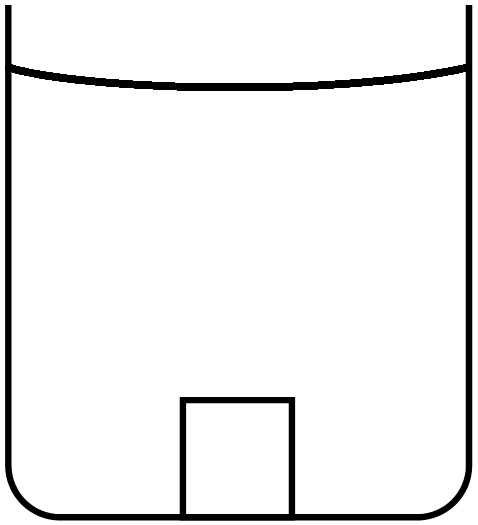
A metal piece of mass 160g lies in equilibrium inside a glass of water The piece touches the bottom of the glass at a small number of points. If the density of the metal is $8000kg/m^3$, find the normal force exerted by the bottom of the glass on the metal piece.
Explain the refraction of light from a denser medium to a rarer medium, using Huygen's principle.
Calculate the potential energy of a system of two charges in an external field.