MCQ
Current is flowing in two parallel good conducting wires in the same direction. They will
- Aattract each other
- Brepel each other
- ✓not exert any force
- Dbe perpendicular to each other
Generate a complete, print-ready paper with questions like this in minutes — across 16+ boards, with answer keys.
A luminous object is placed at a distance of 30 cm from the convex lens of focal length 20 cm. On the other side of the lens, at what distance from the lens a convex mirror of radius of curvature 10 cm be placed in order to have an upright image of the object coincident with it
| (a) 12 cm | (b) 30 cm |
(c) 50 cm |
(d) 60 cm |
Which statement is correct
|
(a) N-type germanium is negatively charged and P-type germanium is positively charged |
|
(b) Both N-type and P-type germanium are neutral |
|
(c) N-type germanium is positively charged and P-type germanium is negatively charged |
|
(d) Both N-type and P-type germanium are negatively charged |
In the following arrangement y = 1.0 mm, d = 0.24 mm and D = 1.2 m. The work function of the material of the emitter is 2.2 eV. The stopping potential V needed to stop the photo current will be
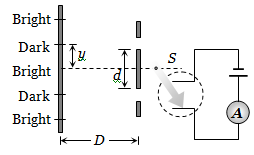
|
(a) 0.9 V |
(b) 0.5 V |
(c) 0.4 V |
(d) 0.1 V |
A square of side ‘a’ has charge Q at its centre and charge ‘q’ at one of the corners. The work required to be done in moving the charge ‘q’ from the corner to the diagonally opposite corner is
|
(a) Zero |
(b) |
(c) |
(d) |
An alternating voltage of 141.4V (rms) is applied to a vacuum diode as shown in the figure. The maximum potential difference across the condenser will be

|
(a) 100 V |
(b) 200 V |
(c) 100 |
(d) 200 |
A cut diamond sparkles because of its
|
(a) Hardness |
(b) High refractive index |
|
(c) Emission of light by the diamond |
(d) Absorption of light by the diamond |
Which of the following are not electromagnetic waves
|
(a) Cosmic rays |
(b) Gamma rays |
(c) b-rays |
(d) X-rays |
The cut-in voltage for silicon diode is approximately
| (a) 0.2 V | (b) 0.6 V | (c) 1.1 V | (d) 1.4 V |


