MCQ
Current provided by a battery is maximum when
- ✓Internal resistance equal to external resistance
- BInternal resistance is greater than external resistance
- CInternal resistance is less than external resistance
- DNone of these
sending current in an external resistance $\mathrm{R}$. Then current in the external circuit be i, then $i=\frac{m n E}{n r+m R}$
It is clear from this equation, that for current to be maximum the value of $(\mathrm{nr}+\mathrm{mR})$ shouid be minimum ie, $n r+m R=[\sqrt{n r}-\sqrt{m R}]^{2}+2 \sqrt{m n R r}$
It's minimum value is zero.
ie, $[\sqrt{n r}-\sqrt{m R}]^{2}=0$
$\sqrt{n r}-\sqrt{m R}=0$
$n r=m R$
$\Rightarrow R=\frac{n r}{m}$
but $\frac{n r}{m}$ is the internal resistance of the whole battery. Thus, current is maximum when the internal resistance of battery is equal to external resistance.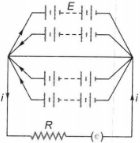
Generate a complete, print-ready paper with questions like this in minutes — across 16+ boards, with answer keys.