MCQ
Current sensitivity of a moving coil galvanometer is $5\,div/mA$ and its voltage sensitivity (angular deflection per unit voltage applied) is $20\,div/V$. The resistance of the galvanometer is ................. $\Omega$
  • A
    $40$
  • B
    $25$
  • C
    $500$
  • $ 250$

Answer

Correct option: D.
$ 250$
d
Current sensitivity

$\mathrm{I}_{\mathrm{s}}=\frac{\mathrm{NBA}}{\mathrm{c}}$

Voltage sensitivity

$\mathrm{v}_{\mathrm{s}}=\frac{\mathrm{NBA}}{\mathrm{CR}_{\mathrm{G}}}$

So, resistance of galvanometer

$R_{G}=\frac{l_{s}}{V_{s}}=\frac{5 \times 1}{20 \times 10^{-3}}=\frac{5000}{20}=250\, \Omega$

Need a full question paper?

Generate a complete, print-ready paper with questions like this in minutes — across 16+ boards, with answer keys.

Start Generating Free

Similar questions

On mixing the salt in water, the surface tension of water will
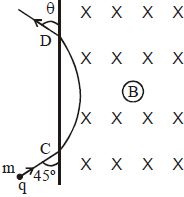
A particle of mass $m = 1.67 \times 10^{-27}\, kg$ and charge $q = 1.6 \times 10^{-19} \, C$ enters a region of uniform magnetic field of strength $1$ $tesla$ along the direction shown in the figure. If the direction of the magnetic field is along the outward normal to the plane of the paper, then the time spent by the particle in the region of the magnetic field after entering it at $C$ is nearly :-......$ns$
Which of following can not be polarised
A string of $7 \;m$ length has a mass of $0.035\,kg$. If tension in the string is $60.5\; N,$ then speed of a wave on the string is .... $m/s$
The potential due to an electrostatic charge distribution is $V(r)=\frac{q e^{-\alpha e r}}{4 \pi \varepsilon_{0} r}$, where $\alpha$ is positive. The net charge within a sphere centred at the origin and of radius $1/ \alpha$ is
An observer starts moving with uniform acceleration $a$ toward a stationary sound source emitting a whistle of frequency $n.$ As the observer approaches source, the apparent frequency, heard by the observer varies with time as
A particle executes simple harmonic motion with an amplitude of $5\, cm$. When the particle is at $4\, cm$ from the mean position, the magnitude of its velocity is $SI\,units$ is equal to that of its acceleration. Then, its periodic time in seconds is
A uniform cylinder of length $L$ and mass $M$ having cross-sectional area $A$ is suspended, with its length vertical, from a fixed point by a massless spring, such that it is half submerged in a liquid of density $\sigma $ at equilibrium position. When the cylinder is given a downward push and released, it starts oscillating vertically with a small amplitude. The time period $T$ of the oscillations of the cylinder will be
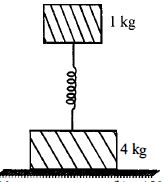
Two bodies of masses $1\, kg$ and $4\, kg$ are connected to a vertical spring, as shown in the figure. The smaller mass executes simple harmonic motion of angular frequency $25\, rad/s$, and amplitude $1.6\, cm$ while the bigger mass remains stationary on the ground. The maximum force exerted by the system on the floor is ..... $N$ ( take $g = 10\, ms^{-2}$)
The graph between wave number $(\bar \nu )$ and angular frequency ($\omega$) is