Two bodies of masses $1\, kg$ and $4\, kg$ are connected to a vertical spring, as shown in the figure. The smaller mass executes simple harmonic motion of angular frequency $25\, rad/s$, and amplitude $1.6\, cm$ while the bigger mass remains stationary on the ground. The maximum force exerted by the system on the floor is ..... $N$ ( take $g = 10\, ms^{-2}$)
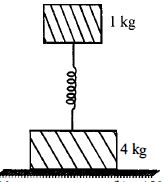
JEE MAIN 2014, Diffcult
Download our app for free and get started
Mass of bigger body $M=4 \mathrm{kg}$
Mass of smaller body $\mathrm{m}=1 \mathrm{kg}$
Smaller mass $(\mathrm{m}=1 \mathrm{kg})$ $executes \,S.H.M \,of$
angular frequency $\omega=25$ rad $/ \mathrm{s}$
Amplitude $x=1.6 \mathrm{cm}=1.6 \times 10^{-2}$
As we know,
$\mathrm{T}=2 \pi \sqrt{\frac{\mathrm{m}}{\mathrm{K}}}$
$\boldsymbol{\alpha}, \quad \frac{2 \pi}{\omega}=2 \pi \sqrt{\frac{\mathrm{m}}{\mathrm{K}}}$
or, $\quad \frac{1}{25}=\sqrt{\frac{1}{\mathrm{K}}}[\because \mathrm{m}=1 \mathrm{kg} ; \omega=25 \mathrm{rad} / \mathrm{s}]$
or, $\quad \mathrm{K}=625 \mathrm{Nm}^{-1}$
The maximum force exerted by the system on the floor
$=\mathrm{Mg}+\mathrm{Kx}+\mathrm{mg}$
$=4 \times 10+625 \times 1.6 \times 10^{-2}+1 \times 10$
$=40+10+10$
$=60 N$

Download our appand get started for free
Experience the future of education. Simply download our apps or reach out to us for more information. Let's shape the future of learning together!No signup needed.*
Similar Questions
- 1A uniform disc of mass $M$ and radius $R$ is suspended in vertical plane from a point on its periphery. Its time period of oscillation is ........View Solution
- 2A simple harmonic wave having an amplitude a and time period $T$ is represented by the equation $y = 5\sin \pi (t + 4)m.$ Then the value of amplitude $(a)$ in $(m)$ and time period $(T) $ in second areView Solution
- 3View SolutionTime period of a simple pendulum will be double, if we
- 4The total energy of particle performing $S.H.M.$ depend onView Solution
- 5A loaded vertical spring executes $S.H.M.$ with a time period of $4\; sec$. The difference between the kinetic energy and potential energy of this system varies with a period of ........$sec$View Solution
- 6$A$ particle of mass m is constrained to move on $x$ -axis. $A$ force $F$ acts on the particle. $F$ always points toward the position labeled $E$. For example, when the particle is to the left of $E, F$ points to the right. The magnitude of $F$ is a constant $F$ except at point $E$ where it is zero. The system is horizontal. $F$ is the net force acting on the particle. The particle is displaced a distance $A$ towards left from the equilibrium position $E$ and released from rest at $t = 0.$ Find minimum time it will take to reach from $x = - \frac{A}{2}$ to $0$.View Solution
- 7View SolutionWhich of the following expressions represent simple harmonic motion
- 8The displacement $x$ (in metre) of a particle in, simple harmonic motion is related to time t (in seconds) asView Solution
$x = 0.01\cos \left( {\pi \,t + \frac{\pi }{4}} \right)$
The frequency of the motion will be
- 9For a body executing $S.H.M. :$View Solution
$(a)$ Potential energy is always equal to its $K.E.$
$(b)$ Average potential and kinetic energy over any given time interval are always equal.
$(c)$ Sum of the kinetic and potential energy at any point of time is constant.
$(d)$ Average $K.E.$ in one time period is equal to average potential energy in one time period.
Choose the most appropriate option from the options given below:
- 10A $S.H.M.$ has amplitude $‘a’$ and time period $T$. The maximum velocity will beView Solution