Currents of a $10\, ampere$ and $2\, ampere$ are passed through two parallel thin wires $A$ and $B$ respectively in opposite directions. Wire $A$ is infinitely long and the length of the wire $B$ is $2\, m$. The force acting on the conductor $B$, which is situated at $10\, cm$ distance from $A$ will be
AIEEE 2012, Medium
Download our app for free and get started
Force acting on conductor $B$ due to conductor $A$ is given by relation $F=\frac{\mu_{0} I_{1} I_{2} I}{2 \pi r}$
$I-$ length of conductor $B$
$r$ distance between two conductors
$\therefore F=\frac{4 \pi \times 10^{-7} \times 10 \times 2 \times 2}{2 \times \pi \times 0.1}=8 \times 10^{-5}\, \mathrm{N}$

Download our appand get started for free
Experience the future of education. Simply download our apps or reach out to us for more information. Let's shape the future of learning together!No signup needed.*
Similar Questions
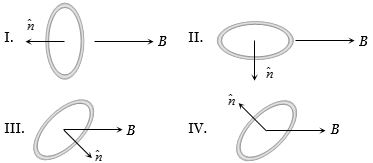
- 1A current carrying loop is placed in a uniform magnetic field in four different orientations, $I$, $II$, $III$ & $IV$ arrange them in the decreasing order of potential EnergyView Solution
- 2View SolutionA moving coil sensitive galvanometer gives at once much more deflection. To control its speed of deflection
- 3An electron moving in a circular orbit of radius $r$ makes $n$ rotations per second. The magnetic field produced at the centre has magnitudeView Solution
- 4View SolutionThe resistance of an ideal voltmeter is
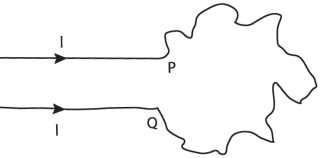
- 5Assertion $(A):$ A wire bent into an irregular shape with the points $P$ and $Q$ fixed. If a current $I$ passed through the wire, then the area enclosed by the irregular portion of the wire increases.View Solution
Reason $(R):$ Opposite currents carrying wires repel each other.
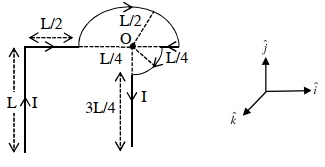
- 6Which one of the following options represents the magnetic field $\vec{B}$ at $O$ due to the current flowing in the given wire segments lying on the $x y$ plane?View Solution
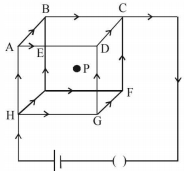
- 7A steady current is set up in a cubic network composed of wires of equal resistance and length $d$ as shown in figure. What is the magnetic field at the centre P due to the cubic networkView Solution
- 8Find magnetic field at point $P$ in given diagram.View Solution
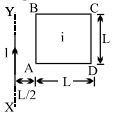
- 9A square loop $ABCD$, carrying a current $i,$ is placed near and coplanar with a long straight conductor $XY$ carrying a current $I,$ the net force on the loop will beView Solution
- 10An electric current passes through a long straight wire. At a distance $5\, cm$ from the wire, The magnetic field is $B$. The field at $20\, cm$ from the wire would beView Solution