A steady current is set up in a cubic network composed of wires of equal resistance and length $d$ as shown in figure. What is the magnetic field at the centre P due to the cubic network
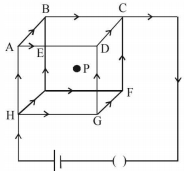
Medium


Download our appand get started for free
Experience the future of education. Simply download our apps or reach out to us for more information. Let's shape the future of learning together!No signup needed.*
Similar Questions
- 1Two particles of charges $+Q$ and $-Q$ are projected from the same point with a velocity $v$ in a region of uniform magnetic field $B$ such that the velocity vector makes an angle $q$ with the magnetic field. Their masses are $M$ and $2M,$ respectively. Then, they will meet again for the first time at a point whose distance from the point of projection isView Solution
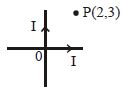
- 2Two mutually perpendicular insulated conducting wires carrying equal currents $I$, intersect at origin. Then the resultant magnetic induction at point $P(2m, 3m)$ will beView Solution
- 3Due to the flow of current in a circular loop of radius $R$, the magnetic induction produced at the centre of the loop is $B$. The magnetic moment of the loop is $({\mu _0} = {\rm{permeability}}\,{\rm{constant)}}$View Solution
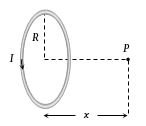
- 4A coil having $N$ $turns$ carry a current $I$ as shown in the figure. The magnetic field intensity at point $P$ isView Solution
- 5A galvanometer is used in laboratory for the null point in electrical experiments. If, on passing a current of $6 \,m A$ it produces a deflection of $2^{\circ},$ its figure of merit is close to :View Solution
- 6View SolutionTwo electrons are moving along parallel lines unidirectionarly with same velocity they will
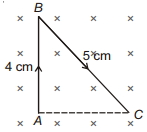
- 7A uniform conducting wire $A B C$ has a mass of $10 \,g$. A current of $2 \,A$ flows through it. The wire is kept in a uniform magnetic field $B=2 T$. The acceleration of the wire will be ............. $ms ^{-2}$View Solution
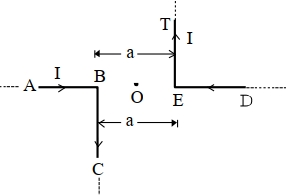
- 8The magnitude of magnetic induction at mid-point $O$ due to current arrangement as shown in Fig will beView Solution
- 9A proton and an $\alpha - $particle enter a uniform magnetic field perpendicularly with the same speed. If proton takes $25$ $\mu \, sec$ to make $5$ revolutions, then the periodic time for the $\alpha - $ particle would be........$\mu \, sec$View Solution
- 10View SolutionA negative test charge is moving near a long straight wire carrying a current. The force acting on the test charge is parallel to the direction of the current. The motion of the charge is